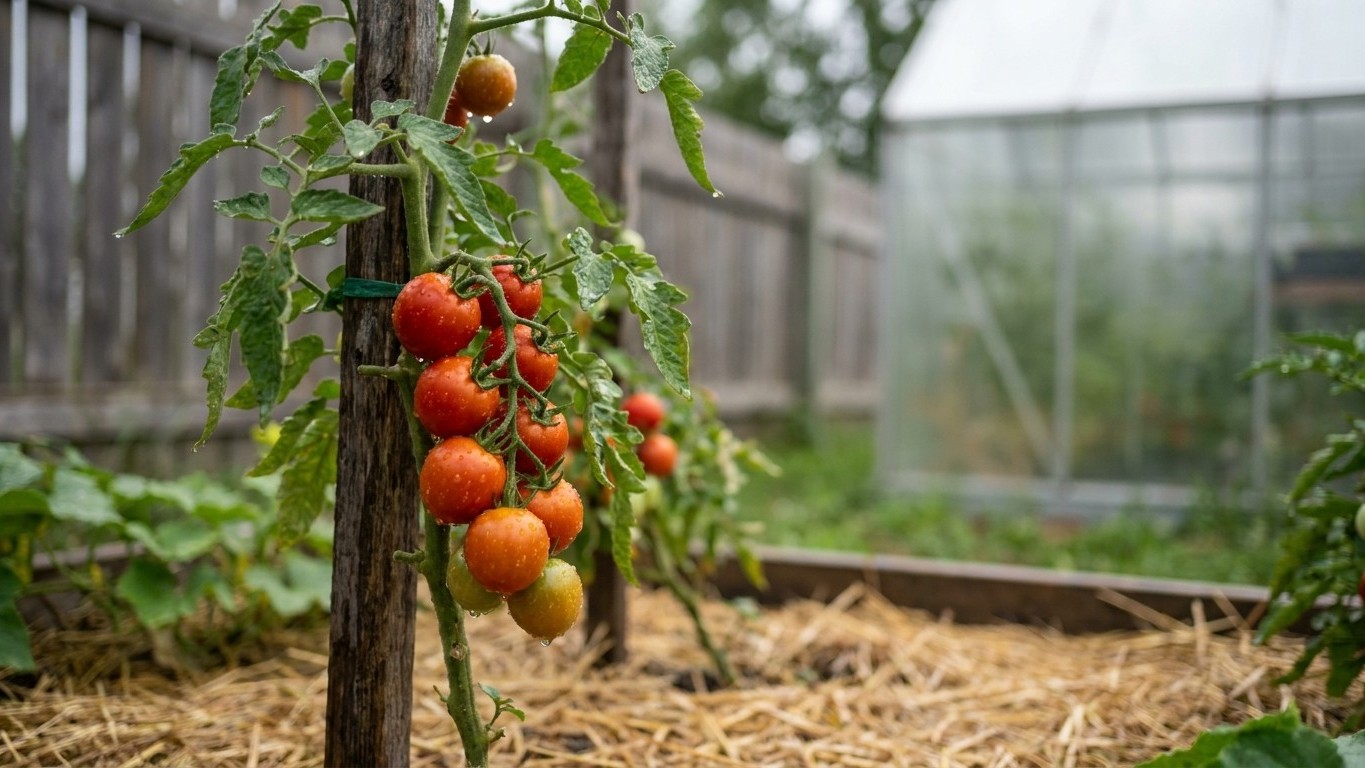

Saskatoon’s average last spring frost falls on May 18 and the average first fall frost on September 18, according to Environment and Climate Change Canada’s 1981-2010 Climate Normals for the Saskatoon SRC station. That gives a mean frost-free window of roughly four months, but it’s a midpoint, not a promise: frost lands later than May 18 in about half the years on record. Set transplants out in early June rather than the moment the calendar clears, and pick a cultivar whose days-to-maturity leaves real room against September’s mean frost date.
What this comes down to in Saskatchewan

For a Saskatoon-area garden, the arithmetic starts with the same two numbers from Environment and Climate Change Canada’s Canadian Climate Normals (1981-2010): a mean last spring frost of May 18 and a mean first fall frost of September 18. Subtract one from the other and the mean frost-free season runs about 123 days. That figure is a mean, not a safe date. ECCC’s own normals show frost falling later than May 18 in one year out of two, so treating May 18 as a green light gets seedlings killed in roughly half the springs on record.
These numbers come from a single station, Saskatoon SRC, sitting in the middle of the province’s growing region. Move north toward Prince Albert or up onto higher ground and the frost-free window narrows on both ends. A garden in a sheltered river valley south of Saskatoon may see frost lift earlier and hold off later than the station average, while an exposed rise a short drive away can run colder than the official figures suggest.
Working from that 123-day window, growers in the Saskatoon area typically wait until early June to move tomato transplants outside, well past the mean frost date, to cover the years when frost runs late. Once that transplant date is fixed, matching it to a cultivar with the right days-to-maturity figure is a separate decision covered in Tomato Varieties That Ripen in Time in Saskatchewan. This page is about getting the calendar right, not the cultivar list.
Working it out for your own garden
The same two dates from Saskatoon SRC work for any tomato calendar if the count runs in the right order: back from transplant to a seed-starting date, then forward from transplant to check the harvest actually fits before the fall frost mean.
Counting back to a seed-starting date
Tomato seedlings need roughly six to eight weeks indoors before they’re ready to go in the ground. If early June is the target transplant window for the Saskatoon area, counting back six to eight weeks lands seed-starting in mid-April through early May, a range rather than a single date, because both the transplant window and the six-to-eight-week guideline are themselves ranges. Starting earlier than that produces leggy, rootbound seedlings sitting in pots waiting for soil to catch up. Starting later shortens how much of the frost-free window is left to work with once they finally go in.
Counting forward to check the harvest
Once a transplant date is fixed, the other direction of the count matters just as much: does the cultivar’s days-to-maturity leave enough season before the September 18 mean fall frost? The table below runs that calculation for several catalogue tomatoes, using an early-June transplant and counting forward from the packet’s days-to-maturity figure.
| Cultivar | Days to maturity (from transplant) | First ripe | Margin before mean fall frost (Sept 18) |
|---|---|---|---|
| Sakura | 55 | Late July | 54 days |
| Juliet | 60 | Late July | 49 days |
| Amalfi | 68 | Early August | 41 days |
| Cherokee Purple | 72 | Mid-August | 37 days |
| San Marzano II | 78 | Mid-August | 31 days |
Every cultivar in that table still clears the mean fall frost with weeks to spare, because catalogue days-to-maturity count from transplant, not from seed, and Saskatoon’s mean season is long enough to cover even the 78-day San Marzano II. That margin narrows fast, though, if either end of the calculation slips. Push the transplant date back two weeks for a cold, wet spring, and pair that with a fall frost that lands earlier than the September 18 mean, which the same normals say happens in about half of years, and a 78-day paste tomato can still be green when frost hits. A 55-day cultivar like Sakura or Edox, by contrast, still finishes with room to spare even under that same squeeze.
The mistakes this state punishes

A run of warm days in mid-May is the most common trap here. Air temperatures can feel like summer while the soil eight inches down is still holding winter cold, and tomatoes set into that soil stall instead of growing, some don’t recover at all. Wait for the soil itself to warm, not just the forecast, and treat the May 18 mean frost date as the middle of the risk, not the end of it.
Picking a long-season slicer or paste tomato without a plan for season extension is the second mistake. A 75- to 78-day cultivar like Tiren, Granadero or San Marzano II clears Saskatoon’s mean frost window on paper, but that margin assumes a normal year on both ends. Where the transplant date slips even a week and the fall frost arrives on the early side, a long-season variety loses its cushion first. Row cover or a cold frame at each end of the season buys some of that margin back. Skipping it and hoping for an average year does not.
Starting seed indoors too early is the quieter version of the same mistake. Six to eight weeks before transplant is the guideline for a reason. Seedlings started in February or early March for an early-June transplant spend an extra month rootbound in a small pot, and they rarely outgrow that setback once they finally reach the garden.
Checking this against your county
Everything above is anchored to one weather station, Saskatoon SRC, and Saskatchewan is too large a province for one frost date to hold everywhere. Before locking in a planting date, check your county’s own extension office or Saskatchewan’s agriculture and agribusiness resources for local frost records rather than assuming Saskatoon’s window is also yours. Anyone who has already worked through growing tomatoes in Saskatchewan has the soil prep and spacing settled. The county office is where the last local calibration on timing happens.
Common questions
Is May 18 actually safe for planting tomatoes outside near Saskatoon?
No. May 18 is the mean last spring frost from Environment and Climate Change Canada’s 1981-2010 normals for the Saskatoon SRC station, and frost falls later than that in roughly half the years on record. Most growers in the area wait until early June to set transplants out, and still watch the forecast for a week or two afterward.
How many weeks before transplant should I start tomato seed indoors?
Six to eight weeks is the standard window. If early June is your transplant target, that puts seed-starting in mid-April through early May, and starting much earlier just leaves seedlings rootbound and stressed before they ever see the garden.
Does a determinate tomato ripen faster than an indeterminate one in Saskatchewan?
Not necessarily. Determinate and indeterminate describe plant habit, not speed. Glacier is a 55-day determinate and Celebrity Plus is a 78-day determinate, so the days-to-maturity figure on the packet, not the habit, is what tells you whether a cultivar fits the season.
What do I do if frost is forecast after I’ve already set out my tomatoes?
Cover the plants overnight with row cover, cloches, or even upturned buckets. Since Saskatoon’s mean frost date is a midpoint rather than a cutoff, a frost after an early-June planting isn’t unusual, and a night or two of cover is usually enough to get plants through it.
If you follow the almanac, here is when to plant tomatoes by the moon. It is a tradition, not a proven method.