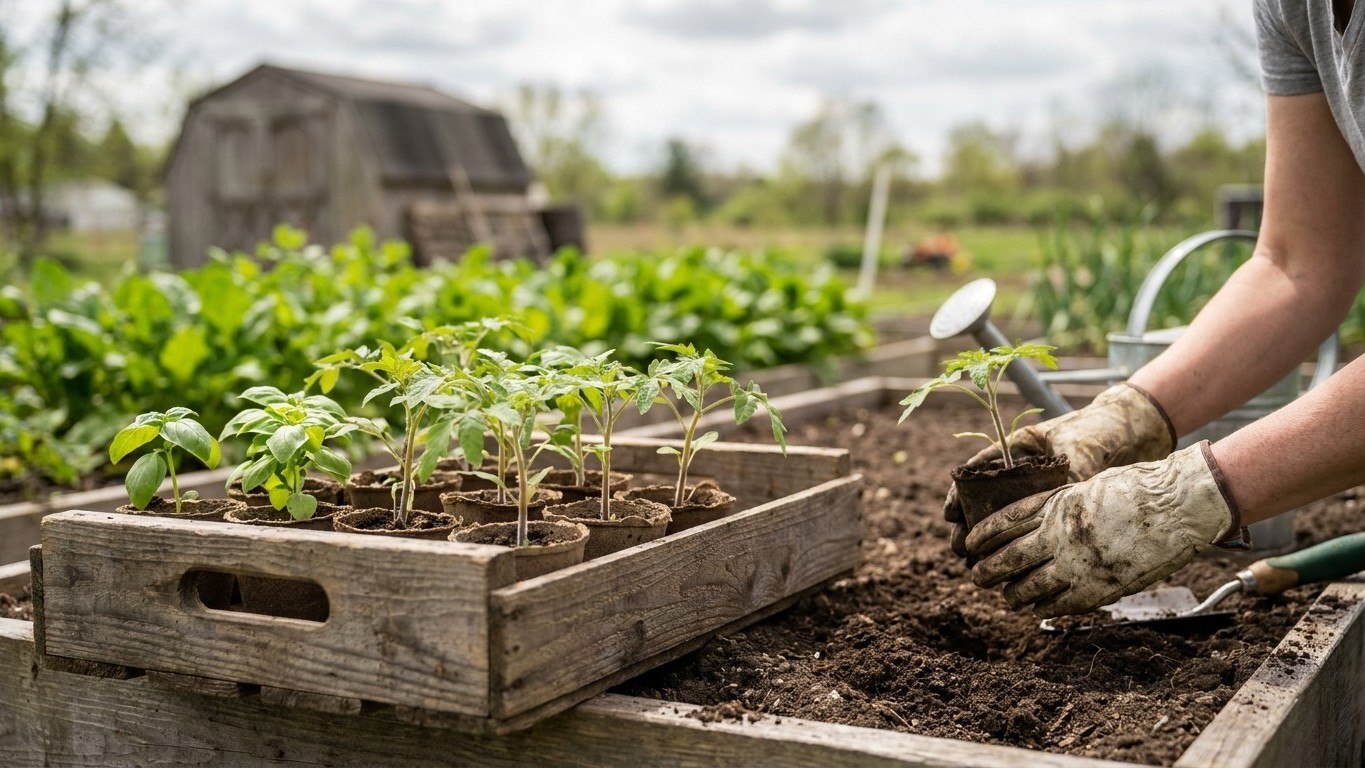

Early May and late May are almost two different gardens in Saskatchewan. In the first half of the month, hardy greens, peas, onion sets and root crops can go straight into workable soil. In the second half, as soil warms and the average last frost date of May 18 approaches, the window opens wider, but frost risk does not disappear. Tender crops still wait.
What goes in the ground in May

Soil temperature decides far more than the calendar does. A thermometer pushed four inches into the bed tells you more than the date on the wall. Peas, spinach and radish will germinate in soil barely above 40°F. Carrots and beets prefer it a little warmer, closer to 50°F. Tomatoes, peppers, squash and beans want soil in the 60s, and pushing them in early does not make them grow faster, it just stalls them or kills them outright.
The average last spring frost at the Saskatoon SRC station sits at May 18, based on Environment and Climate Change Canada’s 1981-2010 climate normals. That figure is a midpoint, not a guarantee. In roughly half of all years, frost arrives after that date, sometimes well after. Treat it as the center of a window, not the edge of one.
That split shapes the whole month. Here is a rough guide to what fits where:
| Crop | When it can go in during May | Why |
|---|---|---|
| Peas, spinach, radish, lettuce | Early May, as soon as soil is workable | Tolerate light frost, germinate in cold soil |
| Onion sets, shallots, leeks | Early to mid-May | Hardy alliums, need a long season anyway |
| Carrots, beets, Swiss chard | Mid-May | Need slightly warmer soil to germinate evenly |
| Potatoes | Mid to late May | Sprouts can handle a light frost if soil is hilled |
| Tomatoes, peppers, squash, beans, cucumbers | Only after the last frost risk has clearly passed, often into early June in colder pockets | No frost tolerance, killed outright below 32°F |
Garlic, if it was not planted the previous fall, is not a May crop here. Hardy greens and peas carry the early part of the month; alliums and roots carry the middle; everything tender waits for soil, not for the sun on your shoulders.
What to start under cover
Anything meant to fruit in a Saskatchewan garden, tomatoes, peppers, and most melons, should already have been started indoors weeks before frost breaks, since these plants need six to eight weeks of head start before they go outside. If that window was missed, buying transplants from a local greenhouse is usually more reliable than starting from seed this late, given a growing season that averages about 123 days between the mean last spring frost and the mean first fall frost of September 18.
May itself is the right moment to start faster-growing warm-season crops under cover for transplanting out once soil has firmly warmed, typically three to four weeks before you plan to set them in the ground. Cucumbers, summer squash and zucchini fall into this category. Started indoors or in a cold frame in early May, they are ready to move outside by early June without becoming rootbound.
The two failure modes show up every spring. Start too early, hold plants too long indoors under weak light, and they turn leggy and stressed before they ever see open soil. Start too late, and a short prairie season leaves no time for fruit to mature before fall frost arrives. Counting backward from the frost window, rather than from a fixed date on a seed packet, keeps both mistakes in check. If your county historically clears frost later than the Saskatoon average, push your under-cover start a week or two later as well, since transplanting into cold soil undoes the head start entirely.
Cold frames and low tunnels earn their keep in May. They let a gardener start lettuce, brassica transplants and a second wave of hardy greens a few weeks ahead of open-ground timing, with the cover pulled once the plants have hardened off.
What is ready to pick
Little comes out of a Saskatchewan garden in May from open ground, and that is normal for a zone this cold, not a sign of something gone wrong. The harvest this month comes from what survived winter or was pushed early under cover.
Rhubarb is usually the first real harvest, with stalks thick enough to pull by mid to late May depending on how quickly the crown woke up. Chives and other perennial herbs green up early and can be cut as soon as growth is a few inches tall. Asparagus from an established bed, three years or older, sends up its first spears this month, and they should be cut while still tight and firm, before the tips loosen and start to fern out.
Cold frames planted the previous fall or very early in spring may already be yielding spinach, mâche or overwintered kale, all of which taste sweeter after cold exposure. Indoors, sprouts and microgreens fill the gap for anyone wanting fresh greens on a shorter timeline than the garden allows.
The other job this month is checking what is left in storage. Potatoes held in a cool cellar should be examined for sprouting eyes and soft spots. Onions that have started to send up green shoots from the neck are on their way out and should be used first. Winter squash, if any remain, need a squeeze test at the stem end; give at all, and it belongs in the kitchen this week, not back on the shelf.
The jobs that matter this month

May is a working month more than a planting month in a lot of ways, and skipping these tasks costs real yield later.
Soil and structure
Working wet clay soil in early May, tempting as it is after a long winter, compacts it for the whole season. A simple squeeze test settles it: grab a handful, and if it holds together in a slick ball rather than crumbling, it is too wet to till or dig. Once soil is workable, this is the month to spread compost, test pH, and prepare beds before planting pushes everything else aside. Any perennials that need dividing, like rhubarb crowns or overgrown chive clumps, split easily now while they are just waking up.
Pruning, structures, and pests
Fruit trees and berry canes should be pruned before buds swell too far; once leaves unfurl, the window closes for another year. Trellises, stakes and cold frames need repair before plants that require them are in the ground, since retrofitting a support around an established squash vine or pea row is far harder than setting it early. Flea beetles and cutworms show up as soon as the first tender seedlings do, so a quick scouting pass through beds of brassicas and young transplants in the second half of the month catches problems while they are still small.
Hardening off transplants, whether store-bought or homegrown, belongs on the May calendar too. A week of gradually longer stints outside in a sheltered spot toughens up stems and leaf surfaces before the shock of full sun and prairie wind.
What not to do in May
The most common mistake is trusting the air temperature over the soil. A warm, sunny afternoon in early May can feel like summer while the ground four inches down is still in the 40s. Tomatoes and peppers set into that soil do not die outright, but they sulk for weeks, and a stalled tomato transplant rarely catches up to one planted correctly a few weeks later into warmer ground.
Pulling mulch and row cover off too early after a mild stretch is the second trap. Saskatchewan springs swing hard, and a string of 60°F days can be followed by a frost that catches uncovered seedlings off guard. Leave protection in place, or keep it within reach, until the risk has genuinely passed for your specific location rather than for the general average.
Nitrogen timing trips people up as well. A heavy dose of nitrogen fertilizer on young transplants pushes soft, leafy growth at the expense of root development, and that soft growth is exactly what late frost damages worst. Hold off on nitrogen-heavy feeding until plants are established and actively growing, and lean on phosphorus-friendly starter fertilizers instead when transplanting.
Skipping the hardening-off step rounds out the list of classic errors. A transplant moved straight from a warm windowsill to open prairie wind and full sun often shows scorched leaves and transplant shock within days, setting it back further than if it had simply been started a week later.
Checking this against your own county
A province-wide date is a starting point, not an instruction. The May 18 average last frost comes from a single station, Saskatoon SRC, and Saskatchewan is not one climate. Northern districts and areas near larger lakes commonly run one to two weeks behind that figure, while some southern pockets clear frost earlier. Elevation and local topography shift things further still. For a planting calendar built around your own district, and for current-season updates, the Saskatchewan Ministry of Agriculture’s extension resources are the right next stop.
Common questions
Can I plant tomatoes outside in Saskatchewan in May?
Generally no, at least not for most of the month. The average last frost falls around May 18, and in about half of years frost arrives later than that. Tomatoes have zero frost tolerance, so waiting until soil has consistently warmed, often into late May or early June depending on your district, protects the investment of a full season’s crop.
When is it safe to plant vegetables in Saskatchewan?
It depends entirely on the crop. Hardy greens, peas and alliums tolerate cold soil and light frost and can go in early in the month. Tender, frost-sensitive crops should wait until well past the mean last frost date of May 18, with some buffer built in since that date is a midpoint, not a cutoff.
What zone is Saskatchewan for gardening?
The reference city used for this page sits in Canadian plant hardiness zone 3a, according to Natural Resources Canada’s 1991-2020 data. This is the Canadian system, built on seven climate variables, and it does not convert directly to the USDA zones used elsewhere in the United States. Treat it as its own scale.
What can I direct sow in May in Saskatchewan?
Peas, spinach, radish and lettuce can go into workable soil early in the month. Onion sets, carrots, beets and Swiss chard follow once soil has warmed slightly further, typically by mid-May. Potatoes can be planted mid to late May, hilled up for protection against a stray light frost.
Gardeners who plant by the Moon can check the May 2027 moon planting calendar, a tradition rather than a proven method.