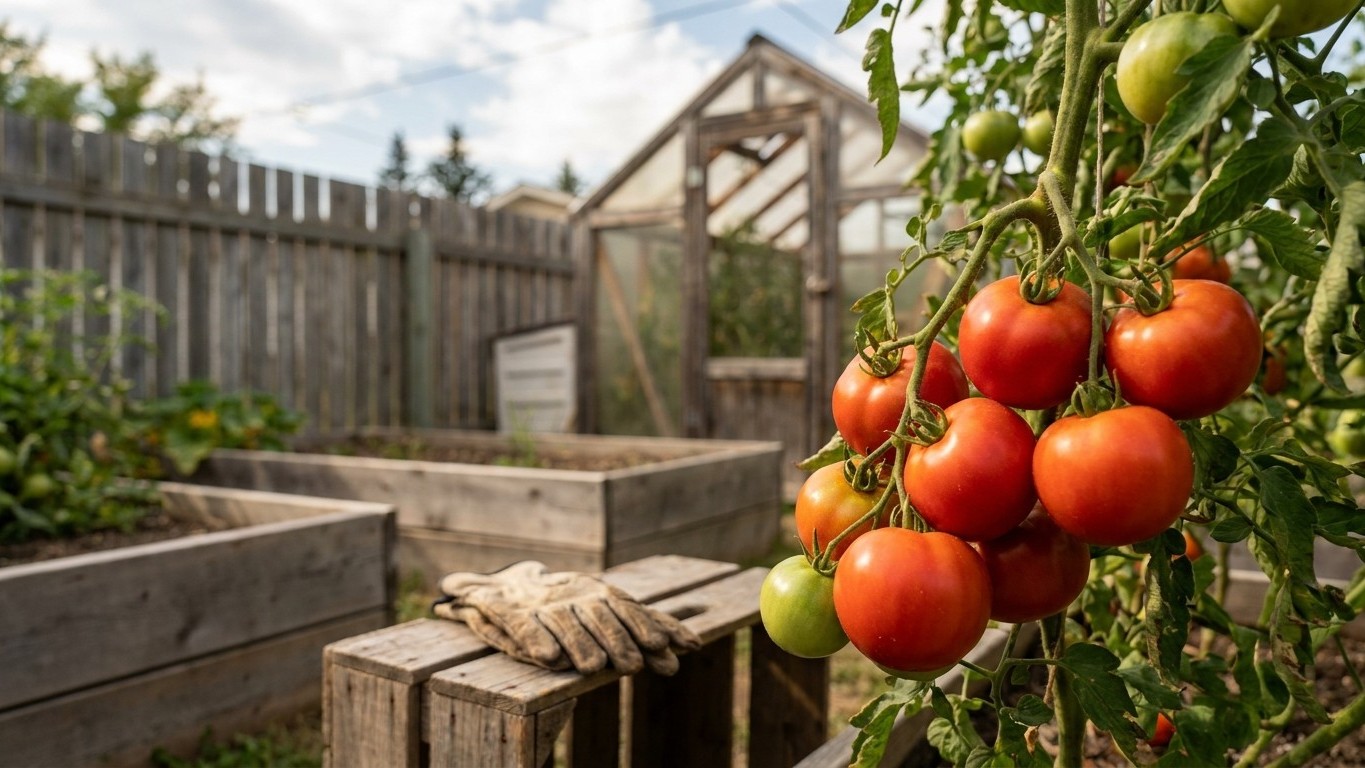

Saskatchewan gardeners set tomato transplants outside once the risk of frost has passed, and near Saskatoon that falls close to May 18 on average, according to Environment and Climate Change Canada’s 1981-2010 climate normals for the Saskatoon SRC station. That date is a midpoint, not a guarantee: frost has arrived later than May 18 in roughly half of the past thirty years. Start seed indoors now if you haven’t already, and hold transplants for a clear forecast rather than for the calendar date itself.
When to plant Tomatoes in Saskatchewan

The frost record kept at the Saskatoon SRC station by Environment and Climate Change Canada puts the average last spring frost at May 18 and the average first fall frost at September 18, for a frost-free season of about 122 days. Those figures are 1981-2010 climate normals for one station near Saskatoon, and they describe a mean, not a safe cutoff. In roughly half of those thirty years, frost struck later than May 18. Treat that date as the center of a window that can slide into early June, not as a day to plant by.
Gardeners farther north, at higher elevation, or away from the moderating effect of the South Saskatchewan River valley should expect their own frost window to run later in spring and earlier in fall than Saskatoon’s does. For a sense of just how much shorter a season can get, growers in the territory covered by Growing Tomatoes in Yukon: Planting Dates, Varieties and Ripening Before Frost work with an even tighter frost-free stretch, and the same caution about local variation applies there.
Working backward from transplant date
Tomatoes need six to eight weeks of indoor growth before they’re ready to go in the ground, counted from seed to a stocky transplant with true leaves and a firm stem. Counting Back From a transplant date in early June, that puts indoor seed starting somewhere in mid to late March for most Saskatchewan gardeners, adjusted a week or two either way depending on how warm your seed-starting setup runs. For the full breakdown of these dates, see Tomato Planting Dates in Saskatchewan: Counting Back From Your Frost Window.
Don’t sow earlier just to get ahead. A tomato seedling that sits in a small pot for weeks past its ready date turns root-bound and leggy, and it takes longer to recover once transplanted than a properly timed seedling would have taken to grow in the first place. It also pays to know what you’re up against once plants are in the ground; see Tomato Pests in Saskatchewan: Which Ones Actually Show Up Here. Choosing the right cultivar matters just as much as timing: see Tomato Varieties That Ripen in Time in Saskatchewan for options suited to this short growing season.
Hardening off and transplanting
Give seedlings seven to ten days outdoors in gradually increasing exposure before they go into open ground. An hour or two in filtered light the first day, building up to a full day of sun and wind by the end of the week, toughens the stem and leaf surface against the shock of outdoor conditions. Skip this step and a seedling that looked perfectly healthy in a greenhouse will scorch or stall within days of going in the ground.
Wait until the soil has genuinely warmed, not just until the calendar clears May 18. Tomato roots stall below about 50°F soil temperature and can suffer chilling injury even without an actual frost. A row cover or cloche kept on hand buys a week or two of margin on either side of the average date and lets you set plants out with more confidence than the bare date alone would give you.
Soil and site preparation
Tomatoes want a minimum of six to eight hours of direct sun, and in a season this short, more sun beats less every time. Pick the warmest, most sheltered spot in the yard. A south-facing wall or a fence line that blocks prairie wind adds real heat over a season that earns each warm day the hard way.
Work compost or well-rotted manure into the bed the fall before, or at minimum a few weeks ahead of transplanting, so it has time to break down instead of tying up nitrogen right when the young plants need it most. Saskatchewan’s prairie soils tend toward clay or clay loam with decent native fertility but slow drainage in low spots. If water stands in the bed after a hard rain, raise it. A mounded row or a raised bed four to six inches high drains faster and warms sooner in spring, and that head start on warmth matters more here than it would in a longer-season state.
Space plants generously. Indeterminate varieties need 24 to 36 inches between plants and 36 to 48 inches between rows, while determinate types can go a bit tighter. Crowded plants trap humidity around the foliage, and that damp, still air is exactly the condition that favors early blight and other leaf diseases through a cool, wet spring.
Warm the soil before you plant rather than after. Laying black plastic mulch over the bed for a week or two ahead of transplanting raises soil temperature measurably and gives young roots a warmer start than bare ground. Pull back the plastic to check for standing moisture underneath before committing to it for the season, since trapped water beneath plastic in a wet spring does more harm than the warmth is worth. A simple home soil test, rather than a guess, also tells you whether the bed needs lime or extra phosphorus before you spend money and a short season finding out the hard way.
Varieties that suit Saskatchewan
With roughly 122 frost-free days at Saskatoon according to Environment and Climate Change Canada, the single trait that matters most is days to maturity counted from transplant, not from seed. A tomato listed at 78 days needs 78 warm days after it goes in the ground before the first fruit ripens, and every one of those days competes directly with the fall frost date.
Short-season cherry and small-fruited types clear the season with the most room to spare. Sakura and Edox, both 55 days from transplant, along with Valentine and Glacier at the same 55 days, set out in early June and ripen by late July, leaving roughly 54 days of margin before the average September 18 frost. Sun Gold at 57 days, and the 60-day types Supersweet 100 and Juliet, follow a week or so behind and still ripen by late July with 49 to 52 days to spare.
Mid-season varieties still work here, but with less room for a late spring or an early fall. Amalfi, at 68 days, ripens in early August with about 41 days of margin. Cherokee Purple and Big Beef Plus, both 72 days, and Tiren and Granadero at 75 days, ripen in mid August with 31 to 37 days left before the average frost date. San Marzano II and Celebrity Plus, at 78 days, are the longest-season names on this list and carry the thinnest cushion, about 31 days, which means a frost arriving even a week or two ahead of the Saskatoon average can catch fruit still green.
| Variety | Days to maturity | Type | Approx. margin before average frost* |
|---|---|---|---|
| Sakura | 55 | Indeterminate | 54 days |
| Valentine | 55 | Indeterminate | 54 days |
| Glacier | 55 | Determinate | 54 days |
| Sun Gold | 57 | Indeterminate | 52 days |
| Juliet | 60 | Indeterminate | 49 days |
| Amalfi | 68 | Determinate | 41 days |
| Cherokee Purple | 72 | Indeterminate | 37 days |
| Tiren | 75 | Indeterminate | 34 days |
| San Marzano II | 78 | Indeterminate | 31 days |
*Figures assume transplant in early June and the Saskatoon SRC average frost date of September 18. Adjust the margin down if you garden farther north or at higher elevation.
Disease resistance matters more in a short season, since there’s no time left to lose plants to wilt and replant. Celebrity Plus and Big Beef Plus carry resistance to Nematodes, Gray Leaf Spot, and Tomato Mosaic Virus. Sakura, Edox, Sun Gold, Tiren, and Granadero resist one or more races of Fusarium Wilt, and Valentine, Amalfi, and Juliet carry resistance to early or late blight, the two fungal diseases that show up most often in a cool, damp Saskatchewan spring. Determinate types such as Glacier, Celebrity Plus, and Amalfi set most of their fruit in a shorter window and finish earlier as a group, which suits a garden racing the frost. Indeterminate types such as Cherokee Purple, San Marzano II, and Big Beef Plus keep producing right up to frost but need the full season to make that habit worthwhile.
What to plant alongside
Basil earns its spot as the classic tomato companion for a practical reason rather than a mythical one: both plants want the same heat, the same water, and the same sun, so they thrive under identical care without competing hard for either. Interplanting basil between tomato plants also fills the ground that would otherwise sit bare and weedy in the gaps between stems.
Borage and other pollinator-drawing flowers bring bees in when cool, breezy spring weather makes tomato flowers slow to set fruit on their own, and calendula or marigold at the bed edge is sometimes credited with distracting or repelling above-ground pests, though the evidence for marigold suppressing soil nematodes is much thinner than its reputation suggests. Treat it as an attractive border rather than reliable pest control.
Onions, garlic, and chives planted at the edge of a tomato bed rarely cause problems, and their scent is often credited with confusing pests that navigate by smell, though this leans more on garden tradition than tested science. Skip potatoes near tomatoes: both belong to the nightshade family and share the same blights and soil-borne pests, so planting them close together just doubles the ground where disease can build up year over year.
Corn is worth avoiding too, mainly because the tomato fruitworm and the corn earworm are the same insect, and a corn patch next to your tomatoes hands that pest a second course. Brassicas like cabbage and broccoli compete for the same nutrients tomatoes need in quantity, particularly nitrogen and potassium at fruiting time, so keep them in a separate bed rather than tucked into the same row. Fennel is the one plant most experienced growers keep well clear of everything else in the vegetable garden, tomatoes included, since it releases compounds that can slow the growth of many neighboring plants and rarely earns back the space it takes.
Watering, feeding and support
Water deeply and infrequently rather than a little every day. A deep soak that reaches six to eight inches down encourages roots to grow deep, which makes the plant more resilient through the dry spells and wind that prairie summers bring. Aim for about an inch of water a week, counting rainfall, and increase that during hot, dry stretches or once fruit starts sizing up.
Mulch and feeding
A layer of straw or grass-clipping mulch, laid once the soil has warmed through in June, holds moisture, keeps soil temperature more even, and stops rain from splashing soil-borne fungus spores up onto the lower leaves. Skip it earlier in spring, though. Mulch laid on cold ground slows the very warming you’re trying to encourage.
Feed at planting with a balanced fertilizer worked into the hole, then hold off on nitrogen once flowering starts. Too much nitrogen at that stage pushes green leafy growth at the expense of fruit, which is the last thing a short-season garden can afford to trade away. A side dressing higher in phosphorus and potassium once the first fruit sets carries the plant through its heaviest production without encouraging more leaf.
Staking, caging and pruning
Indeterminate varieties like Cherokee Purple, San Marzano II, and Sun Gold keep growing and setting fruit all season and need a tall stake, a sturdy cage, or a trellis strong enough to hold a heavily loaded plant through a windy prairie afternoon. Determinate types such as Glacier, Amalfi, and Celebrity Plus stay more compact and can usually get by with a shorter cage.
Pruning suckers, the small shoots that emerge in the joint between the main stem and a leaf branch, on indeterminate varieties channels the plant’s energy into fewer, larger stems and can speed ripening by a few days, which matters when the season is this tight. Pinch them out while they’re small, using your fingers rather than a blade. A cut left by scissors or a knife heals more slowly and gives disease an easier way in.
Common problems

Blossom end rot shows up as a flat, sunken, leathery brown-to-black patch on the bottom of the fruit, usually starting while the tomato is still green. It’s caused by a local calcium shortage inside the fruit, almost always triggered by uneven watering rather than a true lack of calcium in the soil. Keep watering consistent through dry spells, and the fruit that forms after you fix the watering usually comes in clean.
Cracking, either in rings around the top of the fruit or in splits running down from the stem, comes from a sudden heavy rain or a deep watering after the plant has gone through a dry stretch. The fruit swells faster than the skin can stretch to match it. Mulch and steady watering reduce the swings that cause this, and picking fruit as soon as it’s ripe rather than leaving it on the vine limits how much time each tomato has to crack.
Leaf curl and wilt
Leaves that curl upward along the edges without discoloring are usually just a response to heat and moisture stress and aren’t a disease at all. Leaves that yellow, wilt, or die from the bottom of the plant upward, especially alongside brown streaking inside a cut stem, point to Fusarium or Verticillium wilt, both soil-borne fungal diseases with no cure once a plant is infected. This is exactly why the resistance codes on varieties like Sakura, Sun Gold, and Supersweet 100 are worth checking before you buy: a resistant variety in infected soil keeps growing where a susceptible one collapses.
Early blight and late blight both cause dark spots or blotches on leaves, working from the bottom of the plant upward in cool, damp conditions, which a Saskatchewan spring supplies often enough. Early blight produces concentric-ring “target” spots on older leaves. Late blight moves faster, producing water-soaked, greasy-looking patches that can take down a whole plant within days of wet weather. A similarly damp, blight-prone climate shows up in Growing Tomatoes in Newfoundland and Labrador: Planting Dates, Varieties and Ripening Before Frost, another short-season Canadian growing region dealing with the same fungal pressure. Remove and destroy affected leaves as soon as you see them rather than composting them, since both fungi overwinter in plant debris and soil.
Poor fruit set and pests
Flowers that form but drop without setting fruit are usually a temperature problem. Tomato pollen doesn’t set well below about 55°F at night or above roughly 90°F in the day, and a cool early-season night in Saskatchewan can knock a whole flush of blossoms off the plant. There’s little to do about it beyond patience and, if a cold snap is forecast, a floating row cover to hold in a few extra degrees overnight.
- Aphids: small, soft-bodied insects clustered on new growth, controlled with a strong water spray or insecticidal soap
- Tomato hornworm: a large green caterpillar with white diagonal stripes, best controlled by hand-picking it off the plant
- Flea beetles: tiny jumping beetles that riddle young leaves with small holes, worst on transplants before they’ve fully hardened off
Ripening before the frost comes back
This is the question a Saskatchewan tomato garden really has to settle: whether the fruit has enough warm days left to ripen before the cold returns. Environment and Climate Change Canada’s normals put the frost-free stretch at Saskatoon at about 122 days on average, running from a last spring frost around May 18 to a first fall frost around September 18, and both dates are means, not guarantees, in either direction.
Transplants go in around early June rather than right at the average frost date, since a young tomato set out too early into cool soil just sits and does nothing useful. That early-June start, subtracted from the roughly 122-day season, leaves a working window of around 15 to 16 weeks before the average frost returns, and every variety’s days-to-maturity figure has to fit inside that window with room to spare for a frost that arrives ahead of schedule.
Varieties in the 55 to 60 day range, Sakura, Edox, Valentine, Glacier, Sun Gold, Supersweet 100, and Juliet among them, ripen by late July on that schedule and carry 49 to 54 days of margin, which comfortably absorbs a frost arriving weeks earlier than average. The 68 to 75 day varieties, Amalfi, Cherokee Purple, Big Beef Plus, Tiren, and Granadero, ripen from early to mid August and still carry 31 to 41 days of cushion. San Marzano II and Celebrity Plus, at 78 days, ripen in mid August with about 31 days left, workable in an average year but leaving the least room if frost comes early.
Three things buy extra weeks on either end of the season: starting seed indoors on schedule rather than late, warming the bed with black plastic or a low tunnel ahead of transplanting, and covering plants with a frost blanket on any night the September forecast dips close to freezing. None of these rewrite the math for a 78-day variety in a year with an early frost, but they widen the margin for everything shorter than that, and they’re the difference most years between a full harvest and one cut short by a week or two.
Harvest and end of season
Pick tomatoes once they’ve reached full color for their variety: golden-orange for Sun Gold, deep dusky pink-purple for Cherokee Purple, solid red for Big Beef Plus and Celebrity Plus. Fruit continues to ripen after picking, so there’s no advantage to leaving a fully colored tomato on the vine longer than necessary, and doing so only exposes it to cracking, pests, or a surprise frost.
Ripening fruit indoors
As the first fall frost approaches, on average September 18 at Saskatoon according to Environment and Climate Change Canada, pull any green tomatoes showing a hint of color change, a slight lightening or blush, and bring them inside to finish on a windowsill or in a paper bag at room temperature. Fully mature green fruit, firm and pale rather than dark green, will ripen off the vine over one to three weeks. Immature dark green fruit mostly won’t ripen well and is better used green, fried or pickled.
Whole plants can also be pulled by the roots and hung upside down in a garage or basement before a hard frost, letting fruit continue ripening slowly indoors over several more weeks. This buys real time for a mid-to-late-season variety like Tiren or San Marzano II that hasn’t quite finished when the first cold night is forecast.
Store ripe tomatoes at room temperature rather than in the refrigerator, since cold dulls both flavor and texture. Once the season is truly over, clear all plant debris from the bed rather than tilling it under, since diseased foliage left in the garden carries blight and wilt spores straight into next year’s soil.
Local help
County-level frost dates, soil testing, and season-specific advice go well beyond what the Saskatoon SRC averages can tell any one garden. The Saskatchewan guides hub is a starting point for province-wide resources, and a local soil test is worth doing before you commit to a fertilizer plan, since guessing wastes both money and a growing season that’s already short.
For soil testing and district-specific guidance, reach out to the Government of Saskatchewan’s agriculture and agribusiness service, which can connect you with testing labs and current recommendations for your area.
Common questions
Do I need a greenhouse to grow tomatoes in Saskatchewan?
No, most Saskatchewan gardeners grow tomatoes outdoors with nothing more than a warm site and a frost blanket for cold nights. A greenhouse, hoop house, or cold frame helps most with extending the warm window on both ends, and it makes a real difference for anyone trying to ripen a 75 to 78 day variety like Tiren or San Marzano II reliably every year.
What do I do if frost is forecast before my tomatoes finish ripening?
Cover plants overnight with a bedsheet, row cover, or frost blanket anchored at the edges, since even a thin layer holds in several degrees of warmth. If a hard freeze is coming rather than a light frost, pick everything showing any color change and bring it inside to finish on a windowsill, since a frozen tomato turns to mush within a day and won’t ripen at all.
Can I direct-seed tomatoes instead of starting them indoors?
Direct-seeding isn’t practical this far north. A tomato seed needs warm soil to germinate and then still needs its full days-to-maturity count on top of that, and Saskatchewan’s season isn’t long enough to fit both steps outdoors, even with the shortest varieties on this list. Start seed indoors and transplant out a stocky seedling instead.
Why do my tomato plants have flowers but never set fruit?
Cold nights are the usual cause, since tomato pollen doesn’t set reliably once nighttime temperatures drop into the low 50s Fahrenheit, which happens often enough in a Saskatchewan spring or early September. Gently shaking flower clusters by hand around midday, when pollen is driest, can improve set slightly in borderline conditions, but there’s no fix for a genuinely cold night beyond waiting it out or covering the plants.
Are container-grown tomatoes a better option than in-ground beds here?
Containers warm up faster than garden soil in spring, which can help get a short-season variety like Glacier or Valentine off to an earlier start, and pots can be moved under cover on a cold night late in the season. The tradeoff is that containers dry out faster and need more frequent watering than an in-ground bed, sometimes daily in hot, windy weather.
Related guides
- Growing Tomatoes in Alberta: Planting Dates, Varieties and Ripening Before Frost
- Growing Tomatoes in Manitoba: Planting Dates, Varieties and Ripening Before Frost
- Growing Tomatoes in Yukon: Planting Dates, Varieties and Ripening Before Frost
- The Best Summer Squash to Grow in Saskatchewan
- When to Sow Sweet Corn in Saskatchewan
- Growing Beets in Saskatchewan