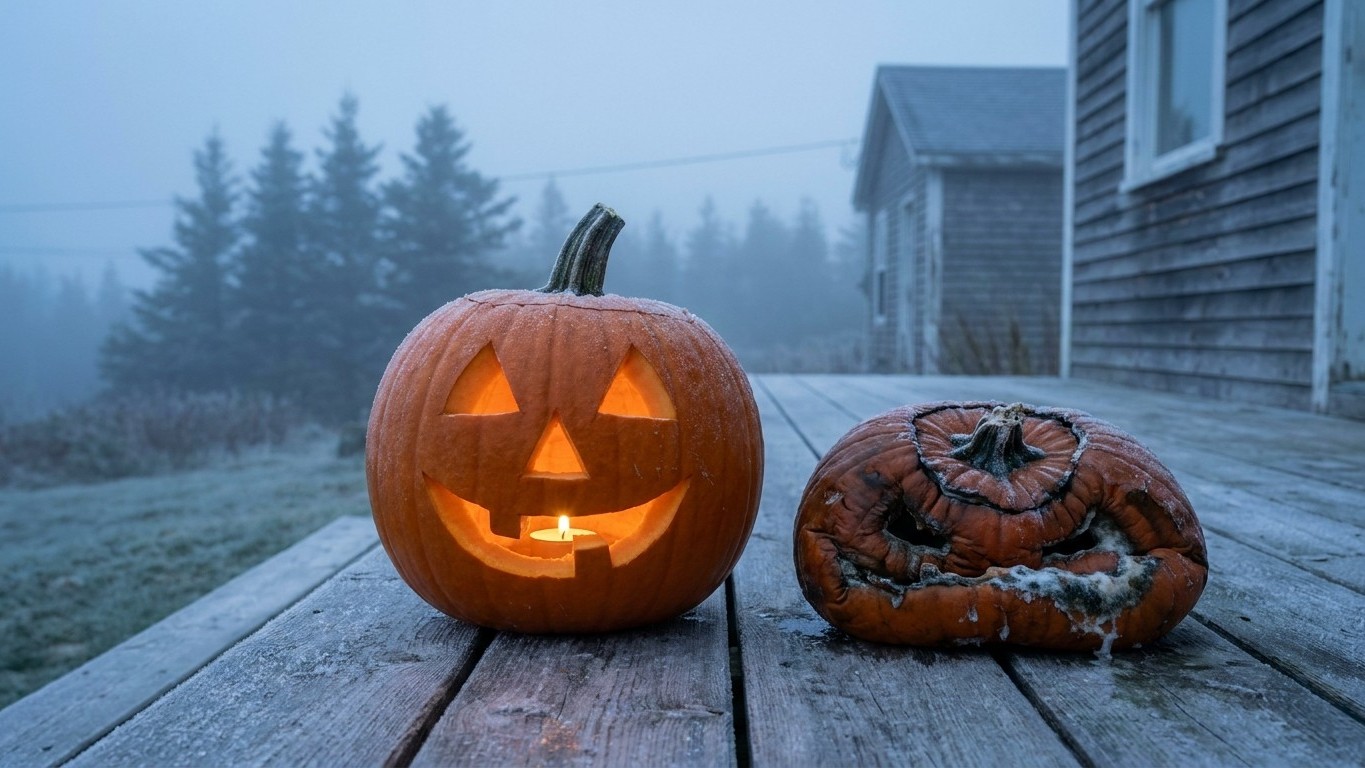

Newfoundland’s mean first fall frost lands around October 17, roughly two weeks before Halloween. That timing changes the whole calculation for a pumpkin sitting on a porch step: the carving window here is narrower than in milder parts of Canada, and knowing where the risk actually comes from (cold, not heat) tells you exactly how to plan the next few weeks.
The short answer

Environment and Climate Change Canada puts the mean first fall frost for the St. John’s area at around October 17, based on climate normals recorded at the ST JOHN’S A station over the 1981-2010 period. That’s an average, not a promise. In roughly one year out of two, frost shows up later than that date, and in the other half it arrives earlier. Treat October 17 as the midpoint of a window, not a line you can plan around with certainty.
What that means in practical terms: if you Carve a Pumpkin the weekend before Halloween and leave it out on the step, there’s a real chance a frost has already passed through by then, sometimes more than once. A pumpkin that’s already carved and exposed to a hard freeze softens fast once it thaws. The flesh turns watery, the cut edges slump, and a jack-o’-lantern that looked crisp on Tuesday can look collapsed by Thursday.
So the short answer is this: in most of Newfoundland and Labrador, don’t expect the porch to stay pumpkin-friendly for long once late October arrives. The safer approach is to carve close to Halloween itself, ideally within a few days of October 31, and to keep the whole, uncarved pumpkin somewhere cool and stable until then rather than trusting the outdoor air. Given that the mean frost date falls about two weeks before Halloween, anyone planning to display a carved pumpkin outside for more than a couple of days is working against the odds, not with them.
This isn’t unique to St. John’s. The same normals station data applies broadly across the Avalon Peninsula, and inland or northern districts in Labrador typically see frost even earlier, since coastal areas moderate temperature swings more than inland ones do. If you’re carving in a community well inland or farther north, treat October 17 as a late estimate for your area, not an early one.
None of this means you have to rush the process. It means being deliberate about sequencing: buy or harvest the pumpkin early if you want, but hold off on cutting into it until you’re within a handful of days of Halloween, and keep it somewhere the frost can’t reach it in the meantime.
Frost or heat: which one gets it here
University of Illinois Extension recommends keeping a whole pumpkin in a cool, dark spot between 45 and 50 degrees Fahrenheit, where it can last three to six months before it starts to break down. That band is the target. The question for any region is which direction the local climate tends to miss that target: too cold, or too warm.
The cold end
In Newfoundland and Labrador, cold is the dominant risk, not heat. The mean first fall frost arriving around October 17 means outdoor temperatures are already dipping below the 45-50 F storage band, and often well below it, for weeks before Halloween even arrives. Once a hard freeze sets in, a pumpkin left outside doesn’t just sit at an uncomfortably cold temperature, it can freeze solid, and freezing ruins the cell structure inside. When it thaws, the flesh turns mushy and the rind can pit or collapse. This is a different failure than the slow, mold-driven decay you’d see in a warm climate. It’s fast, and it happens overnight.
Worth separating here: winter hardiness and fall frost timing are not the same measurement. The coldest month’s mean daily minimum in the St. John’s area runs around 16.4 F, which describes how brutal January gets, not when the first frost of autumn shows up. Don’t use hardiness-zone thinking to guess at a frost date. They answer different questions.
The warm end
Heat simply isn’t the concern here in late October. Unlike warmer regions where an unseasonably mild autumn can push storage temperatures above 50 F and speed up softening and mold growth, Newfoundland and Labrador’s late-October air is, if anything, undershooting the storage band on the cold side. There’s no meaningful stretch of the season where a pumpkin left outdoors risks overheating. The entire planning problem here is keeping the pumpkin warm enough and protected, not cool enough.
Where to keep it until you carve
Given that outdoor temperatures in Newfoundland and Labrador tend to undercut the 45-50 F storage window well before Halloween, the goal is finding an indoor or sheltered spot that holds steadier, warmer conditions without exposing the pumpkin to heat sources or ripening produce. A few practical options, in order of how well they tend to work in this climate:
- An unheated porch or entryway that stays above freezing. If your porch is enclosed and doesn’t dip below freezing overnight, it can work for the days right before Halloween, but check it against outdoor forecasts once the frost season starts.
- A cool basement or cellar. This is usually the best match for the 45-50 F target in a Newfoundland home, since basements stay buffered from both outdoor frost and indoor heating.
- An attached, unheated garage. Workable as long as temperatures inside don’t fall to freezing, which can happen quickly once outdoor lows drop in October.
- Away from any ripening fruit or vegetables. Keep the pumpkin clear of apples, potatoes, and tomatoes. Ripening produce gives off a gas that speeds up the pumpkin’s own aging, according to University of Illinois Extension, so a porch or pantry shelf sitting next to a crate of apples is one of the worst spots you could pick.
- Away from direct heat and direct sun. A kitchen counter near a stove, or a windowsill that gets afternoon sun, pushes the pumpkin’s temperature above the storage band and shortens how long it holds up before you even pick up a knife.
Once you’re ready to carve, look for a pumpkin with 1 to 2 inches of stem still attached. The stem isn’t decorative and it isn’t something to lift the pumpkin by; it functions as a seal. If it breaks off, that spot on top is exposed and becomes the first place spoilage sets in, according to University of Illinois Extension guidance on choosing a pumpkin. Weight matters more than shape: a heavy pumpkin for its size, free of soft spots or blemishes, is the one worth carving.
Checking this against your own county
Climate normals describe an average across a wide area, and Newfoundland and Labrador covers a lot of ground, from the Avalon Peninsula to inland Labrador. Coastal communities, inland valleys, and higher elevations can all see frost arrive on different schedules even within the same region. If you want a reading closer to your own backyard, the Newfoundland and Labrador Department of Fisheries, Forestry and Agriculture is the provincial resource to check for local growing-season and frost information.
That kind of local check matters more the farther you are from St. John’s. A frost date drawn from one weather station is a useful starting point, not a guarantee for every driveway and porch in the province.
Common questions
How long does a carved pumpkin last in Newfoundland and Labrador?
No university extension publishes a set number of days for a carved pumpkin, and there’s no research-backed preservation protocol for one either. What’s actually documented is how to choose a pumpkin well and how to store it whole. The practical move is to carve close to Halloween rather than days or weeks ahead, and to accept that once it’s cut open, its clock is already running.
Should I bring my pumpkin inside once frost hits?
Yes, if you want it to last. Once outdoor temperatures drop toward or below freezing, a pumpkin left outside is no longer in the 45-50 F range recommended for storage, and a hard freeze can damage the flesh outright. Moving it to a cool basement or an unheated but frost-free space protects it until you’re ready to carve.
Does the hardiness zone tell me when frost will hit?
No. A hardiness zone describes winter cold severity, useful for deciding what plants survive the season, but it says nothing about when the first fall frost arrives. For that, the mean first fall frost date from climate normals is the relevant figure, and even that is an average rather than a fixed day.
Can I carve early and just keep it away from heat?
Keeping a carved pumpkin cool slows some spoilage, but cutting into it exposes the flesh no matter the temperature, and there’s no published extension guidance on how many days that buys you. The more reliable approach is choosing a sound pumpkin with an intact stem, storing it whole in a cool, dark spot, and carving it only when you’re within a few days of actually displaying it.