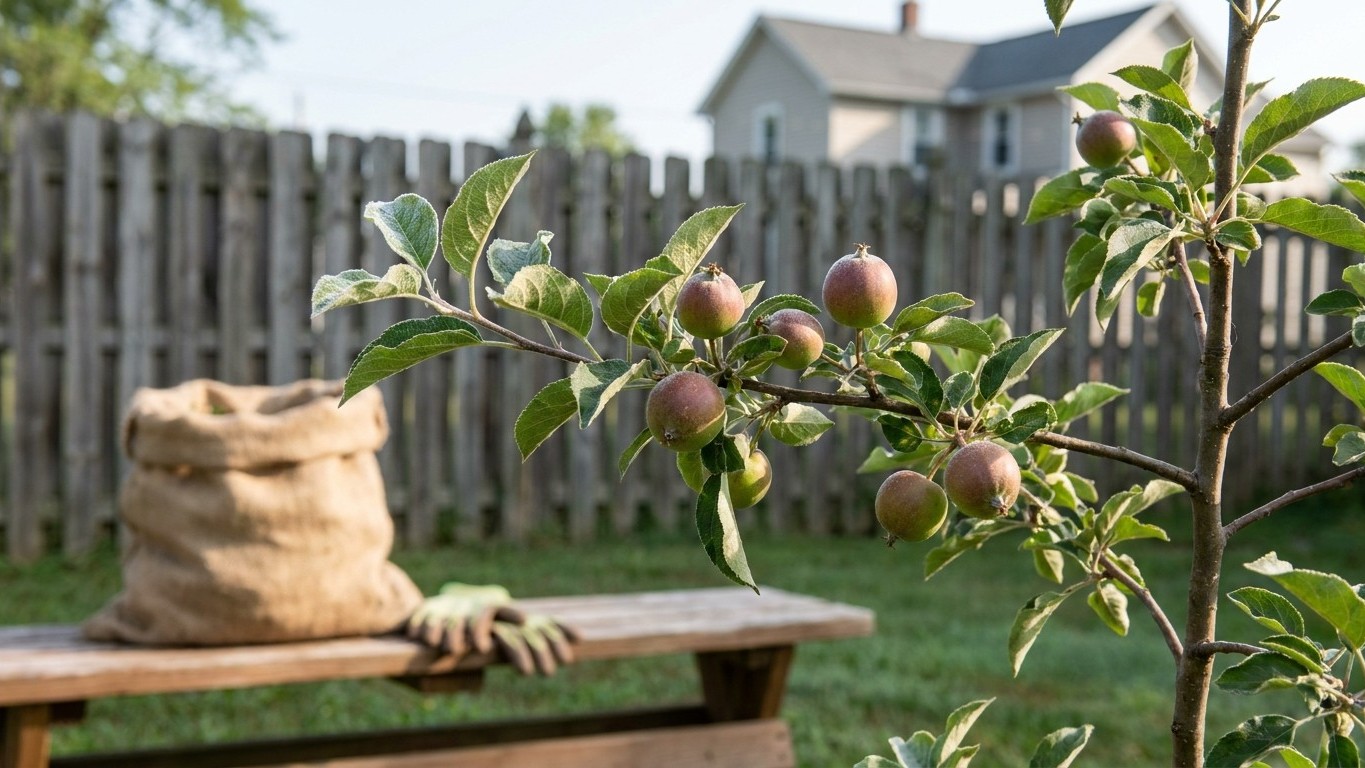

Late April frost is what actually ends an Ohio apple harvest before it starts — not the winter cold everyone worries about, but a warm week in spring that pushes buds open early, followed by one night in the twenties. Growers who pick a variety for its flavor alone, without checking when it blooms relative to their local frost date, lose the crop to a single night more often than to any pest or disease. The zone number on the seed packet won’t warn you about that.
Can you grow apples in Ohio
Ohio’s apple climate is defined by that 5b-6b spread, not by a single number. The USDA map’s Columbus reading of zone 6a sits comfortably in the middle of the range that almost every commercial apple cultivar is bred for, and NOAA’s 1991-2020 normals put Columbus’s coldest-month average minimum at 22.6°F, well above the temperature that damages dormant apple wood. That reading describes central Ohio specifically. Growers near the Ohio River in the south, where the growing season runs a little longer, tend to land closer to 6b, while higher ground in the northeast, shaped by Lake Erie’s snowbelt, can sit at 5b or occasionally colder in a sheltered hollow.
None of that rules out any part of the state. It changes which varieties are a safe bet and how much margin you have on either end of the season. A grower in the Ohio River valley can lean toward later-ripening dessert varieties that need a longer stretch of warm days, while a grower in the snowbelt does better choosing among the varieties bred for the colder end of that range and paying closer attention to bud stage in spring. Checking these timings against an Ohio apple Calendar makes it easier to match a variety’s bloom and ripening window to your specific region.
What the numbers actually tell you
The hardiness figure tells you whether the tree’s wood and buds survive winter. It says nothing about whether the tree flowers well, sets fruit reliably, or ripens before frost. Those depend on winter chill, pollination, and the timing of the last spring freeze, each covered in the sections below. Treat the zone rating as the first filter, not the only one, and don’t buy a tree on hardiness alone.
Which varieties suit this climate

Once a variety’s published hardiness range covers Ohio’s 5b-6b spread, the second filter is winter chill: the number of cold hours below about 45°F a tree needs before it will break dormancy and bloom evenly. A variety bred for the Deep South, tuned to a short mild winter, does not accumulate enough chill in Ohio and blooms thin and, which is why consulting a guide to The Best Apple Varieties for Ohio before planting saves a season of guesswork ragged over several weeks instead of in one flush. Ohio sits firmly at the high-chill end of the national range, closer in that respect to states like South Dakota than to warm-winter states such as Georgia, where growers plant low-chill selections that would never satisfy dormancy in a Midwest winter.
Among varieties whose published hardiness covers zones 5 through 8, several are common choices in the Midwest: ‘Liberty’, ‘Enterprise’, ‘Honeycrisp’, ‘GoldRush’, and ‘Empire’. ‘Liberty’ and ‘Enterprise’ also carry scab resistance, which matters in Ohio’s humid summers. ‘Honeycrisp’ is widely planted but is a notoriously light, uneven bearer regardless of climate, so don’t count on it as your only tree. No Ohio State University Extension publication that we have on hand names a ranked list of recommended cultivars for the state, so treat these as catalog-hardiness matches to verify with your local nursery, not an OSU recommendation.
| Variety | Published hardiness | Bloom timing | Notes |
|---|---|---|---|
| ‘Liberty’ | Zones 4-8 | Mid-season | Scab-resistant, reliable diploid pollen |
| ‘Enterprise’ | Zones 4-8 | Mid to late | Scab-resistant, good pollen partner for ‘Liberty’ |
| ‘Honeycrisp’ | Zones 3-7 | Mid-season | Fertile pollen but an uneven, light bearer |
| ‘GoldRush’ | Zones 5-8 | Late | Keeps well, needs a longer warm stretch to ripen |
| ‘Jonagold’ | Zones 5-8 | Mid-season | Triploid, produces sterile pollen, needs two other pollinizers |
Planting a pair that works here
An apple tree needs a second tree blooming at the same time nearby, and at least one of the pair has to produce fertile pollen. Plant a single tree and you may get flowers with no fruit behind them, especially in a cool, wet spring when bees fly less. Among the varieties that suit Ohio’s hardiness range, ‘Liberty’ and ‘Enterprise’ bloom at overlapping times and both carry fertile pollen, which makes them a dependable pair for a first planting. ‘Honeycrisp’ also blooms mid-season and can serve as a third tree or a pollinizer for either of those two.
Watch for triploid varieties, which look and taste fine but produce pollen that cannot fertilize any tree, including themselves. ‘Jonagold’ is the common example on this list: it needs two other trees nearby that bloom at the same time and produce fertile pollen, since it cannot pollinate its own neighbors even if they return the favor. Buying a single ‘Jonagold’ and a single crabapple as a pollinizer works only if the crabapple’s bloom window actually overlaps, which is worth confirming with the nursery before you plant rather than after.
A home orchard of just two or three trees does best sticking to varieties with known, fertile, overlapping bloom, which is a narrower list than the hardiness table above. When in doubt, choose two diploid varieties with published mid-season bloom over any combination that includes a triploid, and save the triploid for a third or fourth tree once the pollination base is already secure.
The frost that costs a crop here

The Ohio State University Extension’s Ohio Gardening Calendar puts the last spring frost for zone 6a, measured near Columbus, at May 5 to May 15. Other parts of the state, particularly the Ohio River valley and the Lake Erie shoreline, see their own last frost fall earlier or later than that window, so treat it as a Columbus-area reference rather than a statewide date.
Why bud stage matters more than the calendar
The real risk isn’t to the tree. A hard frost that hits after the buds have opened to show pink, and especially during bloom or just after petal fall, kills the open flowers or the newly set fruit while the tree’s wood and buds survive completely unharmed. The tree looks fine come June. The crop for that year is simply gone, because there’s no second bloom to replace what froze.
There is not much a home grower can do to stop a hard freeze outright, but a few things reduce the odds of losing the whole crop. Covering small trees with row cover or old sheets on a forecast frost night buys a few degrees. Avoiding low ground where cold air pools protects an orchard more than any single-night fix. The most reliable protection, though, is variety choice: a late-blooming selection like ‘GoldRush’ or ‘Enterprise’ flowers after the highest-risk window has usually passed, which matters most in a spring where frost lingers into the back half of that May 5 to May 15 range.
The apple year in Ohio
Timing an apple tree by the calendar alone is a mistake. The tree runs on its own stages, and those stages should be read against the local frost window, not against a fixed date on a wall calendar.
Stage by stage
- Dormancy (winter, through late February in most of the state): prune while the tree is fully asleep and the wood is easy to see.
- Green tip (as buds swell before the last frost window): the tree is waking up, and this is the last easy window for dormant oil sprays.
- Pink bud (typically close to the start of the OSU Extension’s May 5 to May 15 last-frost window near Columbus): flowers are showing color and are now vulnerable to a hard freeze.
- Bloom (often overlapping the tail end of that frost window): watch the forecast closely, since this is the highest-risk stage for frost damage to the crop.
- Petal fall and fruit set (just after bloom, once the frost risk has usually passed): thin fruit clusters down to one or two apples each to improve size and reduce limb strain.
- Harvest (timing varies by variety, but the season closes as the OSU Extension’s first fall frost of October 5 to October 15 approaches near Columbus): pick before a hard freeze if fruit is still on the tree, since a freeze softens flesh and shortens storage life.
Because pink bud and bloom sit right on top of the Columbus-area frost window, the few days on either side of that window are the ones to actually watch on the forecast, not the calendar date itself. A cold spring pushes those stages later into the window and raises the odds a late freeze catches an open flower.
Local help
For a variety list matched to your county and current spray guidance for scab, cedar-apple rust, and codling moth, the Ohio State University Extension is the right first call. Extension offices vary their advice by county, so ask for guidance tied to your specific location rather than a generic statewide sheet, and confirm any variety you’re considering against the local frost dates for your own reference city, not just the Columbus figures used above.
Common questions
Can I grow apples without a second tree?
Not reliably. A lone apple tree, even a self-fertile-labeled one, sets a much smaller crop than a tree with a genuine pollinizer nearby, and most varieties sold in Ohio nurseries need cross-pollination to set fruit at all.
Why did my tree bloom fine but set almost no fruit?
The two most common causes are a missing or poorly matched pollinizer and a cold, wet spell during bloom that kept bees from flying. Check whether a compatible variety was blooming at the same time before assuming the frost was to blame.
Do crabapples work as pollinizers for my apple trees?
Many do, since crabapples generally produce abundant fertile pollen, but only if their bloom period actually overlaps with your apple variety’s. Confirm bloom timing with the nursery rather than assuming any crabapple will do.
How do I know if my orchard site is a frost pocket?
Low ground where cold air settles on a still night, or a spot at the bottom of a slope, tends to run colder at bud break than the rest of the yard. If frost damage shows up on the same trees year after year while others nearby are fine, the site itself is likely the problem.
Is it too late to plant apple trees if I missed the spring window?
Bare-root trees are best planted while dormant, but container-grown trees can generally go in through most of the growing season as long as they get consistent water after planting. A tree planted later in the year simply needs more attention to watering through its first summer.