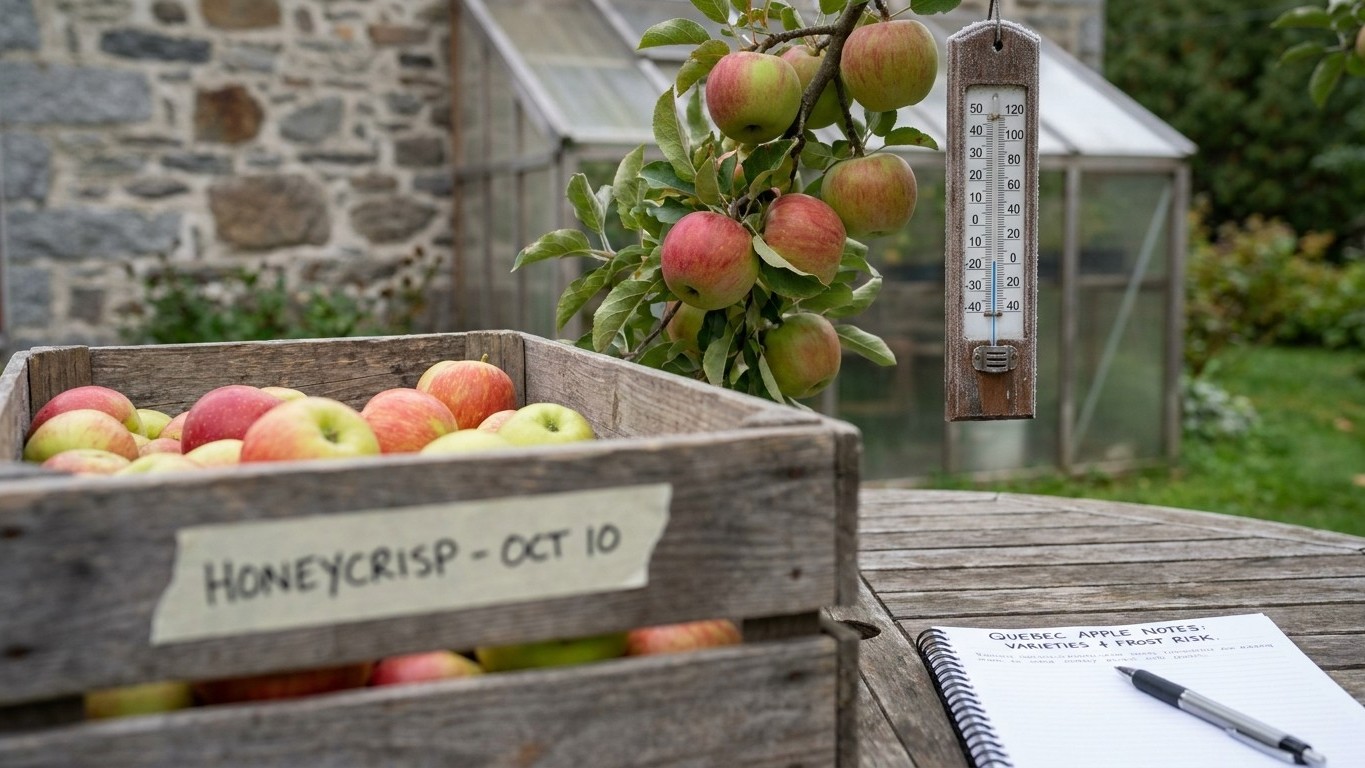

Apples grow well across most of settled Quebec, provided the tree on offer is rated hardy enough for the winter minimums Environment and Climate Change Canada records for the province’s most populated corridor. At the Montreal/St-Hubert station, the coldest month averages a daily minimum of -14.1 °C under ECCC’s 1981-2010 climate normals, cold enough to kill outright any cultivar bred for a milder zone. Before buying a tree, check its published hardiness rating against that number rather than trusting a nursery tag that just says “cold hardy.”
Which varieties suit this climate

The -14.1 °C mean minimum from ECCC’s Montreal/St-Hubert record is the filter that matters most. It rules out anything rated for a warmer zone than the one Montreal actually experiences, and it is worse further from the St. Lawrence valley, in the Laurentians or the Eastern Townships uplands, where winters run colder still. Buy trees cataloged as hardy to at least this level of cold, not to a national average. Nurseries publish these ratings on the tag or in the catalogue description, so this is a check you can make before the tree leaves the garden centre.
Within that limit, several long-established cultivars have a published record of surviving winters this severe, and a fuller rundown of The Best Apple Varieties for Quebec can help narrow the choice further. McIntosh, the apple most associated with Quebec orchards, is cataloged hardy to zone 4 and blooms in midseason. Cortland and Spartan carry the same zone 4 rating and a similar midseason bloom. Honeycrisp and Haralson, both bred in Minnesota for prairie winters, are cataloged to zone 3, a step hardier still, with Haralson blooming noticeably later. Liberty, rated to zone 4, adds scab immunity to the list, which matters in a climate wet enough for the disease to spread. Once a variety is chosen, The Quebec Apple Calendar, Stage by Stage lays out what to expect from bloom through harvest across a typical growing season.
| Variety | Published hardiness | Bloom timing | Harvest window |
|---|---|---|---|
| McIntosh | Zone 4 | Midseason | Early to mid fall |
| Cortland | Zone 4 | Midseason | Fall |
| Spartan | Zone 4 | Midseason | Fall |
| Liberty | Zone 4 | Midseason | Fall |
| Honeycrisp | Zone 3 | Midseason | Early fall |
| Haralson | Zone 3 | Late | Fall |
Winter chill: the second filter
Hardiness tells you whether the wood survives the winter. Winter chill tells you whether the flowers open properly the following spring, and it is a separate question. A low-chill variety bred for the Deep South, needing only a few hundred hours below about 45°F to break dormancy, will get that requirement satisfied in the first cold snap of a Quebec November and then sit dormant through months of surplus cold it never needed. That surplus does not damage the tree, but a low-chill selection is almost never also cold-hardy to a Montreal winter, which is the real reason it fails here, not the chill math. Quebec sits firmly at the high-chill end of the range apples are bred across, so chill accumulation is never the limiting factor in this territory. The limiting factor is always the -14.1 °C winter minimum above, which is why the varieties worth planting are the ones cataloged for zone 3 or 4 hardiness rather than the ones bred for mild winters.
Growers further west in Saskatchewan work with even colder minimums and lean on tougher selections bred specifically for that extreme, a comparison worth reading in Growing Apples in Saskatchewan: Varieties, Timing and Frost Risk if you garden near the northern edge of Quebec’s apple-growing range.
Quebec’s provincial extension service does not publish a single endorsed variety list for home orchards. The cultivars above are drawn from published nursery hardiness ratings, not a provincial recommendation, so treat them as a starting shortlist to confirm against your own microclimate rather than an official word.
Planting a pair that works here
Apples are not reliably self-fertile. Plant two varieties that flower at overlapping times, and make sure at least one of them produces fertile pollen. Given the shortlist above, McIntosh and Cortland make a workable pair, since both are cataloged as midseason bloomers and both have fertile pollen. Honeycrisp and Liberty overlap in the same midseason window and work as a second option. Haralson blooms later than the others, so pairing it with an early or midseason variety risks a narrow overlap in a short Quebec spring, and it is safer paired with another late-blooming cultivar if one is available locally.
The pairing gets more complicated with triploid varieties, a category that includes well-known apples like Jonagold and Gravenstein. These produce sterile pollen and cannot pollinate anything, including themselves, so an orchard built around a triploid always needs two other, fertile-pollen varieties in bloom at the same time, not just one. Check pollen fertility before buying, not after the tree fails to set fruit. None of the shortlist above is a known triploid, which is part of why they are a reasonable starting point for a two-tree Quebec planting.
Bee activity also depends on weather at bloom time. A cold, wet stretch during the overlap window can suppress pollinator flights even when both trees are flowering correctly, which is one more reason a wider bloom overlap, rather than the bare minimum, is worth planning for in a climate where spring weather is unsettled.
The frost that costs a crop here

At the Montreal/St-Hubert station, Environment and Climate Change Canada’s 1981-2010 normals put the average last spring frost at May 6. That is a mean date, not a safe one: in one year out of two, frost arrives later than May 6, and in the other half of years it arrives earlier. Districts north or upland of Montreal, including much of the Laurentians and the higher parts of the Eastern Townships, run further behind this date still. Treat May 6 as the midpoint of a risk window, never as the day it becomes safe to relax.
What frost actually kills
The tree itself tolerates a hard freeze fine once it is dormant. The risk that costs a Quebec grower an actual crop is narrower and later: a frost that lands after the buds have opened to the pink stage, or after bloom, kills the open flowers directly while leaving the wood and the tree completely undamaged. The tree looks fine all summer. There is simply no fruit on it, because the flowers that would have become apples were killed in a single cold night in May. This is the single most common way a home orchard in this climate loses a whole season’s harvest.
There is not much a grower can do about the date frost falls, but there is something to do about exposure. Plant on a slope or a site with air drainage rather than a low hollow where cold air pools overnight. Delay pruning until bud break is clearly underway, since heavy late-winter pruning can push bloom earlier into the frost window rather than later. For a young or dwarf tree, frost cloth thrown over the canopy on a night with a hard freeze forecast during bloom can save that year’s flowers. Longer term, the real protection in a place where frost lingers into May is a later-blooming variety, like Haralson from the shortlist above, since a flower that has not yet opened when the frost lands is a flower that survives it.
Growers used to comparing figures against warmer US states should also note a difference in vintage. Canada’s climate normals used here run from 1981 to 2010, while the US figures used elsewhere on this site, for a state like Indiana, are drawn from the 1991-2020 period. Read Growing Apples in Indiana: Varieties, Timing and Frost Risk for how a milder, more southerly frost calendar changes the whole planting picture.
The apple year in Quebec
The stages below are anchored to Montreal/St-Hubert’s frost normals from ECCC. A garden further north or at higher elevation runs the same sequence later, sometimes by two or three weeks.
- Dormancy runs through the coldest months, when the mean daily minimum drops to -14.1 °C per ECCC’s normals. No work needed beyond checking young trunks for winter sun scald or rodent damage.
- Green tip appears as temperatures climb toward the average last frost date of May 6. This is the last easy window for dormant pruning before the tree is actively growing.
- Pink bud follows, days before bloom. This is the highest-stakes stage for frost, since the flower parts are exposed but not yet open.
- Bloom typically follows the May 6 average last frost, but with real variance either side of it, which is exactly why the frost risk described above does not disappear once the calendar reaches that date.
- Petal fall and fruit set come next, over one to two weeks, and this is when a grower can first tell whether pollination actually succeeded.
- Harvest for early varieties like Honeycrisp comes well ahead of the average first fall frost of October 5. Later varieties like Haralson are picked closer to that date, and a grower with a late-season variety should have picking done before frost risk climbs again in early October.
Local help
For variety lists specific to a sub-region of the province and for current spray timing guidance, check with Quebec’s Ministère de l’Agriculture, des Pêcheries et de l’Alimentation at MAPAQ. A provincial extension office will always know more about a specific county’s microclimate than a general reference station can.
Common questions
Can I grow apples this far north in Quebec, or is it too cold?
Most of settled Quebec can grow apples, provided the variety is cataloged hardy to the winter minimums recorded for the region. Apples are workable across the province, though the far north and high elevations narrow the realistic variety list to the hardiest cultivars, like Haralson and Honeycrisp.
Why did my tree bloom fine but set no fruit?
The most common causes are a missing or poorly overlapping pollinator variety, a triploid tree with sterile pollen planted as the only other tree, or a frost that hit the open flowers without leaving any visible damage to the tree itself. Check the bloom-time overlap of your two varieties and rule out frost on the relevant nights before assuming a pest or disease problem.
Do I need two apple trees, or will one produce fruit alone?
Plan for two, since almost no apple variety reliably self-pollinates enough to crop well on its own. A single tree occasionally sets a light crop from a neighbour’s tree or a wild crab apple within bee range, but that is not something to plan an orchard around.
How late can frost hit before it stops being a real risk?
Later than most gardeners assume. Montreal/St-Hubert’s average last frost from ECCC is May 6, but that is a mean date, so frost lands after it in roughly half of all years. Treat the whole first half of May as a risk window rather than watching the calendar for a single safe day.
Should I pick a dwarf or a full-size tree for a Quebec winter?
Rootstock affects size and speed to bearing, not cold survival, since winter hardiness is a property of the grafted variety’s wood, not the roots. Choose dwarf or semi-dwarf rootstock for space and ease of frost-cloth coverage during bloom, and choose the variety itself for hardiness and bloom timing as described above.