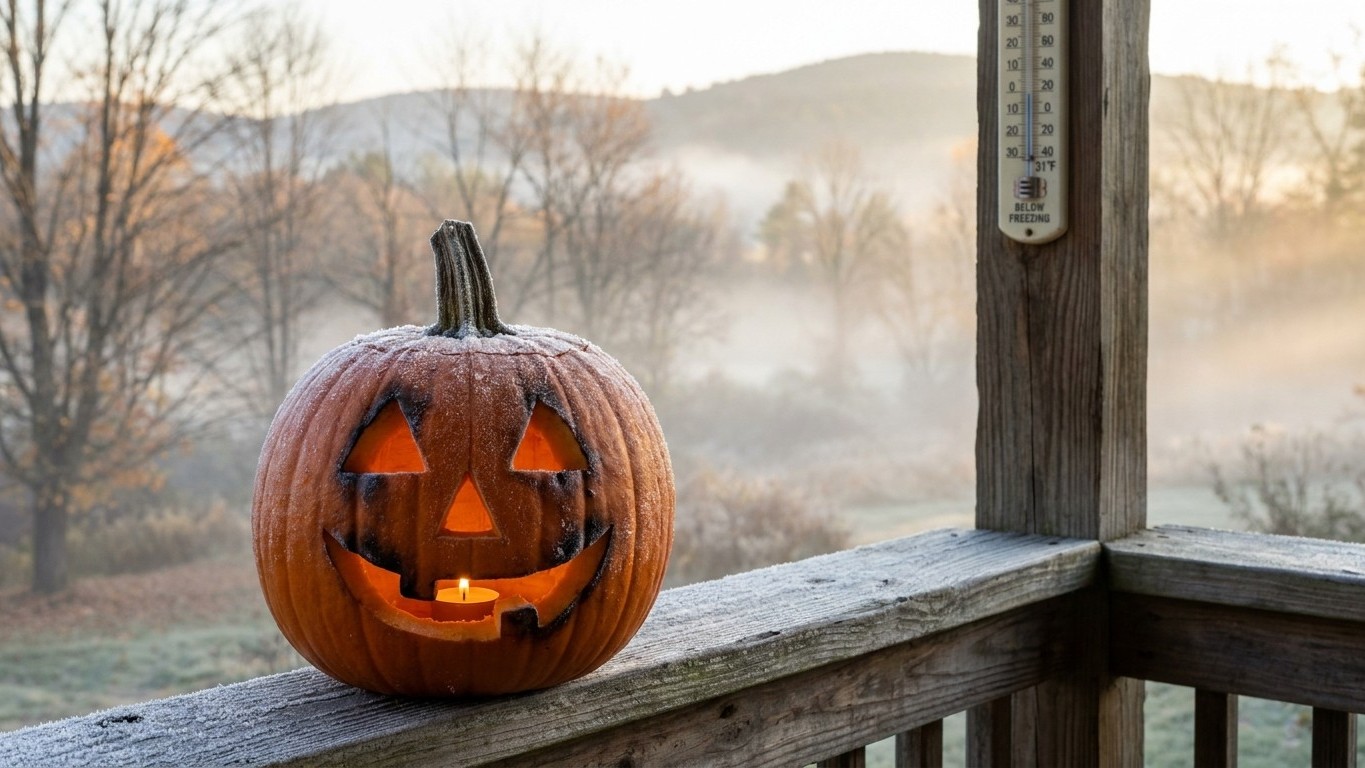

Burlington’s average first fall frost lands around October 3 to October 13, weeks ahead of Halloween. That single fact reshapes the whole question of timing in Vermont: a pumpkin left out on a porch through the end of the month is very likely to meet freezing air before the candle ever goes inside it. The safe window is narrow, and it sits close to Halloween itself, not the weeks before.
The short answer

Vermont’s frost arrives well before Halloween in most years, not around it and certainly not after. The NOAA Climate Normals for the Burlington station put the mean first fall freeze somewhere between October 3 and October 13, which works out to roughly 18 to 28 days ahead of Halloween, even in the state’s mildest pocket along Lake Champlain. That’s the number worth sitting with: nearly a month, in the best case, between the average first freeze and the night you’re actually carving.
The catch is right there in the word “mean.” A mean frost date is an average pulled from thirty years of records, not a schedule. Some years the freeze holds off past that window; other years it shows up early, especially away from the lake’s moderating influence. In the Green Mountains and the Northeast Kingdom, where elevation and distance from open water strip away that buffer, the first freeze typically comes sooner than Burlington’s date, sometimes by a couple of weeks or more.
What that means practically: if you’re carving a pumpkin for Halloween in Vermont, don’t count on stable, storage-friendly temperatures right up to the day. The safest approach is to buy well, keep the pumpkin whole and uncut for as long as you can stand it, and carve close to Halloween itself, ideally within the final handful of days before the holiday rather than earlier in the month. Once frost arrives, the ambient temperature around a porch-stored pumpkin, carved or not, has already dropped past the point where you have much control over it. Waiting to carve isn’t about extending shelf life through some trick; it’s about shrinking the number of days the carved pumpkin has to sit exposed to whatever the Vermont sky decides to do that week.
None of this changes how to select the pumpkin in the first place, and that part is worth getting right before frost ever enters the conversation.
Frost or heat: which one gets it here
University of Illinois Extension recommends storing a whole pumpkin between 45 and 50 degrees Fahrenheit, in a cool, dark spot, away from any fruit or vegetables that are actively ripening. That’s the target band. The question for Vermont is which direction the local climate pushes you off that band, cold or hot, and the answer is not close.
The cold end
Vermont’s risk runs cold, not just in January but in the run-up to Halloween itself. With the mean first fall freeze landing around October 3 to October 13 at the Burlington station, and running earlier still through the Green Mountains and the Northeast Kingdom, a huge share of the state is already experiencing sub-freezing nights before the holiday arrives. That’s well below the 45-50 F storage band, and a hard freeze does real damage to pumpkin flesh, turning it soft and eventually collapsing the cell structure once temperatures thaw again. For context on how far Vermont’s cold can go once winter settles in, the coldest month’s average daily low sits at 12.9 F at the Burlington reference station. Late October doesn’t reach anywhere near that, but it signals the direction the season is heading, and it’s a reminder that unheated outdoor storage in Vermont only gets colder from here, not warmer.
The warm end
Heat simply isn’t the concern in Vermont at this time of year. Late-October daytime highs statewide are typically running well below the range that would push a stored pumpkin toward the soft, sweaty spoilage that shows up in warmer climates. States dealing with lingering 70s and 80s in October have to worry about a pumpkin cooking in its own storage spot. Vermont’s problem is the opposite: keeping the pumpkin above freezing, not below some upper heat threshold. Anyone moving here from a warmer state can drop the heat-spoilage worry entirely and focus on frost.
Where to keep it until you carve
- An enclosed, unheated porch or mudroom, at least until nightly temperatures start regularly dropping into the 20s. This is usually the closest match to that 45-50 F band while it lasts, but it stops being reliable the moment a hard freeze settles in for good.
- A basement or root cellar, especially once outdoor temperatures swing toward or below freezing. Below-grade spaces in Vermont homes tend to hold a steadier, cooler temperature than anything above ground, which makes them the better bet as the season turns.
- An attached, unheated garage, as a middle option between the porch and the basement. Check it on cold nights; an attached garage still tracks outdoor temperature more closely than a basement does.
- Away from apple crates, cider jugs, and any other ripening produce, which is a common thing to have sitting around a Vermont kitchen or mudroom this time of year. Ripening fruit gives off a gas that accelerates aging in a pumpkin, so the spot next to the apple bushel is exactly the wrong one.
- Away from woodstoves, furnace vents, and sunny windowsills indoors. Vermont households lean on wood heat and forced-air furnaces once the cold sets in, and both will push a nearby pumpkin well above the ideal storage range.
Checking this against your own county
Burlington’s frost data comes from a single station on Lake Champlain, the mildest corner of a state where terrain does a lot of the work. A valley floor near the lake and a hillside farm in the Northeast Kingdom can see first frost dates that differ by two weeks or more in the same year. Rather than assume Burlington’s window applies everywhere, check it against your own county through University of Vermont Extension, which tracks local growing-season and frost information county by county.
That’s the more reliable way to time a carve date than any statewide rule of thumb, since Vermont’s mix of lake effect, mountain elevation, and valley cold pockets makes the difference between a mild October and an early, hard one.
Common questions
Should I carve before or after frost hits?
Carve as close to Halloween as you can manage, and lean toward after frost has already arrived rather than before, since keeping the pumpkin whole for longer gives it more protection than carving early ever would.
Does frost harm an uncarved pumpkin sitting outside?
A hard freeze can damage the flesh of a whole pumpkin left outdoors, which is why the 45-50 F storage range matters even before you cut into it. Once temperatures at your storage spot start dropping consistently below freezing, it’s time to move the pumpkin somewhere warmer, like a basement.
How do I pick a pumpkin that holds up best before carving?
Look for one to two inches of stem still attached. That stem is the seal on the pumpkin, not a handle, and once it breaks off the exposed spot becomes an easy entry point for spoilage. Skip anything with blemishes or soft spots, favor heavier pumpkins, and don’t worry about shape.
Is there a way to make a carved pumpkin last longer?
No extension service publishes a preservation protocol or a set number of days a carved pumpkin lasts, so treat any specific timeline or home remedy you see elsewhere as unverified. What actually helps is choosing a pumpkin with an intact stem and no soft spots, keeping it whole in a cool, dark spot until close to Halloween, and carving it as near to the day as your schedule allows.