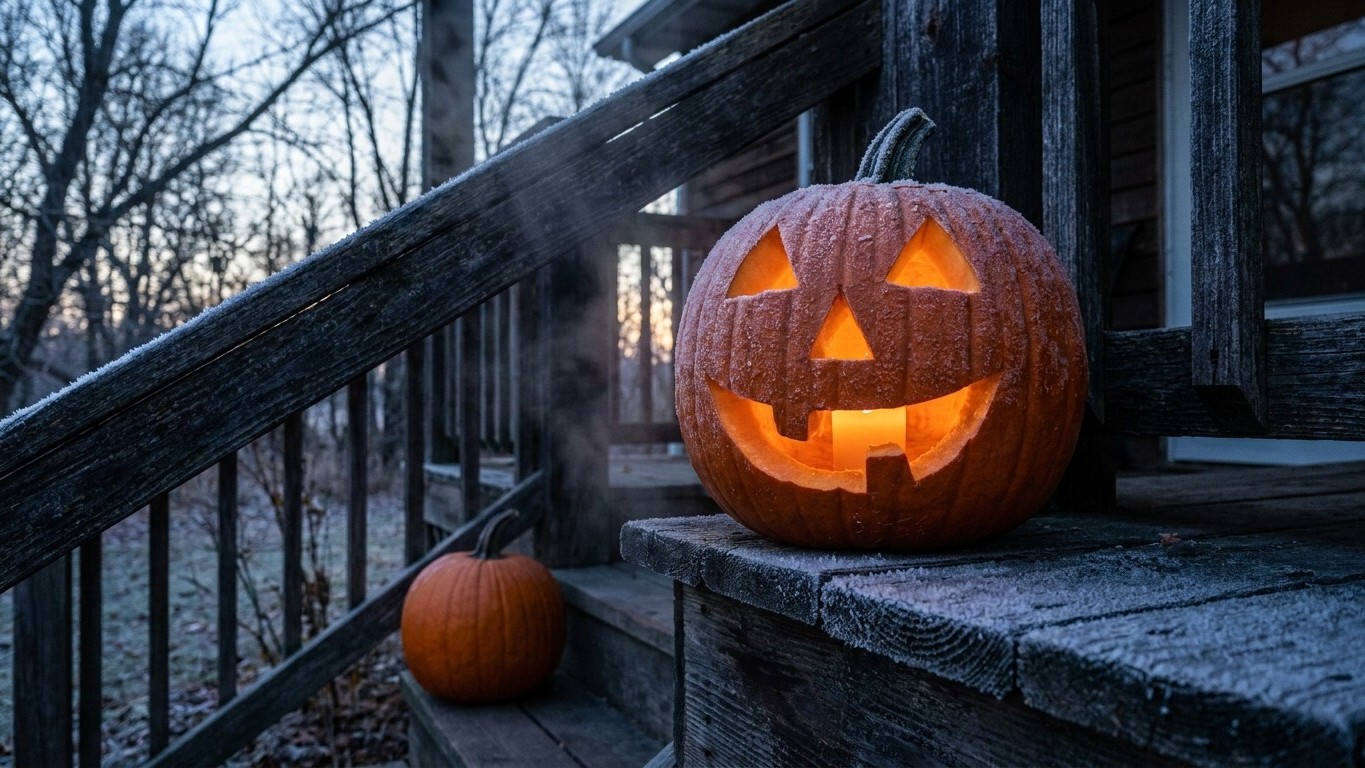

In Minneapolis and the rest of the Twin Cities metro, the mean first fall frost lands somewhere between October 11 and October 23, according to NOAA’s 1991-2020 Climate Normals. That’s the mild end of Minnesota. A pumpkin bought in early October and left whole on a porch will very likely see frost before it sees Halloween. That changes how you should think about the carving window, and it’s worth walking through why.
The short answer

Around October 11 to October 23 is when the Twin Cities area typically records its first freeze, based on three decades of NOAA data. That’s not a hard date. It’s an average built from probability bands, so the actual frost in any given year could show up a week earlier or a week later. Still, it tells you something useful: in the mildest part of Minnesota, frost tends to arrive roughly 8 to 20 days before Halloween, not after it.
For a whole, uncarved pumpkin, that timing barely matters. A pumpkin sitting on a stem, unbroken and unblemished, doesn’t care whether the air outside dips below freezing for a night, as long as it’s not sitting directly in that exposure for an extended stretch. What the frost date really tells the carver is this: by the time Halloween rolls around, cold weather has almost certainly already settled into the region. That’s the backdrop for everything else in this guide.
So where does that leave the actual carving decision? University of Illinois Extension and Utah State University Extension, the two sources most reliable on pumpkin handling, don’t publish a countdown for how long a carved pumpkin holds up once you cut into it. No research institution tracks that number, so nobody can give you a reliable “three days” or “five days” answer, no matter how often you see it repeated elsewhere.
What the research does support is a simple sequence: choose a pumpkin with an intact stem, keep it whole in the right conditions for as long as you can, and carve it close to the day you plan to display it. In a state where frost shows up 8 to 20 days ahead of Halloween in the mild south, and even earlier up north, that means most of your storage window is spent keeping the pumpkin whole, not carved. The carving itself should happen in the final stretch before Halloween, not weeks in advance.
Frost or heat: which one gets it here
The cold end
Minnesota’s answer to “frost or heat” is unambiguous: cold is the risk here, not warmth. The Twin Cities, despite being the mildest part of the state, still average that first freeze between October 11 and October 23, well ahead of Halloween. Head north and the window tightens by two to three weeks at both ends of the season, meaning a pumpkin patch in Bemidji or International Falls is dealing with frost even earlier.
The scale of Minnesota’s cold becomes clearer when you look at winter itself. The coldest month’s mean daily minimum in the Minneapolis area runs about 8.8 F, according to NOAA’s Climate Normals. That’s not the record low, just the average nightly low during the coldest stretch of the year. It illustrates the trajectory an outdoor pumpkin is riding: temperatures don’t level off after the first frost, they keep falling. A porch or unheated garage that hovers near the 45-50 F storage band in early October will likely be far colder than that within a few weeks. Storage outdoors becomes a shrinking window, not a stable one.
The warm end
Heat isn’t the concern in Minnesota the way it might be in a Gulf Coast state. There’s a short stretch in early October, before that first frost, when afternoon temperatures can still climb into ranges warmer than the 45-50 F storage band. During that early window, a pumpkin left in direct sun or a warm sunroom will soften faster than one kept in shade. But that’s a brief and minor factor compared to what comes after. Once frost season arrives, on schedule with the dates above, the dominant risk flips entirely to cold, and it stays that way through Halloween and beyond.
Where to keep it until you carve
Finding a spot in a Minnesota home or yard that holds steady in the 45-50 F range, and stays dark, takes a little thought once outdoor temperatures start swinging. Here’s a practical order of preference:
- An unheated but insulated garage or mudroom. These spaces often track closest to the 45-50 F band in October before the deep cold sets in, and they keep direct sun off the pumpkin.
- A cool basement corner, away from the furnace. Basements in Minnesota homes tend to run cooler and more stable than the rest of the house, which works in the pumpkin’s favor once outdoor temperatures start dropping toward freezing overnight.
- A three-season porch, but only early in the window. Before the first frost hits, an unheated porch can work. Once nighttime lows start flirting with 32 F, move the pumpkin somewhere with more buffer.
- Never near the fruit bowl or a bag of potatoes. Ripening fruits and vegetables release a gas that speeds up aging in a pumpkin sitting nearby, according to University of Illinois Extension. Keep it in its own space, away from apples, tomatoes, and stored potatoes.
- Never directly on cold concrete or exposed to a hard freeze. A prolonged freeze can damage the pumpkin’s flesh even before you get the knife out, so avoid leaving it on an uninsulated slab once temperatures drop hard.
Whichever spot you pick, keep an eye on the stem. University of Illinois Extension recommends choosing a pumpkin with 1 to 2 inches of stem intact, since that stem functions as a seal. Once it breaks off, that section becomes exposed and spoilage risk climbs. Never carry or lift a pumpkin by its stem. Support it from underneath instead.
Checking this against your own county
Minnesota is a big state, and the frost gap between the Twin Cities and the Arrowhead region or the far north is real, running two to three weeks tighter at both ends according to NOAA’s data. If you’re gardening or buying pumpkins outside the metro, the mean frost date above won’t match your county closely enough to plan around.
University of Minnesota Extension, at extension.umn.edu, maintains local offices and county-specific guidance across the state. That’s the resource to check before locking in a carving date, especially if you’re north of the Twin Cities or in a river valley where frost patterns can shift by more than a week from the regional average.
Common questions
Does a whole pumpkin need to go in the refrigerator?
No. University of Illinois Extension recommends a cool, dark location between 45 and 50 F, which is warmer than most refrigerators run. A garage, basement, or enclosed porch works better than a fridge shelf.
How long does a carved pumpkin actually last?
No university extension publishes a number for this, and claims like “three to five days” or bleach-dip methods aren’t backed by research. The reliable guidance is to choose a solid pumpkin with an intact stem, keep it whole until you’re ready, and carve close to the day you plan to display it.
Can I carve a pumpkin before the first frost hits?
Nothing stops you, but since frost in the Twin Cities area typically arrives 8 to 20 days before Halloween, carving early means the cut pumpkin sits exposed through more of that colder, unpredictable stretch. Waiting closer to the day gives you more control.
What if the pumpkin I bought already lost its stem?
University of Illinois Extension notes that once the stem breaks off, that section is exposed and spoilage risk rises. It’s not a reason to throw the pumpkin out, but it does mean you should carve and display it sooner rather than storing it for weeks.