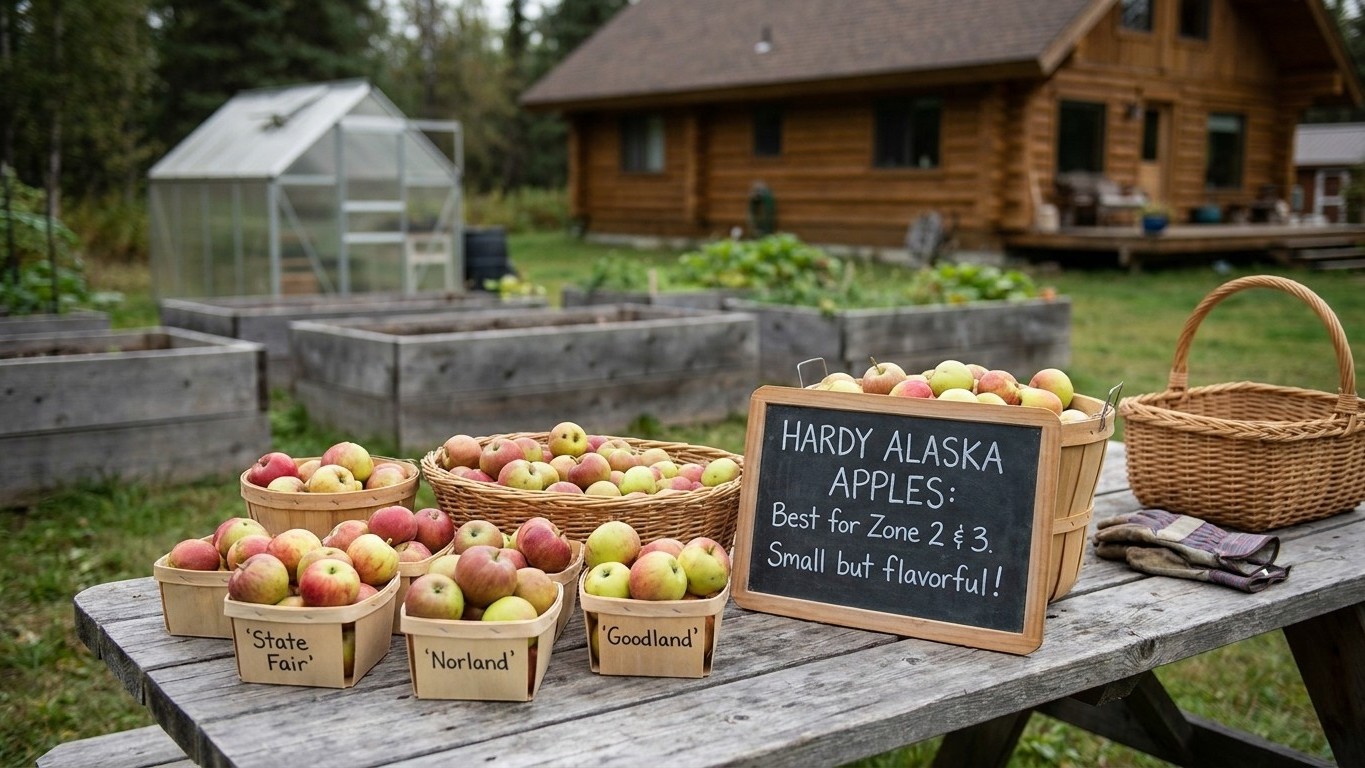

Eleven degrees above zero is the number that actually decides this, not the hardiness zone printed on a nursery tag. That’s the average low Anchorage sees in its coldest month, and it quietly rules out half of what garden catalogs call cold-hardy. The other number is 143 — the frost-free days between the last spring freeze and the first fall freeze. Elsewhere a tree only has to survive winter. Here it also has to ripen before summer runs out, and few varieties manage both.
The short answer for Alaska
Apples are grown successfully in Southcentral Alaska, and Anchorage’s own climate record explains why the list of trees that work is short. The coldest month there averages a daily minimum of 11.1°F, according to NOAA NCEI’s 1991-2020 Climate Normals for the Anchorage reference station. That figure, not the record low anyone remembers from one hard winter, is what an apple tree has to survive most years to stay alive long enough to bear fruit.
The growing season is the second filter. NOAA NCEI’s 1991-2020 normals put Anchorage’s last spring freeze between May 3 and May 12, and the first fall freeze between September 22 and October 1, for a frost-free window of roughly 143 days. A tree that blooms into a late frost, or that needs a longer season than that to size and color its fruit, will not finish before the cold comes back.
Those two numbers, not a catalog description, decide what belongs in an Alaska orchard. Winter hardiness determines whether the tree survives to spring; the length of the frost-free window determines whether the fruit it sets that spring actually ripens. A tree can pass one test and fail the other. If you haven’t settled on a planting site and soil yet, that groundwork is covered in Growing Apples in Alaska.
Working through it

With no single named cultivar to point to, the useful exercise is ranking the categories of apple that actually get planted in Southcentral Alaska, and being honest about what each one costs in exchange for surviving the winter.
Hardiness first, chill second
Hardiness and chill requirement answer two different questions, and growers who check only one get burned by the other. Hardiness is whether the wood survives the coldest month, the 11.1°F average daily minimum NOAA NCEI records for Anchorage. Chill requirement is the number of cold hours a tree needs over winter before it flowers normally in spring, and it is rarely the limiting factor here, since Anchorage winters run long and cold enough to satisfy almost any apple’s chill need several times over. The bloom stage itself, and how it lines up against the May 3 to May 12 last-frost window, is worked through stage by stage in The Alaska Apple Calendar, Stage by Stage.
Ranking the realistic categories
Ranked from most reliable to least reliable in a Southcentral Alaska yard:
| Category | Winter hardiness needed | Season length needed | What it costs you |
|---|---|---|---|
| Ornamental and fruiting crabapples | Highest, bred for boreal conditions | Short, ripens inside 143 frost-free days | Small, tart fruit, mostly used for jelly, cider, or as a pollenizer |
| Cold-hardy dessert apples on extreme-hardy rootstock | High, but the rootstock rating needs confirming separately from the scion | Short to moderate | Fruit quality and storage life below a supermarket apple |
| Standard commercial dessert cultivars from Lower 48 catalogs | Usually too low for an unprotected Anchorage winter | Often longer than the frost-free window allows | High risk of winter kill before the tree ever bears |
The trade-off runs in one direction. Every step toward a fruit that tastes and stores like a grocery-store apple is a step toward a tree that needs a mild winter to survive, and Anchorage’s own 1991-2020 record says a mild winter is not the norm. Most Southcentral orchards plant at least one hardy crabapple purely to guarantee pollination, since apples need overlapping bloom from a second tree and a crabapple’s bloom window is easy to time against the calendar. Ask any nursery selling grafted trees in the state for the winter hardiness zone and chill hours the rootstock and the scion were each tested to, and get that answer in writing before you plant, not after the first hard winter tells you.
What changes across Alaska
Anchorage’s numbers describe Anchorage, and the rest of the state moves the goalposts in both directions.
Interior and the Matanuska-Susitna Valley
The Interior around Fairbanks runs on a continental pattern rather than Anchorage’s coastal one, with colder winter minimums, a shorter frost-free season, and less snow cover to insulate roots. The Matanuska-Susitna Valley, north of Anchorage and a working agricultural area in its own right, sits low enough that cold air drains and pools on the valley floor on calm nights, so a planting site partway up a slope often runs milder than the flat ground below it, even at the same latitude. Neither area has a NOAA reference station in the dataset behind this article, so treat any specific date for them as unverified until you check a local source rather than assuming Anchorage’s window applies.
The coast and the Kenai Peninsula
Southcentral’s coastline, including much of the Kenai Peninsula, sits close enough to Cook Inlet’s moderating water to run milder in winter and cooler in summer than inland Anchorage neighborhoods a few miles away. That coastal buffering is the same effect that makes Anchorage itself one of the mildest inhabited parts of the state rather than a typical one. Southeast Alaska’s panhandle, wetter and more maritime again, sits outside the scope of the Anchorage-based figures in this article entirely, and should be checked against its own station data before you rely on any date here.
The mistakes this climate punishes
Buying on name instead of on rating
The most common failure is ordering a tree because the name is familiar from a grocery store, without asking what winter hardiness zone it was tested to. That tree often survives its first winter on the strength of a young root system and nursery-applied protection, then dies back or fails outright in its second or third winter once Anchorage’s 11.1°F coldest-month average hits it without the extra insulation. The failure shows up in spring, as buds that never open on wood that looks fine from the outside.
Feeding too late in the season
Nitrogen applied in midsummer pushes soft new growth right as the season is closing, and that growth has not hardened off by the time the first fall frost arrives, between September 22 and October 1 in the Anchorage record. Soft wood is the wood that splits or dies back over winter, so the last feeding of the season needs to happen well before that window opens, not inside it.
Planting in a frost pocket
Low ground that collects cold air on clear nights delays bud break in spring and brings the first fall frost in earlier than the surrounding slope, effectively shortening an already short 143-day season from both ends. A tree planted a few feet higher, or against a wall that holds heat, can gain enough days to matter.
Choosing a slow-ripening apple over a hardy one
A cultivar bred for a long, warm growing season can be hardy enough to survive the winter and still never finish. The fruit sets, sizes, and sits green when frost ends the season, wasting a year on a tree that could have carried an earlier-ripening choice instead. This shows up at harvest, not at planting, which is exactly why it is worth checking before you buy.
Checking this against your county
Every figure above is measured at or near Anchorage, and the rest of the state can run warmer, colder, wetter, or drier than that single station. Before you plant, check your own frost dates and any regionally tested apple cultivars with the University of Alaska Fairbanks Cooperative Extension Service, which keeps county-level advice and can tell you whether a given rootstock and scion combination has actually been trialed near you. A local office can also confirm whether crabapple pollenizers are already established nearby, which matters more than any ranking in this article once you know what will actually flower on your own property.
Common questions
Can I just plant a Honeycrisp or Fuji tree from a big box store?
Ask the seller for a documented hardiness rating and a ripening timeline before buying, or check with UAF Cooperative Extension for what has actually been trialed in your area.
Do I need more than one apple tree to get fruit?
Yes. Almost all apple cultivars need cross-pollination from a second tree blooming at the same time, which is why many Southcentral growers plant a hardy crabapple alongside a dessert apple purely as a pollenizer. A single tree standing alone may flower for years without ever setting fruit.
How many years before a young apple tree bears fruit in Alaska?
Grafted apple trees typically start bearing in their third to fifth year regardless of climate, since that timeline is set by the tree’s age and graft rather than by the weather. In a short, cold season the bigger risk is a tree that dies back before it reaches that age, not one that’s simply slow to start.
Can I grow apples in Fairbanks or the Interior?
Possibly, but this article’s figures are drawn from the Anchorage NOAA station and do not describe the Interior’s colder, more continental winters or its shorter frost-free season. Check with UAF Cooperative Extension for Interior-specific frost dates and any cultivars documented to survive there before assuming an Anchorage recommendation applies.