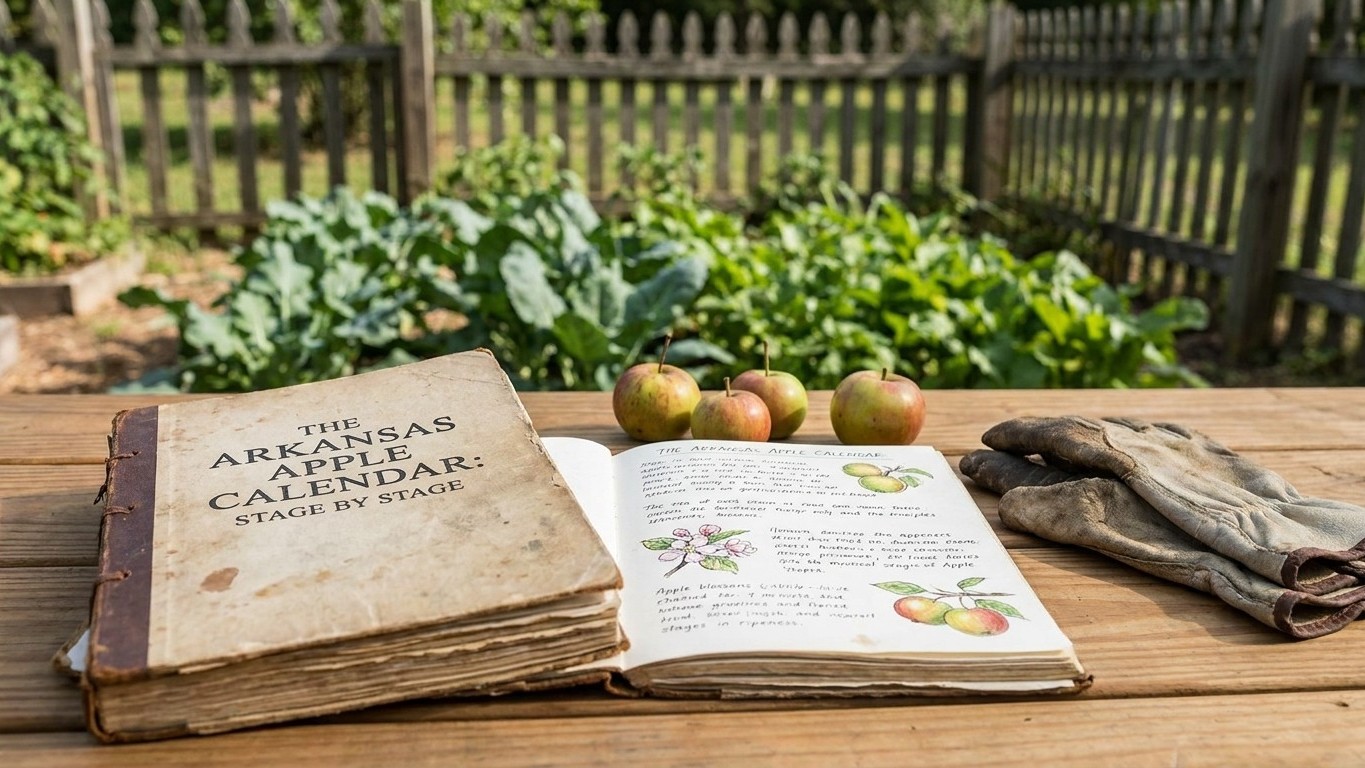

March 12 to March 28 is the real window in Little Rock, not the single “last frost date” most calendars hand you like it’s carved in stone. That’s the difference: everywhere else, growers plan around one day; here, you’re planning around a 30 to 70 percent probability band that can still bite a tree in full bloom. Fall closes the season between November 7 and November 20, but what happens between those two windows — dormancy, bud swell, bloom, set, harvest — is staged by the plant, not the month.
The short answer for Arkansas
In Little Rock, the reference station NOAA’s National Centers for Environmental Information uses for its 1991-2020 climate normals, the window when a 32°F freeze has a real chance of showing up in spring runs March 12 to March 28. That’s not a single date, it’s a band of probability, and bloom that lands anywhere inside it is gambling with a full crop loss. The first fall frost at the same station falls between November 7 and November 20, which marks the point where any late-season growth needs to already be hardened off.
Between those two windows sits the whole growing season: dormancy pruning, bud swell, bloom, fruit set, and harvest, each one keyed to a plant stage rather than a month. A tree that reaches full bloom in early March in an unusually warm year is exposed to weeks of remaining frost risk. A tree that blooms in early April, after the window has closed in most years, isn’t automatically safe either, because the March 12-28 span is only a 30 to 70 percent probability band, not a hard stop.
What the answer depends on: chill accumulated over winter and heat accumulated in spring, both of which vary with cultivar and elevation, plus whatever hardiness a tree needs to survive Arkansas’s coldest month in the first place. NOAA’s 1991-2020 normals put the mean daily minimum of Little Rock’s coldest month at 31.2°F, cold enough to rule out anything but a genuinely apple-hardy rootstock and scion, though not brutal by northern standards. If you’re still deciding what to plant before any of this matters, Growing Apples in Arkansas covers site and rootstock choice, which this calendar assumes you’ve already worked through.
Working through it

Every stage between dormancy and harvest tolerates a different amount of cold, and that tolerance, not the calendar, is what should drive your decisions.
Dormancy and pruning
Prune while the tree is fully dormant, before any bud shows color. In Little Rock’s climate, that means finishing pruning ahead of the frost window opening around March 12 (NOAA NCEI 1991-2020 normals), since cuts made once sap is moving heal slower and can push the tree toward earlier bud break at the worst possible time.
Green tip and pink bud
Green tip, when the first bit of leaf tissue shows at the bud, and pink bud, when the flower cluster is visible but not yet open, both carry meaningfully more cold tolerance than an open blossom. In most years these stages fall inside or just before the March 12-28 window, and a freeze at green tip or pink rarely wipes out the crop the way the same freeze would at bloom.
Bloom
Bloom is the stage that actually decides the year. An open apple blossom has almost none of the cold tolerance a dormant bud has, and if full bloom coincides with a frost event inside that March window, the flowers die and no amount of aftercare brings the crop back. This is why the stage matters more than the date: two trees planted the same week can bloom two weeks apart depending on cultivar and local warmth, and only one of them might clear the frost window in a given year.
Petal fall and fruit set
Once petals drop and the young fruitlets start swelling, frost sensitivity drops but doesn’t disappear. A frost that lands late in the window, toward March 28, can still damage fruitlets that set early. This is also roughly when June drop happens later on, a natural thinning unrelated to frost, just the tree shedding fruit it can’t support.
Harvest
Harvest timing is cultivar-driven, not frost-driven, but the first fall frost window (November 7 to November 20 at Little Rock, per NOAA’s normals) sets the outer boundary. Early to midseason cultivars like ‘Gala’ are usually off the tree well before that window opens. Later cultivars, including ‘Arkansas Black’ and ‘Enterprise’, hang on the tree closer to that window and need to be picked before a hard freeze damages fruit still on the branch. For a full rundown of which cultivars suit which part of that harvest window, The Best Apple Varieties for Arkansas breaks it down by region.
What changes across Arkansas
Little Rock’s frost windows describe the central part of the state, and NOAA’s station data is specific to that reference point, not a statewide constant. The Ozark Plateau in the northwest, at meaningfully higher elevation, tends to hold cold longer into spring, which pushes bud break and bloom later and can work in a grower’s favor by moving bloom further past frost risk. The Ouachita Mountains in west-central Arkansas behave similarly, with cold air settling into the valleys between ridges and creating pockets that lag the surrounding hillsides.
The Arkansas Delta in the eastern part of the state sits at low elevation on flat, open ground, and generally warms faster in late winter than the higher terrain to the west. That earlier warmth pulls green tip and bloom forward, which sounds like an advantage until you remember the last-frost window doesn’t necessarily move with it. An early bloom in the Delta chasing an unusually warm February can still get caught by a frost that arrives on schedule everywhere else in the state.
None of this changes the basic logic, only the timing. The stage-over-calendar rule holds everywhere in Arkansas, but the specific week a tree in the Ozarks reaches pink bud can run well behind the same cultivar in the Delta or in the river valley around Little Rock. If you’re gardening outside the immediate Little Rock area, treat the March 12-28 window as a reference point to adjust from, not a number that applies directly to your ground.
The mistakes this climate punishes
The single most common mistake in this climate is planting a low-chill, early-blooming cultivar bred for milder regions and expecting it to dodge Arkansas’s spring frost window. ‘Anna’ and ‘Dorsett Golden’, both developed for regions with little winter cold, tend to break dormancy and bloom early, and in a warm February or early March that bloom can land squarely inside Little Rock’s March 12-28 frost window instead of clearing it.
The opposite mismatch causes a quieter failure. High-chill cultivars like ‘Honeycrisp’ need a long, cold winter to break dormancy evenly. In a mild winter, chill accumulation falls short, and the result isn’t frost damage but erratic, drawn-out bloom with poor fruit set, the kind of failure that shows up in June as a mostly empty tree rather than an obviously frost-burned one.
Feeding a young tree nitrogen too late in the season causes a third failure that shows up in fall rather than spring. Late feeding pushes soft new growth that hasn’t hardened by the time the first fall frost arrives, and that window at Little Rock runs November 7 to November 20 per NOAA’s normals. Growth still soft when that window opens gets burned back, weakening the tree heading into winter.
| Cultivar | Typical bloom timing | Published chill requirement | Risk in this climate |
|---|---|---|---|
| ‘Anna’ | Early | Low (roughly 200-300 hours) | Can bloom before the frost window closes |
| ‘Dorsett Golden’ | Early | Low (roughly 100-250 hours) | Same early-bloom exposure as ‘Anna’ |
| ‘Gala’ | Mid | Moderate (roughly 500 hours) | Usually clears the window in most years |
| ‘Honeycrisp’ | Mid to late | High (roughly 800-1000 hours) | Chill can fall short in a mild winter |
| ‘Arkansas Black’ | Late | Moderate to high (roughly 800 hours) | Blooms well clear of frost, harvests late |
Matching chill requirement to an actual winter, not an average one, is what separates a full crop from a bare tree. A cultivar chosen for the wrong end of that chill spectrum fails quietly, months before anyone thinks to blame the variety instead of the weather.
Checking this against your county
Little Rock’s frost windows are a starting point, not a county-by-county forecast. The University of Arkansas Division of Agriculture’s Cooperative Extension Service, the state’s land-grant extension body, publishes county-level guidance and can be reached at uaex.uada.edu. Before you commit a bloom-date decision to a specific week, check with your county extension office for local frost records and chill-hour tracking, since elevation and terrain shift both figures away from the Little Rock reference station used throughout this calendar.
A county office with actual local frost records beats an extrapolation from Little Rock every time. That gap between the reference station and your own ground is largest in the Ozarks and smallest in the river valley nearest Little Rock.
Common questions
How do I tell green tip from pink bud on my apple tree?
Green tip is the first sliver of leaf tissue poking out past the bud scales, still tightly closed. Pink bud comes later, when the whole flower cluster has pushed out and shows pink color before the petals separate and open. The gap between the two can pass in just a few days once temperatures warm up, so check trees every couple of days once you see the first green.
Can I grow low-chill apple varieties in south Arkansas?
Low-chill cultivars like ‘Anna’ and ‘Dorsett Golden’ were bred for regions with far less winter cold than most of Arkansas gets, so they can work in the warmer parts of the state, but they also bloom earlier and carry more frost exposure than a moderate-chill cultivar. No source in this article covers county-level chill totals for southern Arkansas specifically, so check with your local extension office before committing to a low-chill variety.
Should I cover my apple blossoms if frost is forecast?
Yes, on a young or small tree it’s worth doing. Drape a frost cloth or old sheet over the canopy before evening and remove it once temperatures rise the next morning, and do it at pink bud or the very start of bloom rather than waiting until the tree is fully open, since covering does less good once the most vulnerable flowers have already opened.
My apple tree bloomed heavily but set almost no fruit, why?
The most common causes are a missing pollinator variety blooming at the same time, poor bee activity during a cold or rainy bloom stretch, or a chill mismatch that produced a weak, drawn-out bloom instead of a strong, synchronized one. Most apple cultivars are self-incompatible and need a second variety flowering in the same window nearby to set a real crop.