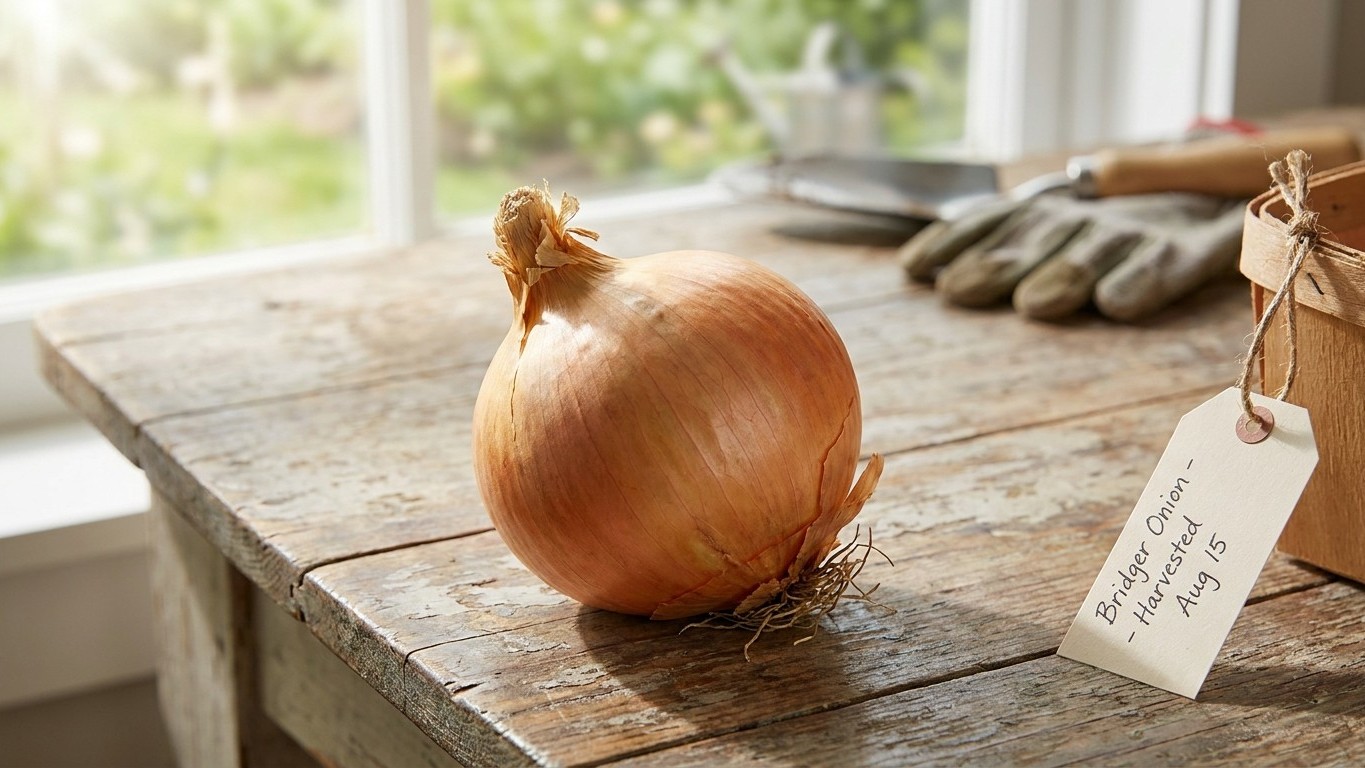

Bridger is a long-day onion, which means its bulbing clock is set by summer daylight hours, not by the calendar or the thermometer. That single fact decides whether this variety will make you a bulb or just a mess of leaves. Here’s what the day-length group means for your garden, what the bulb itself looks like, and how long it will actually sit in your pantry.
Will Bridger bulb where you are

Bridger belongs to the long-day group, and it bulbs correctly between roughly 35 and 50 degrees north latitude. That band covers most of the northern half of the United States, from around the Kansas-Oklahoma line up through the Canadian border, and it’s where this variety was bred to perform.
The mechanism behind this is one of those garden facts that trips people up because it runs against common sense. Onions don’t start forming a bulb because the weather warms up. They start because the plant senses a certain number of daylight hours, and once that threshold hits, the plant redirects its energy from leaf growth into the bulb sitting at its base. Long-day varieties like Bridger need 14 to 16 hours of daylight before they’ll flip that switch, and that kind of long summer day only exists at higher latitudes. The farther north you go, the more daylight you get in June and July, which is exactly why long-day onions are a northern crop and short-day onions are a southern one. It’s a bit counterintuitive: the north, not the warm south, is the natural home for this bulb.
Plant Bridger below that 35th parallel, in Texas or Florida or the Deep South, and the days simply never get long enough to trigger bulbing. The plant won’t shrink the bulb or delay it. It won’t bulb at all. You’ll get a stand of healthy-looking green tops all season, and then, once the tops eventually die back, you’ll find nothing worth pulling out of the ground, or a papery non-bulb that starts rotting within weeks. That’s the real cost of planting the wrong day-length group: not a smaller crop, but no crop.
If you’re gardening right around that 35-degree line, say in northern Texas, Arkansas, or the Carolina foothills, you’re in a blurred zone. Bridger might bulb adequately there, especially with an early start, but it’s not the safe bet a short-day or day-neutral variety would be at that latitude. If you’re anywhere from Nebraska north through the Dakotas, Minnesota, Montana, or the northern tier states in general, you’re squarely in Bridger’s comfort zone.
What Bridger is like
Once it does bulb, Bridger produces a fairly standard-looking storage onion: yellow-skinned, globe-shaped, and ready to harvest about 90 days after transplant. Here’s the catalogue rundown:
- Color: Yellow
- Shape: Globe-shaped bulb, typical of long-day storage onions
- Days to maturity: 90 days from transplant
- Day-length group: Long-day
What nobody publishes for this particular variety is flavor or storage life, and it’s worth being upfront about that rather than guessing. But the day-length group itself tells you something useful, because there’s a real biological trade-off at play. The same sulfur compounds that give an onion its bite and its tears-inducing punch are also the compounds that act as a natural preservative in storage. Short-day onions, bred for mild winters and quick sales, tend to be bred milder and sweeter, and that softer chemistry means they break down faster once cured. Long-day onions, bred to survive a northern winter both in the ground and in the root cellar, tend to run sharper and hold that pungency because the same compounds protecting them from rot also protect them from tasting bland.
So while nobody has published a flavor note or a specific storage window for Bridger by name, its membership in the long-day group points toward the sharper, longer-keeping end of the onion spectrum rather than the sweet-and-short-lived end. That’s a reasonable expectation to carry into the kitchen, not a guarantee.
One thing to never expect from any onion, Bridger included: a variety that’s both candy-sweet raw and a champion in storage. Those two traits work against each other chemically. If a seed catalogue ever promises both in the same breath, read the description twice.
When to plant it
Planting time for onions isn’t fixed to a date on the calendar. It follows the day-length group, and that’s where a lot of gardeners get tripped up moving from one region’s advice to another. Short-day onions, grown mostly across the South, actually go into the ground in fall, overwinter as small plants, and get harvested in late spring before the summer heat sets in. Long-day onions, like Bridger, follow the opposite calendar: they go in during late winter to early spring, grow through the long summer days, and get pulled in late summer or early fall.
Because Bridger is a long-day type, that second schedule is the one to follow. In most of its suitable range, that means starting seed indoors in late winter, six to eight weeks before your last expected frost, or setting out transplants or sets as soon as the soil can be worked in early spring. The goal is to get the plant established and growing vigorously well before the long days of June and July arrive and flip the bulbing switch.
Here’s the test that matters more than any date on a seed packet: the plant needs to have built up enough leaf mass before day length triggers bulbing, because the size of the top growth at that moment is what determines the eventual size of the bulb. Onions don’t add much bulb size after bulbing starts. They’re essentially converting the leaves they’ve already grown into bulb layers. A plant that’s still small and spindly when the trigger hits will make a small onion no matter how perfect the rest of the season goes. A plant with four or five sturdy leaves and a decent root system at that same moment will make a much bigger one.
That’s why getting an early start matters so much more for long-day onions than the exact calendar week you plant. If a late spring, a cold snap, or a delayed transplant sets your onions back, they’ll still try to bulb on schedule once the days get long enough. They just won’t have much leaf mass to work with when they do it.
Growing it well
Onions are shallow-rooted plants, with most of their feeder roots sitting in the top few inches of soil, and that makes them lousy competitors. A bed full of weeds isn’t just an eyesore around onions; it’s a direct hit to bulb size, because every bit of moisture and nutrient a weed pulls from that thin root zone is moisture and nutrient the onion doesn’t get. The same goes for missed watering. Onions don’t wilt dramatically the way some vegetables do when they’re thirsty, so a stretch of dry weather can quietly shrink the eventual harvest without ever showing an obvious sign of stress. Keeping the bed weed-free and evenly moist through the growing season isn’t a nicety with onions; it’s the difference between a fist-sized bulb and a golf-ball one.
Bolting is the other thing to watch for. A stretch of unusually cold weather early in the season, or a plant that simply gets stressed, can trigger a flower stalk to shoot up from the center of the plant. Once that happens, the bulb’s energy goes toward producing seed rather than storage layers, and a bolted onion will not keep. It may still be perfectly edible, but it needs to move to the front of the kitchen line rather than into the root cellar. If you spot a flower stalk forming, that’s a signal to pull and use that particular bulb soon rather than count on it lasting through the season with the rest of the crop.
Beyond weeding, watering, and watching for bolts, there isn’t much exotic care that Bridger or any long-day onion demands. It’s a straightforward crop that rewards consistency over intervention.
Harvesting and keeping it
Onions tell you when they’re ready, and the signal has nothing to do with a date circled on the calendar. As the bulb finishes maturing, the tops start to yellow, weaken at the neck, and eventually flop over on their own under their own weight. That collapse, happening naturally across most of the bed, is the harvest signal to watch for rather than counting exactly 90 days from transplant, though that day count gives you a rough window for when to start checking.
Curing comes next, and it’s the step most home gardeners skip or rush, which is exactly why so many stored onions turn soft and rotten within weeks of coming out of the garden. The bulb’s neck has to dry down until it’s papery and tight before the onion goes into storage, because a wet neck is an open door for the fungal and bacterial rot that ruins a harvest. According to the University of Minnesota Extension, curing onions properly involves drying them in a warm, dry, well-ventilated spot out of direct sun for two to three weeks before storage.
Here’s the sequence, start to finish:
- Watch for the tops to yellow and fall over naturally in the bed, rather than pulling by the calendar.
- Lift the bulbs carefully, shaking off loose soil without bruising the skin.
- Spread them in a single layer somewhere warm, dry, shaded, and airy.
- Let them cure for roughly two to three weeks, until the outer skins rustle like paper and the necks are fully dry and tight.
- Trim the dried tops and roots, and move the cured bulbs into a cool, dark, ventilated storage space.
No published storage window exists specifically for Bridger, so it’s honest to say that rather than invent a number. What’s fair to say is what its long-day heritage implies: sharper, more pungent onions from this group tend to be the ones that hold up longest in storage, sometimes making it well into winter or even spring in a good root cellar, while their milder, sweeter cousins from the short-day group are usually eaten within a couple of months of harvest. An onion that keeps six months carries a household through the coldest part of the year without a grocery run for one; an onion that keeps three gets folded into meals during the fall and early winter and then it’s gone. Cure it right, and you give Bridger every chance to land on the longer end of that range.