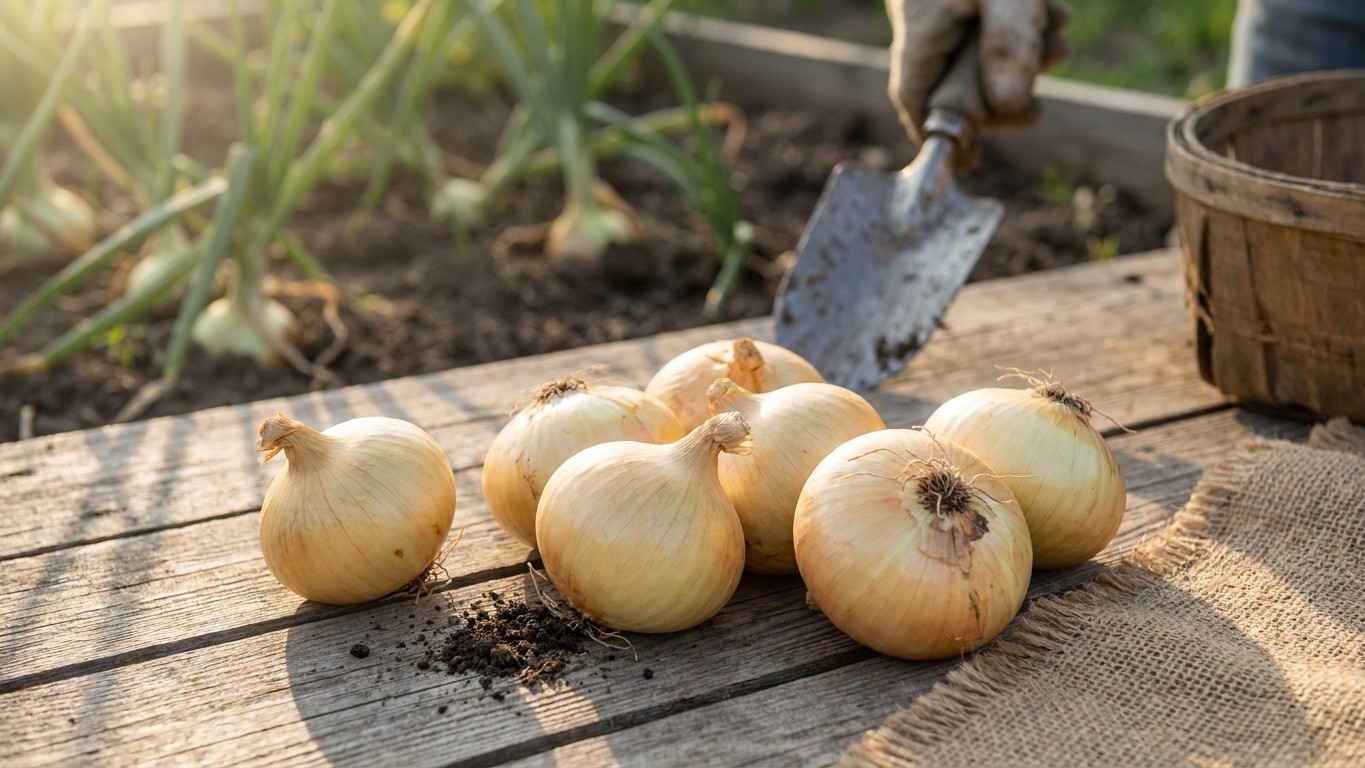

Sierra Blanca is an intermediate-day onion, which means it only forms a bulb correctly between roughly 32 and 45 degrees North latitude. Plant it outside that band and you get tops, not onions. Inside it, expect a yellow bulb ready in 109 days from transplant, mild in flavor, and good for only about a month in storage.
Will Sierra Blanca bulb where you are

This is the fact that decides everything else. Sierra Blanca belongs to the intermediate-day group, which bulbs reliably between 32 and 45 degrees North latitude. That band runs roughly from the Texas-Mexico border up through the Great Lakes and the Mid-Atlantic. If you garden inside it, the variety should size up on schedule. If you garden well outside it, you’re not looking at a smaller or later onion. You’re looking at no bulb at all: green tops that keep growing, then rot once you try to store them.
The mechanism trips people up because it runs against common sense. Onions don’t bulb because the weather warms up. They bulb because of how many hours of daylight the plant receives each day. That’s why long-day onions are grown in the northern states and Canada, where summer days stretch past 14 hours, while short-day onions are grown in the Deep South and along the Gulf Coast, where summer daylight tops out shorter. Intermediate-day types like Sierra Blanca sit in the middle of that spectrum, needing something like 12 to 14 hours of daylight to trigger bulbing. Plant one in Minnesota and the days may never hit the right length at the right time. Plant one in south Florida and the same problem shows up from the other direction.
The 32-45 degree range is a continuum, not a hard line drawn on a map. A garden sitting at 30 or 31 degrees North, say coastal Louisiana or the Rio Grande Valley, is in a blurred zone. So is one at 46 or 47 degrees, up near the Canadian border. In those spots, Sierra Blanca might bulb, might bulb weakly, or might not bulb at all depending on the season’s particular weather and how the transplant dates line up with daylight. If your garden falls near either edge, treat it as a genuine unknown rather than a yes or a no, and consider growing a known short-day or long-day variety alongside it as insurance.
What Sierra Blanca is like
Assuming your latitude cooperates, here’s what actually shows up in the garden and on the counter:
- Color: Yellow
- Maturity: 109 days from transplant
- Flavor: On the sweet side, with relatively few sulfur compounds
- Storage life: About 1 month
The flavor and the storage life aren’t two separate traits. They’re two sides of the same chemistry. The sulfur compounds responsible for a sharp, eye-watering onion are the same compounds that act as a natural preservative inside the bulb, slowing decay and discouraging the microbes that cause rot. Breed or select for a milder, sweeter onion and you’re breeding out some of that protection along with the bite. That’s exactly what’s happened here: Sierra Blanca trades bite for sweetness, and pays for it with a short shelf life.
That trade-off should shape how you use it in the kitchen. This isn’t an onion to tuck into a root cellar and forget about until January. It’s an onion to eat in season, sliced raw on a sandwich or grilled whole, while it’s still firm and mild. No amount of careful curing turns a low-sulfur onion into a long keeper. If you want both a sweet bulb for summer eating and something that lasts through winter, plan on growing two different varieties rather than expecting one to do both jobs.
When to plant it
Planting dates for onions follow the day-length group, and the calendar flips depending on where you garden, which trips up a lot of first-time onion growers. In mild-winter regions, short-day onions typically go into the ground in fall, overwinter as small plants, and bulb up by late spring. In the colder north, long-day onions are started in late winter indoors and transplanted in early spring, so they’ve built enough leaf mass before the long days of June trigger bulbing.
Sierra Blanca, as an intermediate-day type, generally splits the difference and is planted in late winter to early spring across the middle latitudes where it performs best, giving the plant enough of the growing season ahead of the daylight trigger. Exact timing still depends on your local frost dates, so a state extension calendar or a regional planting guide is worth checking before you commit trays of seedlings to the ground.
The date on the calendar matters less than a simple physical test: how big is the plant when day length hits the threshold that triggers bulbing? Onions size their bulb in rough proportion to how much leaf growth they’ve put on beforehand. A transplant with four or five healthy leaves at that trigger point will build a respectably sized bulb. A spindly transplant with two thin leaves at that same moment will form a bulb and stop, small, because it simply didn’t have enough green tissue banked to fuel bigger growth. Getting the timing right, whether that means starting seed indoors earlier or buying started transplants, matters more than hitting an exact calendar date.
Growing it well
Onions have a shallow, sparse root system, which makes them poor competitors for water and nutrients. That’s not a minor detail; it directly limits how big your bulbs get. A row of Sierra Blanca choked by grass or crabgrass isn’t just cosmetically messy. Every weed stealing moisture and nitrogen from the topsoil is stealing directly from bulb size, since the plant has almost no root reach to compensate by pulling resources from deeper or farther away. Keep the bed weeded from the time seedlings go in until the tops start to fall over, and water consistently through dry spells rather than letting the soil swing between soaked and bone-dry.
Bolting is the other risk worth watching for. Cold snaps after transplanting, or transplants that are already oversized and stressed when they go in the ground, can trick an onion into thinking it’s already been through a winter, prompting it to send up a flower stalk instead of committing energy to the bulb. A bolted onion still produces a bulb of sorts, but the core turns woody around the developing flower stem, and that bulb will not store, sweet variety or not. If you spot a seed stalk rising from the center of a plant, treat that bulb as an eat-now onion rather than one to set aside, and pull and use it well before the others come out of the ground.
Beyond weeding, water, and watching for bolting, there’s not much exotic care required. This is a straightforward vegetable that rewards steady attention over any special technique, and the biggest gains come from getting the basics right rather than chasing added inputs.
Harvesting and keeping it
Onions tell you when they’re ready better than any calendar can. As the bulb finishes sizing up, the hollow green tops start to weaken at the neck and flop over on their own, usually a good number of them within the same week or two. That collapse, not a date circled on a planting chart, is the signal that the bulb has stopped growing and it’s time to bring the crop in.
Curing is the step most home gardeners skip, and it’s the reason a surprising number of homegrown onions go soft and moldy within weeks of harvest instead of lasting through their expected keeping time. The neck, the point where the leaves meet the bulb, has to dry down until it’s tight and papery before the onion goes into storage. A wet, fleshy neck is an open door for rot organisms, no matter how firm the bulb feels.
The full sequence, in order:
- Watch for the tops to fall over on their own across most of the bed.
- Pull or lift the bulbs, keeping the tops attached rather than cutting them off.
- Lay or hang the bulbs somewhere warm, dry, and shaded, with airflow around each one, and let them cure for one to two weeks.
- Check the necks: they should feel dry, thin, and papery rather than soft or green, before you trim tops and move bulbs to storage.
- Store in a cool, dry, well-ventilated spot, and plan to use them up within their known keeping time.
For Sierra Blanca, that keeping time is about a month. In practical terms, that means treating this onion as a short-term crop rather than a pantry staple: eat it steadily through late summer and into fall, rather than counting on it to carry you into winter the way a pungent, long-keeping storage onion would. If you want onions on hand well past the harvest window, that job belongs to a different variety, one selected for sulfur content and shelf life rather than sweetness on the plate.