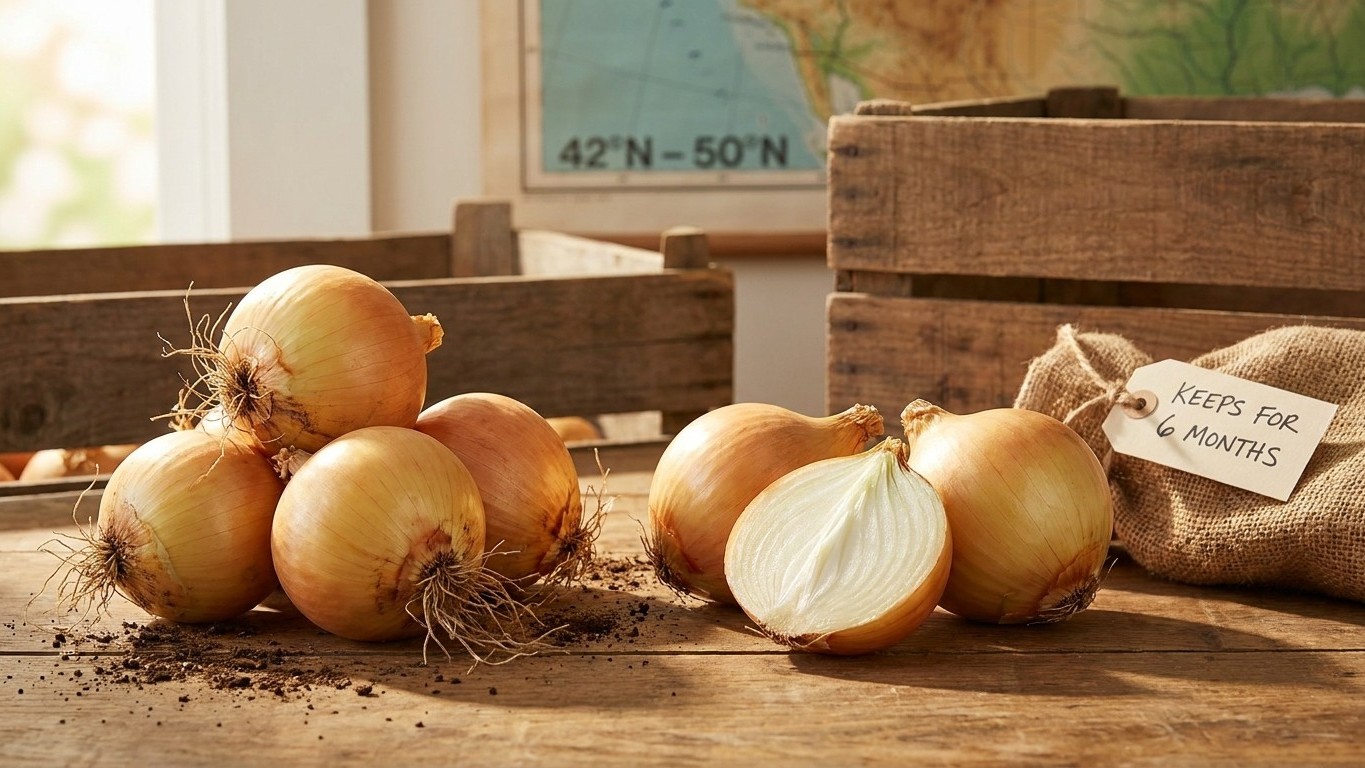

Talon is a long-day onion, which means it needs roughly 14 to 16 hours of summer daylight to form a bulb. That puts its working range between 42 and 50 degrees north latitude, a band that covers the northern half of the country. Get that wrong and you don’t get a small onion, you get no onion at all. Once it does bulb, Talon rewards the wait: a sharp, yellow storage onion that holds for 6 months or more, well into next spring’s cooking.
Will Talon bulb where you are

This is the question to settle before anything else, because nothing downstream matters if the answer is no. Talon belongs to the long-day group, and it bulbs correctly between 42 and 50 degrees N latitude. On a map, that’s roughly the line running from northern California and the mid-Atlantic states up through the northern tier: Oregon, Idaho, Wyoming, the Dakotas, Minnesota, Wisconsin, Michigan, upstate New York, and most of New England.
The mechanism runs against how most people think about growing things. Onions don’t bulb because the weather turns warm. They bulb when day length crosses a threshold, and long-day varieties like Talon need those long summer days, 14 to 16 hours of light, to flip the switch from leaf growth to bulb formation. That’s exactly why long-day onions are a northern crop and not a southern one: the farther north you go in summer, the more daylight hours you actually get, sometimes 15 or 16 hours at the peak, versus 12 to 13 in the Deep South. A grower in Georgia or Texas can plant Talon and watch it grow lush green tops all season, and it will never form a proper bulb, because the days there simply don’t run long enough.
If you garden south of that 42-degree line, look for a short-day or intermediate-day variety instead, not this one. If you’re north of 50, Talon should still perform, since long-day types tolerate the far north’s even longer summer days without trouble. The tighter question is what happens right at the edges, say a garden at 40 or 41 degrees N, or one nudging past 51. Those are blurred zones. The bulb may form smaller than the catalogue size, or bulbing may lag and run into fall frost before the neck has dried down. Nobody can promise a clean yes or no at the margin. If your location sits near either boundary, treat this as a trial-plot variety the first year rather than the one you bet the whole onion patch on.
What Talon is like
Assuming your latitude checks out, here’s what actually shows up in the row and later in the kitchen. Talon is a yellow storage onion, built for the pantry rather than the salad bowl, and it takes its time getting there: 104 days from transplant to maturity, which is on the longer end for onions and part of why it needs that full northern growing season to finish properly.
The grower’s facts
- Color: Yellow, the classic storage-onion skin
- Flavor: Sharp, with real bite when eaten raw
- Days to maturity: 104 days from transplant
- Keeping time: 6 months or more in proper storage
The flavor and the keeping ability aren’t two separate traits, they’re the same trait showing up twice. The sulfur compounds that give an onion its sting when you slice it are the same compounds that act as a natural preservative once the bulb is cured and stored. A mild, sweet onion has fewer of those compounds, which is exactly why it’s pleasant on a sandwich and exactly why it turns soft and spoils within weeks. Talon sits on the sharp end of that scale, which is the tradeoff you’re accepting: you don’t get a sweet onion that also lasts until spring. Nobody does. That combination doesn’t exist in onions, no matter what a seed rack promises. What you get instead is a pantry workhorse, one that’s better cooked than eaten raw, and one you can still be pulling from a mesh bag in March when the sweet varieties from last summer are long gone.
When to plant it
Planting timing follows directly from the day-length group, and this is where the calendar flips depending on where you garden, which trips up a lot of first-time onion growers. Short-day onions get planted in fall in mild-winter regions, overwinter as small plants, and get harvested the following late spring. Long-day onions, Talon included, work the opposite way: they go in the ground in late winter to early spring, as soon as soil can be worked, and they bulb and finish in mid to late summer.
Since Talon is a long-day variety, that late-winter to early-spring window is the one that applies here, whether you’re starting from seed indoors 8 to 10 weeks ahead or setting out transplants once the ground thaws. The goal is to get plants into the soil early enough that they build real size before the long days of June arrive and trigger bulbing.
That timing detail matters more than any date on a seed packet. The single test that decides how big your onions get isn’t when you planted, it’s how big the plant was on the day bulbing kicked in. Once day length crosses that threshold, the plant stops putting energy into leaves and starts putting it into the bulb, using whatever leaf mass it already has as the engine. A plant with four or five sturdy leaves at that moment builds a good-sized bulb. A plant with two thin leaves, because it went in late or struggled early, builds a small one, no matter how well you treat it for the rest of the season. Bulb size is decided early and then locked in. That’s the real reason to get Talon in the ground as soon as the soil allows, rather than treating “late winter to early spring” as a loose suggestion.
Growing it well
Onions have shallow, sparse root systems, which makes them poor competitors for water and nutrients compared to almost anything else in the garden. That’s not a minor detail, it’s the whole growing strategy in one sentence. A weedy row doesn’t just look messy, it directly steals the water and space that would have gone into bulb size, and the bulbs come out noticeably smaller for it. Keeping the bed clean, especially in the first six weeks after planting, does more for final bulb size than almost anything else you can do.
Consistent moisture matters for the same reason. Because the roots sit shallow and don’t range far, they can’t chase down water the way a deeper-rooted plant can, so dry stretches show up fast as stalled growth rather than a slow decline you might catch in time.
Watch for bolting, plants that send up a flower stalk instead of, or in addition to, building a bulb. A bolted onion redirects its energy into seed production, and the bulb that results is often woody at the core and will not store well no matter how carefully you cure it. Bolting tends to show up after a cold snap early in the season stresses young plants, or when the season runs unusually erratic. If you spot a flower stalk forming, don’t panic and don’t wait: pull that particular onion and use it fresh in the kitchen right away rather than setting it aside for the storage pile, since it’s already on a shorter clock than the rest of the row.
Harvesting and keeping it
Talon tells you when it’s ready, and the signal has nothing to do with a date circled on the calendar. The tops fall over on their own, flopping down at the neck under their own weight, and that’s the plant’s way of saying it’s done pulling nutrients up from the roots. Waiting for that signal, rather than pulling early because the season “should” be over, is the single biggest factor in how well the crop stores afterward.
Curing is the step most home gardeners skip entirely, and it’s usually why their stored onions rot within a month or two instead of lasting the season. Curing simply means letting the bulbs sit somewhere warm and dry with good airflow until the neck, the point where the leaves met the bulb, dries down and turns papery. A wet, green neck is an open door for rot organisms; a dry, papery one seals the bulb off.
The sequence, step by step
- Watch for the tops to fall over on their own in the row, that’s the harvest signal, not a date.
- Pull the bulbs on a dry day and leave them, tops attached, out of direct rain.
- Spread them in a single layer somewhere warm, dry, and well-ventilated, a shed or covered porch works fine.
- Cure for one to two weeks, until the necks are fully dry and papery to the touch.
- Trim the dried tops and roots, and move the bulbs into mesh bags or a slatted crate for storage.
- Store in a cool, dark, dry spot; check periodically and pull any bulb showing soft spots.
Get that sequence right, and Talon’s keeping time, 6 months or more, becomes something you actually experience rather than just a number on a page. An onion that lasts six months carries the household from harvest straight through winter and into spring cooking, which is a very different pantry situation than a sweeter variety that’s only good for three months and needs to be worked through by early winter. Plan your kitchen use accordingly: eat the softer, milder onions first if you’re growing more than one variety, and save the Talon bag for the long haul.