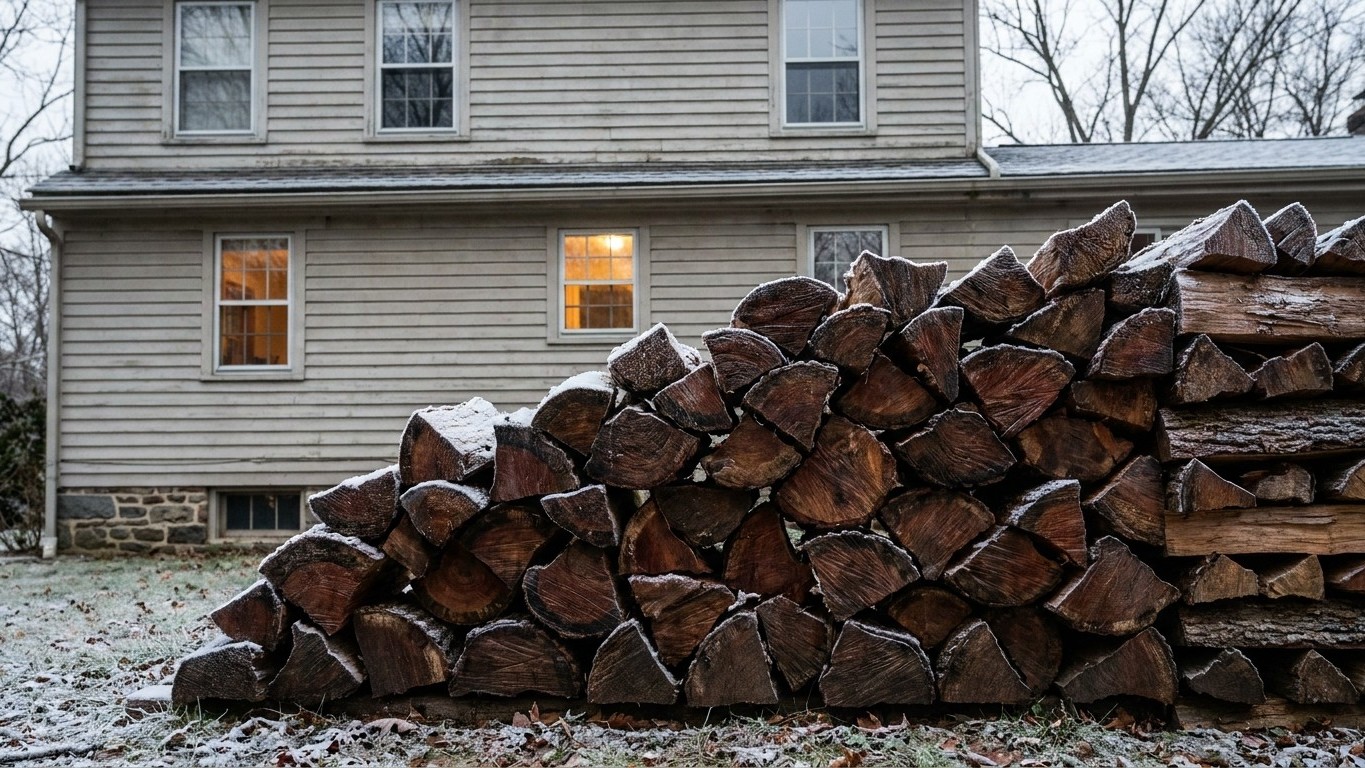

Newark’s coldest month bottoms out at an average low of 25.5°F, according to NOAA’s 1991-2020 Climate Normals. That single number tells you almost everything about heating with wood in New Jersey: how many cords you’ll burn, whether a dense hardwood is worth chasing down, and how much lead time your woodpile actually needs before the cold arrives.
How cold it actually gets here

That 25.5°F figure isn’t a record low or a scary once-in-a-decade freeze. It’s the average daily minimum for the coldest month, meaning on a typical night during that stretch, the temperature settles right around there, dips below it about half the time. That’s the number that decides whether a plant survives, whether pipes freeze, and whether your stove needs to carry the house through the night or just take the edge off.
For firewood, this matters more than most people assume. A winter that regularly sits in the mid-20s at night isn’t a mild one. It’s a winter where a wood stove or insert has real work to do, night after night, for months at a stretch. This isn’t a climate where a bundle from the gas station gets you through a cozy evening and calls it done. It’s a climate where the wood pile is infrastructure.
What heating through this winter actually demands
An overnight low around 25°F means most stoves need to hold a burn for six, eight, sometimes ten hours without much attention if you want to wake up to a warm house instead of a cold one. That’s a different problem than starting fires on chilly fall evenings. It asks for wood that holds coals, releases heat slowly, and doesn’t burn itself out by 2 a.m.
None of this means New Jersey winters rival the northern Midwest or New England’s colder pockets. But 25.5°F is comfortably below freezing, for weeks at a time. That rules out treating wood heat as pure atmosphere. If you’re burning through a New Jersey winter, you’re managing a real heat load, and the choices you make about wood density and seasoning show up directly in your comfort and your wallet.
Which woods are worth the effort here
Given a winter that sits in the mid-20s overnight, density is the variable that matters most. A cord is a fixed volume, a stack measuring 4 feet by 4 feet by 8 feet, or 128 cubic feet, whether you fill it with a light wood or a heavy one. The heavier the wood packed into that same volume, the more actual fuel you’re bringing home, and the more heat you get out of it once it’s dry.
Michigan State University Extension puts a number on what “well-seasoned hardwood” delivers: roughly 20 million BTU per cord. For comparison, that’s in the neighborhood of 145 gallons of #2 fuel oil, or 215 gallons of LP gas. That figure is an average across seasoned hardwood generally. It moves a lot depending on which species you’re burning and how dry it actually is, so treat it as a benchmark, not a guarantee for whatever load lands in your driveway.
Why moisture matters as much as species
Here’s the part that gets overlooked: a well-seasoned hardwood cord and a green hardwood cord of the identical species aren’t delivering the same heat, even though the wood itself hasn’t changed. Green wood can carry over 60 percent moisture. Before that wood gives you any usable heat, the fire has to boil off that water first, and that boiling eats the energy you were counting on. Seasoned wood, at 20 percent moisture or less, skips that tax and burns cleaner, with less smoke and less creosote buildup in your chimney as a result.
Red oak is worth naming specifically because it’s the documented exception on the seasoning side. Its cell structure makes it dry slower than most hardwoods, so it needs more time stacked and exposed to air before it hits that 20 percent target. That’s a real planning problem in a state where winter arrives on a calendar, not when your wood happens to be ready.
| Wood condition | Approx. BTU per cord | Smoke | Notes |
|---|---|---|---|
| Well-seasoned hardwood (20% moisture or less) | ~20 million | Low, clean burn | Benchmark figure from MSU Extension; varies by species |
| Green hardwood (over 60% moisture) | Substantially less usable heat | Heavy, wet, more creosote | Energy spent boiling water before heat is produced |
| Red oak specifically | Falls in the hardwood range once dry | Low once fully seasoned | Dries slower than most hardwoods due to cell structure; needs extra lead time |
The honest caveat: none of this matters if you can’t get a given species seasoned locally. A modest hardwood that’s actually dry and available near you beats a theoretically superior species you can only find green or at a premium. Ask any seller directly how long a load has been split and stacked, not just what tree it came from.
How much wood a winter takes
There’s no honest single answer here, and any site that hands you a flat “three cords a winter” number is guessing on your behalf. What you actually need depends on three things working together, and none of them are fixed.
- The cold itself. A winter that bottoms out at 25.5°F on average, like Newark’s, demands more fuel than a milder one, simply because the temperature gap your stove has to close is bigger, night after night.
- How well your house holds heat. Insulation, air sealing, window quality, even how many exterior walls a room has, all change how much of the heat you generate actually stays inside instead of leaking out.
- Whether wood is your main heat source or a supplement. A household running a wood stove as the primary heat for the whole home burns dramatically more than one using it a few evenings a week alongside a furnace or heat pump.
The mechanism that makes these numbers swing so widely is straightforward: a poorly insulated house in a hard winter can burn through double what a tight, well-sealed house uses in that same climate. Same outdoor temperature, same species of wood, twice the consumption. That gap is almost entirely about the building, not the fuel.
Run your own estimate down that list rather than borrowing someone else’s number. Start with how the coldest weeks typically feel in your house, note whether you’re chasing drafts or holding steady heat, and be honest about whether wood is carrying the whole load or just supplementing a furnace that’s already doing most of the work. That gives you a far more useful figure than any published average.
Drying wood in this climate
Seasoning matters more than species almost everywhere, and New Jersey’s climate, with its humid summers, doesn’t do you any favors on the timeline. Split, stacked hardwood typically needs a full summer of air moving through it to reach that 20 percent moisture target MSU Extension identifies as the burn-ready line. Humidity slows that process compared to a drier climate; it doesn’t stop it, but it stretches it out.
The target doesn’t change with geography: 20 percent moisture or less, whatever region you’re in. What changes is how long it takes to get there, and that’s driven by air circulation and time, not sunshine. Wood stacked in a single dense pile, tarped tight on all sides, dries slower than wood stacked loosely with gaps for air to move through and a cover only over the top.
The mistake that shows up every fall
Given Newark’s coldest month sits at a 25.5°F average low, the most common local mistake is cutting and splitting wood in spring and expecting it to be ready for that same winter. It usually isn’t. A single summer is often the minimum for standard hardwoods split and stacked properly, and red oak, specifically documented as slow-drying because of its cell structure, frequently needs longer than that.
Wood cut this spring is wood for next winter, not this one, unless you’re burning it green and accepting the smoke, the wasted energy boiling off moisture, and the creosote buildup that comes with it. Planning a full year ahead, buying or cutting one winter’s wood while you’re still burning last year’s supply, is the difference between a stove that performs the way the BTU numbers promise and one that never quite lives up to them.