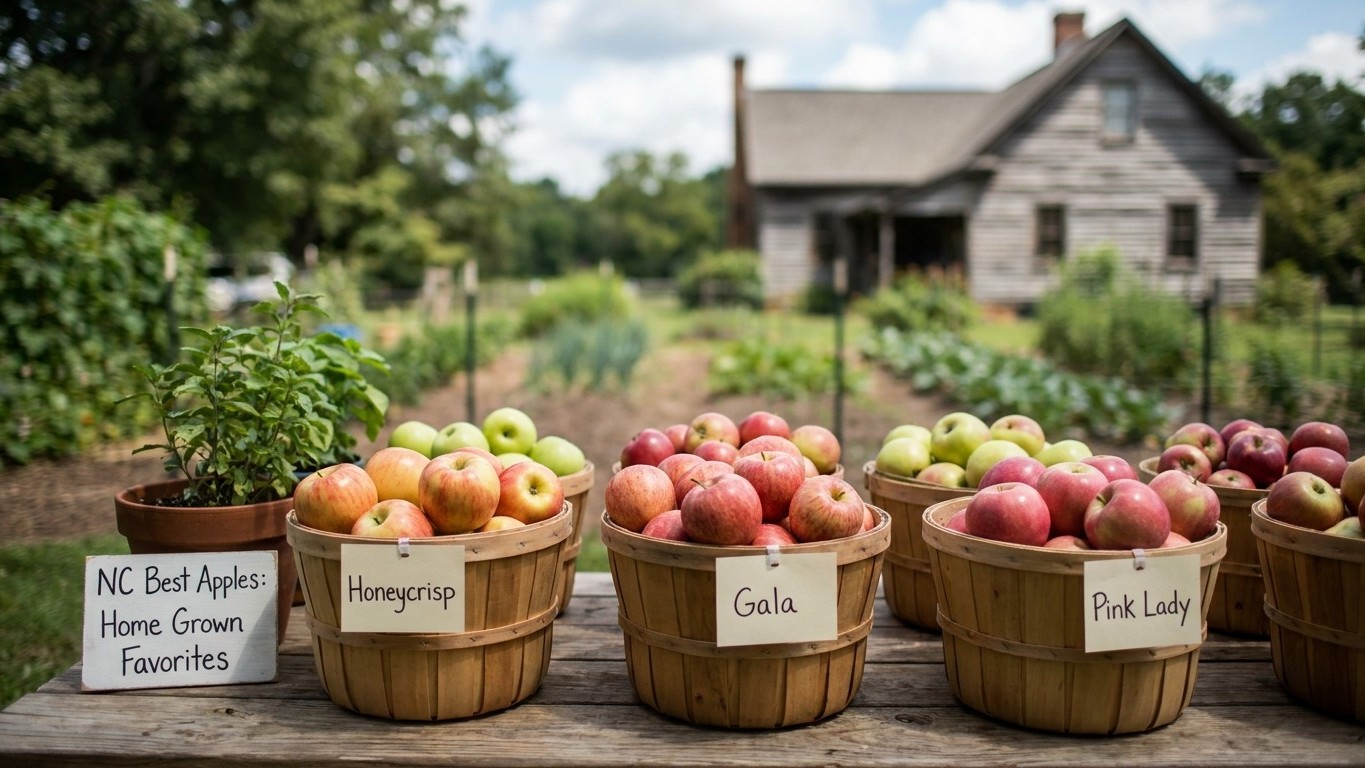

North Carolina doesn’t have one best apple — it has a best apple for your elevation, because a tree that breaks dormancy correctly in Boone can bloom too early to survive in Charlotte. What matters isn’t the variety’s reputation, it’s whether its chill hour requirement and bloom timing actually line up with your county’s last frost date. Before you order a tree, find your local frost dates and ask the nursery for the chill hour rating in writing — the tag’s hardiness zone won’t tell you what you need to know.
The short answer for North Carolina
No single apple cultivar works everywhere in this state, because North Carolina runs from sea level to more than 6,000 feet, and apples respond to two things a hardiness zone number doesn’t capture: how much winter chill a tree needs to break dormancy correctly, and how well its bloom timing lines up with your local frost calendar. If you haven’t already worked through site selection, Growing Apples in North Carolina covers what a young tree needs before variety choice even matters.
At the Charlotte reference station, NOAA’s 1991-2020 climate normals set the average minimum temperature of the coldest month at 29.6°F. That’s mild by apple standards, comfortably within the tolerance of nearly every cultivar sold in the US, so winter cold by itself is rarely what kills an apple tree in the North Carolina Piedmont. What decides success instead is chill hours, the tree’s genetic requirement for accumulated cold before it can flower evenly, matched against what your local winter actually delivers. A tree bred for a colder region than yours can sit dormant too long and bloom in a ragged, drawn-out stretch. A tree bred for a milder winter than yours can push bloom before your last frost has passed.
The other variable is the frost window itself. NOAA’s 1991-2020 normals put Charlotte’s last spring freeze between March 23 and April 5, and the first fall freeze between October 30 and November 8. Any apple you plant needs a bloom period that falls late enough to clear the spring window in most years, and a harvest window that finishes ahead of the fall one. The NC State Extension Service can tell you which named cultivars perform in your specific county and what chill rating each carries.
Settle two questions before you order anything: what is my county’s typical winter chill, and how far ahead of or behind Charlotte’s frost dates does my local last freeze run. Both shift with elevation, and both change the variety math completely.
Working through it

Apple trees move through the same sequence everywhere. Dormancy, green tip, pink, bloom, petal fall, fruit set, harvest. What shifts with elevation and with the year is which calendar date each stage lands on, not the order itself, and that order is what should guide your work in the orchard rather than a month printed in a planting guide.
Dormancy through bloom
Dormancy holds through the coldest stretch of winter. This is when chill hours accumulate, and it’s the stage to do structural pruning while wood is bare and easy to read. Because NOAA’s 1991-2020 normals put Charlotte’s average minimum for the coldest month at a mild 29.6°F, dormancy here rarely brings the kind of hard cold that damages wood. The risk shows up later, not now.
Green tip arrives as buds swell and color starts to show at the tip. A freeze at this stage is usually shrugged off. Pink follows, when the flower bud shows visible color, and by this point a freeze does real damage. Bloom is the most frost-sensitive stage of all: an open flower killed by frost does not set fruit, full stop. Since the Piedmont’s last spring freeze window (NOAA, 1991-2020) runs March 23 to April 5, a variety whose bloom tends to land early in that window carries more risk here than one whose bloom naturally lags a week or two behind it. That’s a bigger factor in variety choice than any hardiness number.
Petal fall through harvest
Petal fall marks the end of frost risk to the flower itself, and it’s the point to start watching for fruit set and to thin overcrowded clusters. Fruit set determines the crop load for the season. Harvest comes months later, and it needs to finish before the first fall freeze, which NOAA’s normals put at October 30 to November 8 for Charlotte. A cultivar that ripens very late in the season leaves less margin against that date, which matters more the further west and upslope you garden. For the fuller month-by-month version of this sequence, The North Carolina Apple Calendar, Stage by Stage lays out what typically lands in each window near you.
What changes across North Carolina
Charlotte’s figures describe the Piedmont, and the rest of the state runs on a different clock. NOAA’s 1991-2020 normals note that the Blue Ridge Mountains to the west run several weeks later in spring than the Piedmont window, which means both the last frost and the effective bloom date shift later at elevation. The coastal plain to the east runs the opposite way, with an earlier spring and a milder winter overall.
| Region | Spring frost timing vs. Charlotte | Winter chill exposure | What it means for variety choice |
|---|---|---|---|
| Blue Ridge Mountains (higher elevation, west) | Several weeks later (NOAA) | Higher and more reliable | Higher-chill, later-blooming trees fit; low-chill cultivars can bloom before the ground is ready anyway |
| Piedmont (Charlotte reference) | March 23 to April 5 (NOAA, 1991-2020) | Moderate | Match bloom timing directly against this window |
| Coastal Plain (east) | Several weeks earlier (NOAA) | Lower and less reliable in mild winters | Lower-chill cultivars needed; watch for erratic bloom in a mild year |
None of these three descriptions is a single figure you can plant against. Within each region, a valley that pools cold air overnight, or a slope that drains it away, can shift bloom by days compared to a neighbor a few miles off. The only local numbers documented here are Charlotte’s, and they describe the Piedmont reference station, not your specific hollow or ridge. Treat them as the starting point for a conversation with your county extension office, not the final word.
The mistakes this climate punishes
Most losses in North Carolina orchards trace back to a mismatch between a tree’s genetics and the actual winter and frost pattern it’s planted into, not to a single bad freeze.
- Planting a high-chill tree on the coastal plain. A mild winter there may never deliver enough cold hours, and the tree responds with delayed, patchy bloom that pollinates poorly.
- Planting an early-blooming variety at elevation. The Blue Ridge Mountains run their last frost several weeks behind the Piedmont, so a tree that blooms on a Piedmont-friendly schedule can still get caught by a late-season freeze up there.
- Feeding late in the season. Nitrogen applied after mid-summer pushes soft new growth that hasn’t hardened off by the time the first fall freeze arrives, which NOAA’s normals put at October 30 to November 8 near Charlotte.
- Ignoring pollination overlap. Two varieties chosen for the same site but bred for different chill totals can end up blooming weeks apart in a real winter, leaving neither one properly pollinated.
- Trusting the hardiness zone alone. A tree can be perfectly cold-hardy for your winter and still fail to fruit well if its chill requirement doesn’t match what that winter delivers.
Each of these shows up at a specific stage, not a specific month. A chill mismatch shows at green tip, when bud break is uneven instead of synchronized. A frost mismatch shows at bloom, when flowers brown and drop instead of setting fruit. Watching the tree’s own stage against the frost window catches both earlier than watching the calendar does.
Checking this against your county
Charlotte’s figures are a Piedmont reference point, and every other part of the state runs on its own frost and chill pattern. Before you commit to a cultivar, contact the NC State Extension Service office for your county. It can tell you the locally observed frost dates for your area, the chill accumulation typical of a normal winter there, and which named cultivars its horticulture agents have actually seen perform well nearby. That’s the figure worth planting against, not a statewide average.
Common questions
What apple variety grows best in North Carolina?
There isn’t one answer for the whole state, because chill needs and frost timing differ enormously between the mountains, Piedmont, and coastal plain. Your county extension office can match a named cultivar to your specific elevation and winter.
How do I know if my winter has enough chill hours?
Ask your county extension office for the typical chill accumulation in your area. They track it locally, and it’s a different number than the Piedmont figure, which itself only describes the Charlotte reference station.
Can I grow apples on the North Carolina coast?
Growers do, but a mild coastal winter delivers less chill than the mountains or Piedmont, so success there depends on choosing a lower-chill cultivar and accepting that bloom can still be uneven in an unusually warm winter. Check with your local extension office for what’s actually been grown successfully in your county.
Why did my apple tree bloom and then lose all its flowers to frost?
Bloom is the most frost-sensitive stage in the whole cycle, and if your variety’s bloom timing sits early within your area’s frost window, a late freeze can take the entire flower set in one night. That’s a variety-and-elevation mismatch, not a fluke, and it’s worth reconsidering the cultivar rather than just hoping for a warmer year.