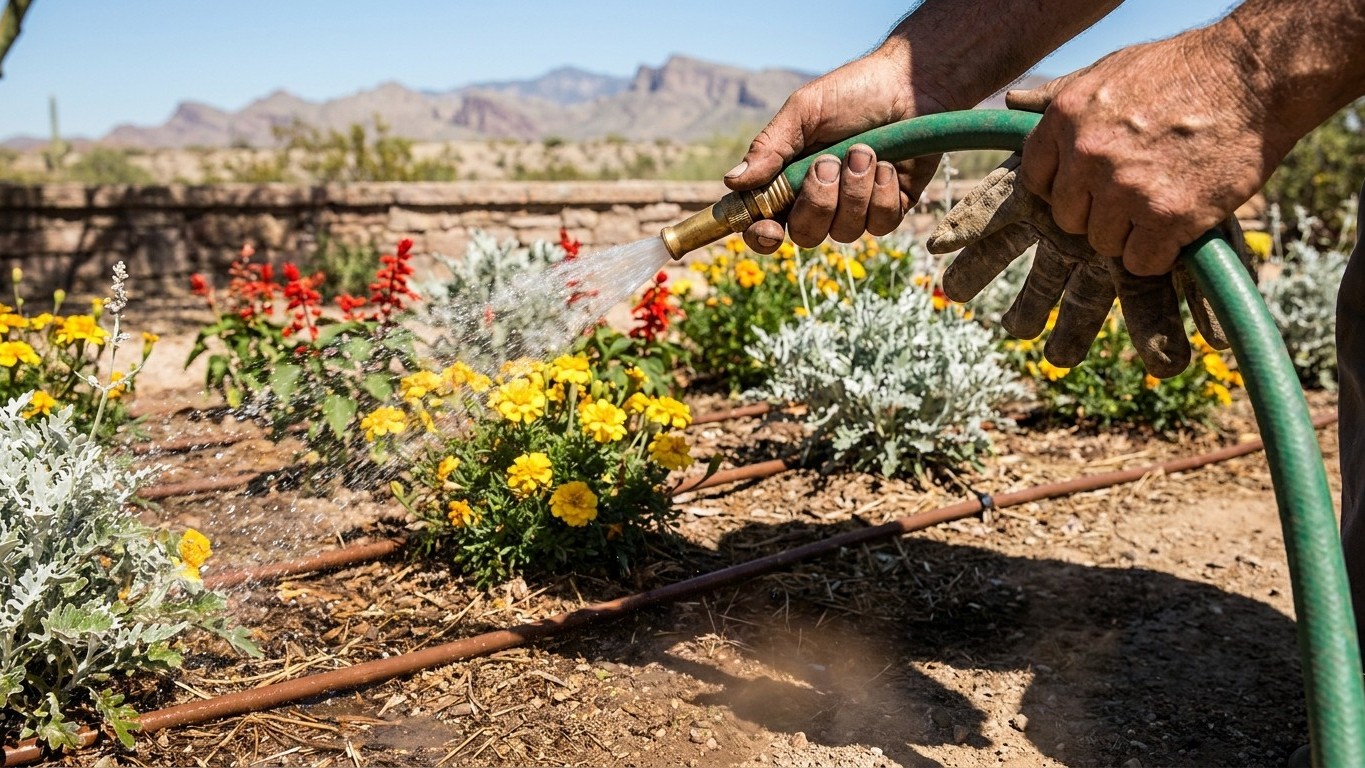

Arizona’s watering rules aren’t one-size-fits-all: a garden bed in Phoenix behaves nothing like one in Flagstaff, and the USDA Plant Hardiness Zone Map puts the state anywhere from zone 4b to zone 10b depending on elevation. What follows applies mainly to the low desert, where most of the state’s population gardens, with notes on how the high country differs. For rules specific to your water provider, Arizona’s Cooperative Extension is the better starting point than a statewide guess.
What the climate asks of you

The 168.9-day heat count
Here’s the number that decides almost everything else: at the Phoenix reference station, an average of 168.9 days a year reach 90F or higher, according to NOAA’s 1991-2020 Climate Normals. That’s not a summer figure. That’s nearly half the calendar. A cool-season lawn or a leafy vegetable that sulks past 90F doesn’t get a break here, it gets months of stress in a row.
Layer the monsoon pattern on top of that heat and the picture gets more specific. June runs close to rainless across the low desert, the driest stretch of the growing season by a wide margin. July and August bring the monsoon, but in short, violent bursts rather than the steady soakings a garden actually wants. A bed that needs roughly an inch of water a week gets almost none of it from the sky in June, which means Watering Through a Dry Spell in Arizona becomes the gardener’s job, carrying that entire inch by hose or drip line, week after week, until the storms arrive and even then only in bursts that a heavy rain event can undo in twenty minutes and leave dry again for a week.
Sand, caliche, and where the water goes
Much of the low desert’s native ground is sandy and fast-draining, often sitting over a hardpan layer called caliche that can stop roots and standing water alike. That combination means the same inch of water that would sit in a clay-heavy garden back east sinks through in hours here. A sandy bed in a territory already short on summer rain isn’t a “water twice a week” garden. It’s often closer to every other day, sometimes daily for shallow-rooted plants, once real heat sets in, and gardeners who’ve moved plants into pots to manage that fast drainage face their own set of rules, covered in Watering Pots and Containers in Arizona.
How much, how often
Deep and infrequent beats frequent and shallow, and the reason is simple biology: a daily five-minute sprinkle only wets the top inch of soil, so roots stay shallow and near the surface, exactly where 90-plus-degree afternoons bake them hardest. A soaking that reaches six to eight inches down pulls roots deeper, into ground that stays cooler and holds moisture longer.
Reading sandy ground vs. clay
Don’t water on a calendar. Check the ground. Push a finger, or better, a garden trowel, about two inches down near the root zone. If it’s dry at that depth, water. If it’s still damp, wait. On sandy low-desert soil that check might come back dry every other day in peak summer, simply because sand holds so little. On the rarer clay pockets found in parts of the state, the same inch of water can sit for a week, and watering again before it has drained doesn’t help the plant, it drowns the roots and can compact the soil further. Clay should never be worked or soaked again while it’s still wet.
Morning is the only time that makes sense for most of the state. Water applied at dawn soaks in before the heat of the day pulls it back out through evaporation, and it gives leaves time to dry before nightfall, which matters for keeping fungal disease down. Evening watering in a place this hot leaves foliage wet overnight, an invitation for the diseases the desert otherwise keeps in check.
Put together, the routine looks like this:
- Check soil moisture two inches down at the base of the plant before touching the hose or timer.
- Water only when that spot is dry, aiming for roughly one inch of water delivered per week, more in extended stretches without monsoon rain.
- Apply water slowly, at the base of the plant, never overhead onto leaves.
- Water in the early morning, before the day’s heat sets in.
- On sandy ground, split that weekly total into shorter, more frequent soakings; on clay, apply it in fewer, deeper sessions and let it fully drain between waterings.
Because the driest month of the summer season delivers next to nothing from the sky, a low-desert garden isn’t really “watered with occasional help.” It’s on irrigation, with rain as the occasional bonus rather than the plan.
Restrictions and rules
Where to check before you set a timer
Watering restrictions in Arizona are set at the level of the individual water provider or municipality, not by a single statewide schedule, and they change from year to year depending on supply conditions. Some cities limit outdoor watering to certain days of the week during drought declarations; others cap watering times or restrict it to early morning and evening hours. None of that is fixed enough to print as a permanent rule here, and a figure that’s accurate this summer can be outdated by next.
The one thing that’s safe to say: in a state where the driest summer month leaves the sky delivering almost nothing, restrictions are a real and recurring part of gardening here, not a rare inconvenience. Before setting an automatic timer for the season, check directly with your city or water utility, and cross-check with Arizona Cooperative Extension for current conservation guidance tailored to your county.
Using less
What a rain barrel can and can’t do here
A rain barrel sounds like an easy win almost anywhere, and the basic math holds in Arizona too: an inch of rain falling on a thousand square feet of roof works out to roughly 600 gallons of runoff. The catch is timing. In a territory where June runs nearly rainless, a barrel sitting under a low-desert roof can go weeks with nothing to collect, then fill fast during a single monsoon downpour in July or August. That stored water can carry a small bed through several dry days right after a storm, but it isn’t a substitute for irrigation during the driest pre-monsoon stretch, when there’s simply no rain falling to catch. Rules on collecting and storing rainwater vary by city, so check local ordinances before installing one.
Beyond the barrel, a handful of changes do more for less effort than anything else in the yard:
- Mulch: a two-to-three-inch layer of bark or gravel mulch slows evaporation from soil that would otherwise dry out within hours under 90-plus-degree sun.
- Drip irrigation: delivering water directly to the root zone instead of spraying it into the air cuts the amount lost to evaporation and wind drift, a real loss in a low-humidity climate.
- Grouping plants by water need: putting thirsty vegetables on one zone and drought-tolerant natives on another means the desert plants aren’t getting watered on the vegetable garden’s schedule, and vice versa.
- Organic matter worked into sandy soil: compost mixed into fast-draining native ground helps it hold moisture longer between waterings, closing some of the gap sandy soil otherwise creates.
- Rain barrels where legal: free water during the monsoon window, even if it can’t cover the dry months on its own.
Common questions
Do I need to water every day in Arizona summers?
On sandy, fast-draining low-desert soil, shallow-rooted plants and container gardens sometimes do need daily attention once temperatures push past 90F for weeks at a stretch, which happens on average 168.9 days a year at the Phoenix reference station. Deeper-rooted, well-mulched beds usually don’t need daily watering even in that heat; check soil moisture at root depth rather than watering on autopilot.
Is Flagstaff on the same watering schedule as Phoenix?
No. Arizona spans USDA zones 4b through 10b, and the high country around Flagstaff sits at the cold end of that range with real winter freezes, unlike the frost-free low desert. Watering needs, timing, and even plant choices differ enough that a Phoenix-based schedule doesn’t transfer.
Does Arizona freeze in spring, and does that affect planting?
In the low desert, rarely. NOAA records show the Phoenix-area station dropped to 32F in only 6 of 30 recent springs, and the frost-free season there runs essentially year-round. The planting calendar in this part of the state is limited by summer heat stopping fruit set for months, not by frost. The high country is a different climate entirely and does freeze hard.
Where do I find current watering restrictions for my address?
Restrictions are set locally, by city or water utility, and they shift with drought conditions from year to year. Contact your water provider directly, and check Arizona Cooperative Extension for conservation guidance specific to your county.