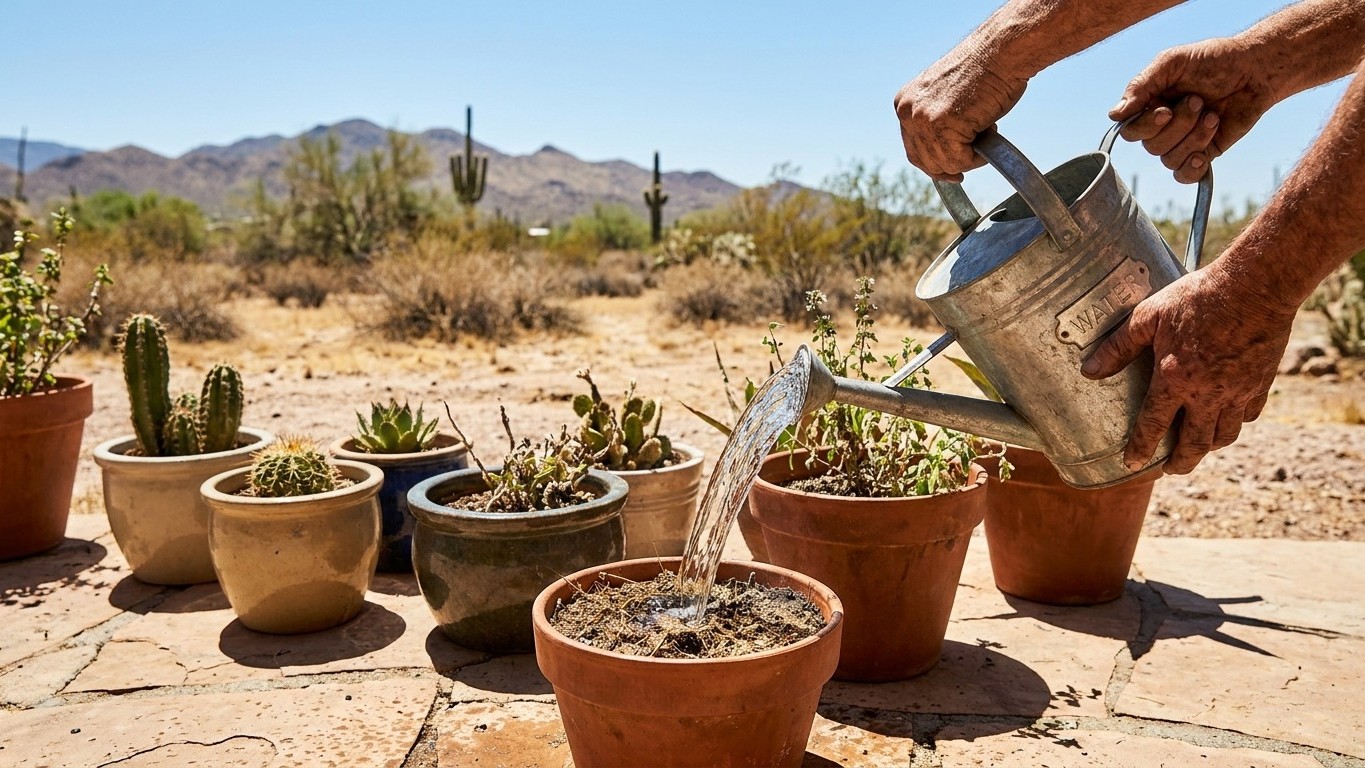

Arizona gardens face a stretch where the sky delivers almost nothing and the thermometer barely lets up: June brings just 0.02 inches of rain while the region logs 168.9 days a year at or above 90F. That combination decides almost everything about how, when and how much a gardener needs to water here.
What changes here

Two numbers set the terms for anyone watering in Arizona: 0.02 inches of rain in June, the driest summer month, and 168.9 days a year that reach 90F or higher. Together they mean the sky contributes almost nothing to a garden’s water budget right when the heat is asking the most of it, so nearly every drop a plant gets in early summer has to come from a hose, a can or a drip line.
Run the arithmetic and the gap gets concrete. A typical bed wants roughly an inch of water a week to keep roots supplied. June’s 0.02 inches spread across roughly 4.3 weeks in the month works out to about 0.0047 inches of rain per week, close enough to nothing that it doesn’t change a watering schedule at all. That leaves the gardener to supply essentially the full inch, about 0.995 inches every week, entirely by hand or by system. July and August ease that slightly, with 0.91 and 0.93 inches for the whole month respectively, but even those wetter summer months average only around 0.21 inches of rain a week, still a fraction of what a bed needs.
Soil texture decides what happens to that inch once it lands. On sandy ground, water drains through within a day, so the inch a gardener applies has to be split into smaller, more frequent doses or it simply passes below the root zone before roots can use it. On heavy clay, that same inch can sit in the soil for a week, which sounds convenient until a second watering arrives too soon and drowns roots that never had a chance to dry out. Knowing which kind of ground is under a given bed matters as much as knowing the rainfall total.
How to water when it matters
Deep, infrequent watering at the base of the plant, done in the morning, is the method that fits Arizona’s numbers. Deep watering pushes moisture down to where roots actually live, training them to grow downward instead of staying shallow and vulnerable. Infrequent watering lets the top inch of soil dry between sessions, which is what root systems need to breathe and what keeps fungal problems from taking hold. Watering at the base instead of overhead means the water goes where roots can use it rather than evaporating off leaves in the middle of a 90-plus-degree afternoon. Morning watering gives roots hours to draw up moisture before the day’s heat peaks, instead of losing it to evaporation the way a midday watering would.
The only reliable way to know when to water again is to check the soil, not the calendar and not the sky. Push a finger two inches down, or use a trowel for a quick core sample, and if that depth is dry, it’s time to water; if it’s still damp, wait.
- Start with about an inch of water a week as a baseline, applied in one or two deep sessions rather than daily sprinkles.
- Check soil moisture two inches down with a finger or trowel before every watering, and skip a session if it’s still damp.
- On sandy soil, split that inch into shorter, more frequent soakings, since the ground drains fast and roots can’t draw on water that has already passed through.
- On clay soil, water less often but let each session soak in fully, since clay can hold a week’s worth of moisture and a second watering too soon will drown roots.
- Water at the base of the plant, early in the morning, so moisture reaches roots before the day’s heat and evaporation take over.
Treat the one-inch figure as a starting point to test against a particular bed’s own drainage and plant mix, not as a fixed rule to follow blindly all season.
What goes wrong
Watering a little every day
A quick daily sprinkle feels responsible, but it only wets the top inch or two of soil. Roots follow the water, so they stay shallow and close to the surface, exactly where 168.9 days of 90-plus heat each year will bake them. This is the costliest habit in a territory this hot and this dry, because it trains a garden to need constant attention while never building the deep root system that would let it handle a missed day.
Watering the leaves in the evening
Wetting foliage at night leaves it damp for hours with no sun or breeze to dry it out. That damp window is exactly when fungal spores germinate, turning an evening watering into an invitation for disease rather than a kindness to the plant.
Trusting a summer thunderstorm
A dramatic downpour can look like it solved the watering problem for the week, but many Arizona summer storms drop their rain fast and hard, and most of it runs off a dry, sun-baked surface instead of soaking in. The only way to know is to check with a finger two inches down after the storm passes, not to assume the sky did the work.
Skipping mulch
Bare soil left exposed to 90-degree afternoons loses moisture to evaporation almost as fast as it’s applied. A layer of mulch around the base of a plant slows that loss, which matters more here than almost anywhere else given how many days a year push past that heat threshold.
Local help
The University of Arizona Cooperative Extension offers guidance suited to local soil and climate conditions across the state. Watering restrictions vary by city, county and water provider, and they change over time, so check current rules with the local water utility or district before setting a fixed schedule.
Common questions
How much should I water container plants in Arizona summer heat?
Containers dry out faster than garden beds because they have less soil mass and more exposed surface. Check the soil an inch down with a finger daily during the hottest stretch, and water whenever it’s dry at that depth rather than on a fixed schedule.
Does Arizona get enough summer rain to skip watering?
No. June averages just 0.02 inches of rain for the entire month, and even the wetter summer months of July and August stay under an inch each, so a garden depends almost entirely on hand or system watering through summer.
What time of day is worst for watering in Arizona?
Midday and evening are both poor choices: midday watering loses much of its water to evaporation before roots can use it, while evening watering leaves foliage damp overnight and encourages fungal disease.
Do sandy and clay soils need different watering schedules in Arizona?
Yes. Sandy soil drains within a day and needs shorter, more frequent watering, while clay soil can hold moisture for about a week and needs longer gaps between sessions to avoid drowning roots.