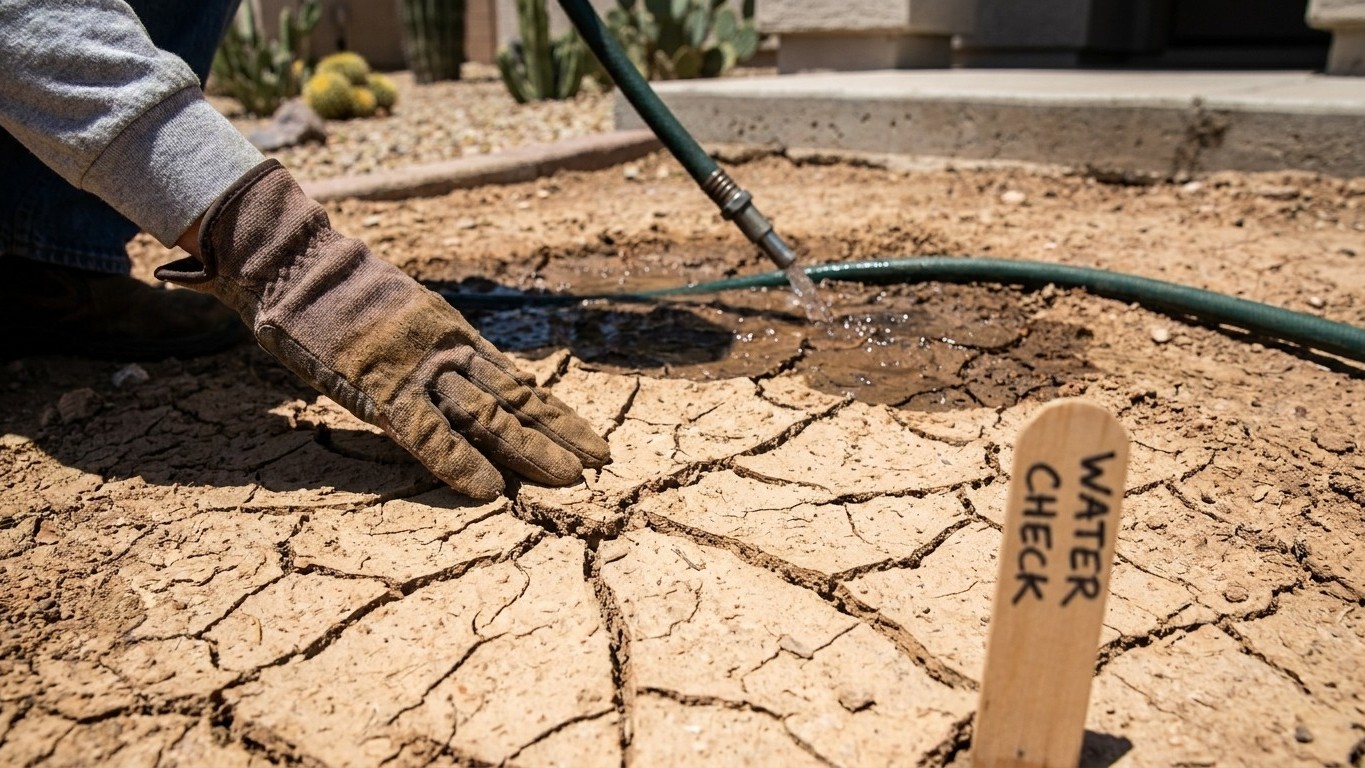

Arizona’s growing season runs on two brutal numbers: almost no rain in early summer, and months of heat that pull moisture out of the ground almost as fast as it goes in. The answer isn’t watering more often out of habit. It’s watering deeply, on a schedule tied to what the soil actually holds, and checking it with your hands instead of trusting the sky or the calendar.
What changes here

Start with two numbers. June, the driest summer month at the reference station, gets about 0.02 inches of rain. And the same station averages 168.9 days a year at or above 90 degrees, nearly half the days on the calendar. Put together, that means the hottest stretch of the growing season arrives with almost no rainfall to offset it, so every drop a garden bed gets in June has to come from a hose, not a cloud.
The arithmetic makes the gap concrete. A typical garden bed wants roughly an inch of water a week. Spread June’s 0.02 inches across that month’s four-plus weeks, and the sky is contributing a number so small it rounds to nothing, a few thousandths of an inch a week. That leaves the gardener responsible for essentially the whole inch, every single week, for as long as that pattern holds. July and August ease up some, with 0.91 and 0.93 inches falling over those months, but that rain tends to arrive as short, hard monsoon bursts rather than a steady soak, which changes how much of it actually reaches root depth versus how much runs off a hardened, sun-baked surface.
Soil decides where that water goes
Arizona ground varies a lot from one yard to the next, from fast-draining decomposed granite and sandy fill to dense clay pockets that hold water far longer. That same inch behaves differently depending on which one you’re standing on. On sandy, fast-draining ground, water moves through quickly and needs to be replaced sooner. On heavier, clay-leaning ground, that inch can sit near the roots for the better part of a week, which changes not how much you water but how often. Neither the amount above nor a soil test replaces the other. They work together.
How to water when it matters
The method that works in Arizona isn’t the one that works in a wetter climate with milder afternoons. Here, the goal is to get water down past the first few inches of soil, where the sun and heat can’t pull it right back out, and to do it before the day’s heat load kicks in.
Why deep, at the base, and in the morning
Deep watering pushes roots downward, chasing the moisture, which makes the whole plant more resilient during a 100-degree afternoon. Watering at the base rather than overhead means the water actually reaches soil instead of evaporating off leaves before it gets there, a real loss on a day pushing toward one of those 168.9 hours above 90. Morning watering gives the plant time to take up moisture before peak heat, and it gives any water that lands on foliage a chance to dry, instead of sitting damp overnight.
Knowing when to water again matters more than any fixed schedule. Push a finger, or a trowel, about two inches into the soil near the root zone. If it’s dry at that depth, it’s time. If it’s still cool and damp, wait. Surface soil dries out and looks parched in Arizona heat within hours, which fools a lot of gardeners into watering when the roots below are still fine.
Use this sequence as a starting point, then adjust it against your own soil and how quickly that two-inch check comes up dry:
- Start with about 1 inch of total water per week, split into two deep soakings rather than one.
- Water in the early morning, before the heat of the day sets in.
- Apply water at the base of the plant, with a soaker hose, drip line, or a slow-running hose rather than a sprinkler.
- Check soil moisture two inches down before every watering; skip a session if it’s still damp.
- On sandy, fast-draining ground, shorten the interval between soakings; on heavier clay ground, lengthen it and watch for water pooling rather than absorbing.
What goes wrong
Most watering failures in Arizona aren’t about neglect. They’re about habits that make sense somewhere else but backfire under this much heat.
A little water every day
This is the costliest mistake here, because it trains roots to stay near the surface, where the day’s heat reaches them directly and evaporation claims a chunk of the water before it ever reaches the root zone. A daily sprinkle feels responsible. It’s actually starving the plant of the deep moisture it needs to survive an afternoon in the 100s.
Watering the leaves in the evening
Wet foliage that sits through a warm, humid overnight period is an invitation to fungal disease. It doesn’t get the sun exposure that would dry it quickly, the way morning watering does.
Trusting a monsoon downpour
A hard summer thunderstorm can look like it solved the problem, but a lot of that water runs off baked, hardened soil rather than soaking in. Check with a finger two inches down before skipping a scheduled watering. Don’t assume the sky did the work.
Skipping mulch
Bare soil in this much heat gives back moisture almost as fast as it’s applied. A few inches of mulch around the base of a plant slows that loss and buys the roots time between waterings, which matters most in a place logging close to 169 days a year above 90 degrees.
Local help
The University of Arizona Cooperative Extension offers region-specific guidance for gardeners across the state, including help identifying local soil conditions. Watering restrictions vary by city and water district and change over time, so check current rules with your own water provider rather than assuming a statewide standard applies.
Common questions
How often should I water in an Arizona summer?
There’s no fixed number that fits every yard, but a starting point is two deep soakings a week, adjusted by checking soil moisture two inches down before each one.
Does mulch really make a measurable difference here?
Yes. Bare soil in high heat loses moisture to evaporation quickly, and mulch slows that loss, which stretches the time between waterings.
Can I rely on monsoon rain in July and August?
It helps, but a lot of a hard downpour runs off rather than soaking in. Check the soil at root depth rather than assuming a storm did the job.
Is morning or evening watering better?
Morning. It gives water time to reach the roots before peak heat and lets any wet foliage dry out, instead of sitting damp overnight where disease can take hold.