
Coastal British Columbia gets a long, wet, mild winter rather than a hard one, and that changes the bulb math. Some spring bulbs sail through it every year. Others come up leafy and blank unless a gardener steps in with a refrigerator, which is where Forcing Spring Bulbs Indoors in British Columbia becomes a reliable workaround. Here’s what actually flowers, what doesn’t, and what the calendar and the cold both demand.
When to plant bulbs in British Columbia

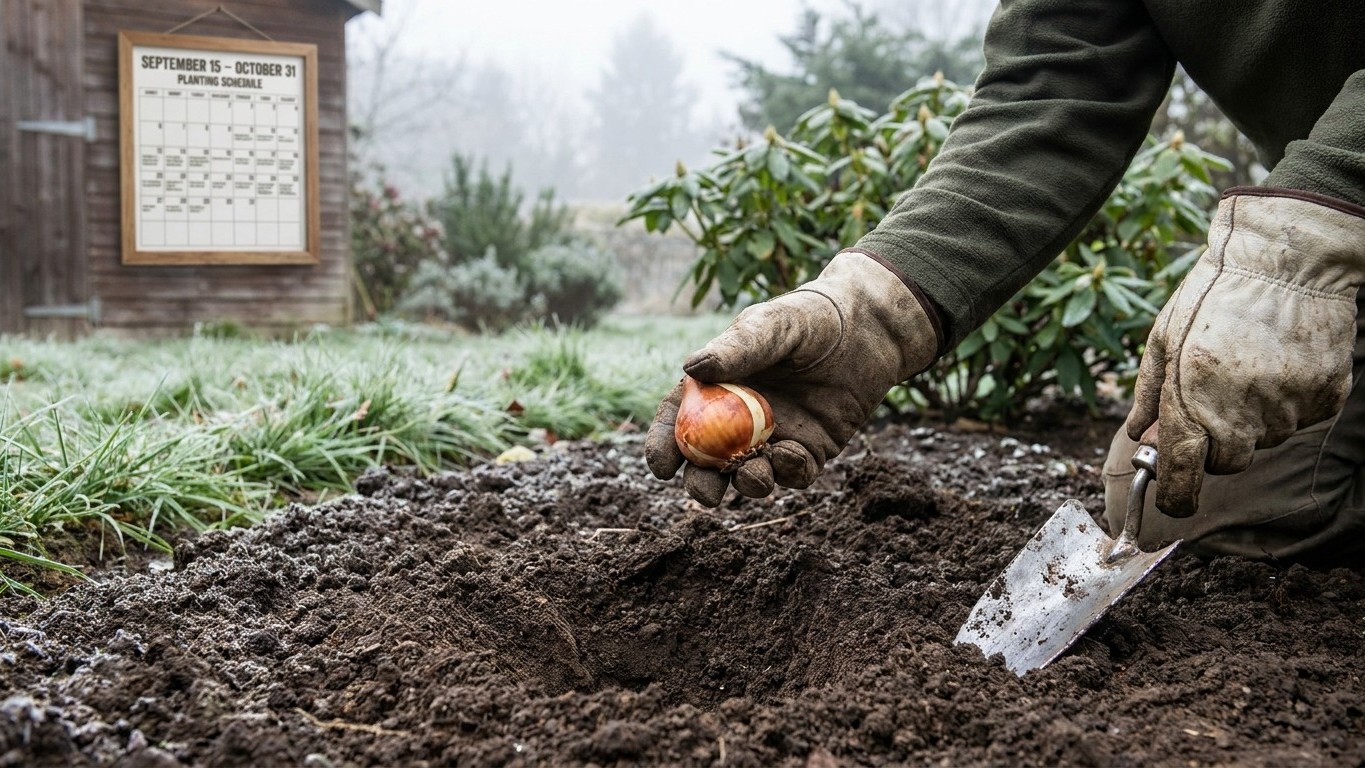
Plant spring bulbs once the soil has cooled from summer heat but well before it locks up hard for winter. On the coast, that window sits roughly from mid-September through late October, timed to land about six weeks ahead of the average first fall frost on November 10, recorded at Vancouver International Airport. Six weeks is the rule of thumb nurseries and extension offices use across cold-winter climates, because it gives a bulb enough time to grow roots into settled soil without pushing top growth that a freeze can shred.
Plant too early, while the ground is still warm from September sun, and a bulb can send up a shoot before winter arrives. That shoot gets killed back by the first freeze, and the bulb wastes stored energy it needed for spring. Plant too late, after the soil has gone cold and heavy with November rain, and roots barely start before the ground stiffens. A bulb that goes in without rooting comes up weak the following spring, or sometimes not at all, because it spent the winter sitting in cold, wet soil doing nothing.
Why the frost date is a guess, not a guarantee
November 10 is an average, drawn from decades of Environment and Climate Change Canada records at the Vancouver airport station. An average means half of all years the first frost actually lands after that date, and half the years it lands before. Treat it as the midpoint of a planting window, not a safe deadline. A gardener working from a single calendar date, rather than a range of weeks, ends up either rushing bulbs into warm ground or missing the window entirely when an early cold snap hits in a below-average year.
It’s also worth remembering that this date comes from one station near sea level at the airport. Anyone gardening in the Fraser Valley uplands, the Sunshine Coast’s higher elevations, or further inland toward the Interior should expect the frost, and the planting window that leads up to it, to arrive earlier than the coastal reading suggests.
Whether your winter is cold enough
A spring bulb doesn’t just need to survive winter. It needs a specific dose of cold to flower at all. Most classic spring bulbs, tulips, daffodils, hyacinths, require somewhere around twelve to fourteen weeks with soil temperatures below about 45°F. That stretch of chill triggers the chemical changes inside the bulb that build a flower stem. Skip it, or cut it short, and the bulb still grows leaves, it just doesn’t build a flower, or it pushes a bud so short it never clears the foliage.
British Columbia’s coastal climate makes this a real question rather than a formality. The reference station used for this territory, Vancouver, sits in Canadian hardiness zone 9a, one of the mildest ratings in the country. Note that this is the Canadian zone system, built from seven climate variables, and it does not convert to a USDA zone; Natural Resources Canada is explicit that the two scales don’t map onto each other cleanly. The coldest month’s average daily minimum here runs at 33.5°F, comfortably below the 45°F threshold on the days that matter. But that figure only confirms the coldest snaps get cold enough. It says nothing about how many consecutive weeks the ground actually stays there, and on the wet, ocean-moderated coast, a long unbroken stretch of sub-45°F soil is not something every winter delivers.
That’s the crossing that decides whether a bulb blooms here or just leafs out. Bulbs with a lower chill requirement clear it most years without help. Bulbs that need the full twelve to fourteen weeks are running on the edge, and in a mild winter, they can come up short.
| Bulb | Weeks of cold required | What coastal BC typically delivers | Verdict |
|---|---|---|---|
| Tulip | 12–14 weeks below 45°F | Short, interrupted cold; a mild winter can fall well under this | Marginal, pre-chill for reliable bloom |
| Hyacinth | 12–14 weeks below 45°F | Same short, interrupted cold as tulips | Marginal, pre-chill recommended |
| Daffodil (Narcissus) | 12–14 weeks, tolerant of milder soil | Generally delivered, especially inland from the coast | Adequate, no chilling needed |
| Crocus | 8–15 weeks depending on species | Delivered most years | Adequate |
| Allium | 8–10 weeks | Delivered reliably | Adequate |
For tulips and hyacinths on the marginal side of that table, pre-chilling is the fix, and it has to be done properly. Bulbs go in a paper bag in the refrigerator, not the freezer, for a full twelve weeks before planting, kept well away from apples, pears, or any ripening fruit. Ripening fruit gives off ethylene gas, and ethylene kills the flower bud developing inside the bulb before it ever reaches soil. A gardener who skips this step and plants tulips straight into a mild coastal winter, hoping for the best, has effectively spent money on foliage. The bulb rarely dies outright. It just never flowers, or flowers once weakly and gives up in year two.
Which bulbs suit British Columbia
Given the cold math above, the bulbs that thrive here without any intervention are the ones with a shorter or more forgiving chill requirement, paired with tolerance for a wet winter rather than a frozen one. The following do well across coastal and Lower Mainland British Columbia gardens, planted at the standard fall window:
- Daffodil (Narcissus): USDA hardiness zones 3–9, reliable bloomer, naturalizes well, unbothered by mild winters
- Crocus: USDA hardiness zones 3–8, early, dependable, tolerates the shorter chill period fine
- Allium: USDA hardiness zones 3–8, low chill need, thrives in the same drainage conditions BC gardens already require
- Snowdrop (Galanthus): USDA hardiness zones 3–7, one of the earliest to bloom, well suited to a mild, wet winter
Tulips and hyacinths, both rated for a similarly broad hardiness range, are the ones that disappoint here without pre-chilling. The failure has a specific shape: strong leaves the first spring, a flower that’s short-stemmed or absent, and by the second or third year, nothing at all as the unchilled bulb slowly exhausts itself trying to bloom on borrowed reserves. A bulb’s hardiness range is never a hard line either way. One planted against a south-facing wall, in a sheltered raised bed, often outperforms the same bulb in an open, wind-exposed border, even where both sit in the same zone on paper.
What digs them up here
Squirrels and voles are selective, and the selection comes down to chemistry, not chance. Daffodils, along with any bulb in the onion family, contain compounds that make them bitter or mildly toxic to rodents, so they get left alone in the ground. Tulips and crocus have no such defense. Both are essentially rodent food, and a freshly planted bed of either is often dug up within days of planting, sometimes the same night.
- Bulbs squirrels and voles dig up: tulip, crocus, hyacinth
- Bulbs squirrels and voles leave alone: daffodil, allium, snowdrop
For the vulnerable bulbs, the one measure that consistently works is physical: lay galvanized wire mesh flat over the planting bed, pinned down at the edges, and leave it in place until the ground freezes and the digging season passes. Rodents can’t chew through it or dig under a mesh laid flush to the soil. Repellent sprays and granules, by contrast, mostly wash off in BC’s fall rain within a week or two, right when bulbs are freshly planted and most exposed. Anyone planting tulips here is already managing the chilling issue above; adding wire mesh solves the separate, unrelated problem of losing those same bulbs to a hungry vole before winter even starts.
Where to check for your own county
Every figure above, the frost date, the coldest month minimum, the 9a rating, comes from a single reference station at Vancouver. British Columbia stretches from mild coastal valleys to cold Interior plateaus and mountain districts, spanning several climate zones within the same province. A planting window built around the coastal capital region can run two to three weeks off in either direction once a garden sits at higher elevation, further from the moderating ocean, or in a colder Interior valley.
The BC Ministry of Agriculture and Food publishes regional growing information through its agriculture and food services site, and local municipal or regional district horticultural programs can fill in the gaps a province-wide figure misses. Checking a local source before committing a full bed of tulips to pre-chilling, or skipping it, is worth the ten minutes it takes.