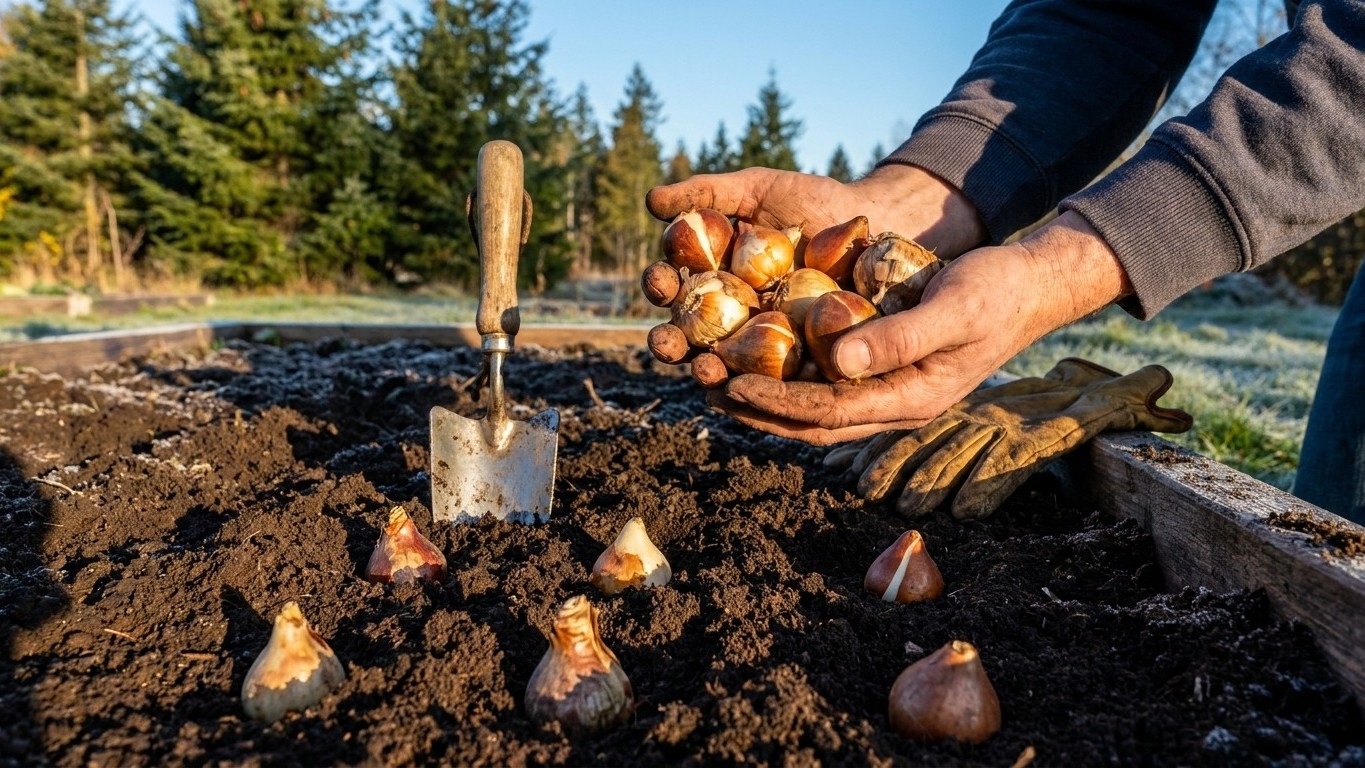

Colorado’s high, dry winters are exactly what spring bulbs are built for. The state’s average coldest-month low of 18.4°F comfortably clears what tulips, daffodils, crocus, and hyacinths need to bloom, and most of the state falls squarely within their hardiness range. The catch isn’t the cold, it’s the timing, the elevation swings, and the animals that dig faster than you can plant.
When to plant bulbs in Colorado

Plant spring bulbs once the soil has cooled from summer but before it locks up hard for winter. In practice, that means working backward from the average first fall frost, which for the Denver area (station USW00003017) falls between September 30 and October 12, per NOAA’s 1991-2020 Climate Normals. Aim to get bulbs in the ground about six weeks before that window closes, which puts most Front Range planting in mid-September through late October. For gardeners short on in-ground space, Growing Spring Bulbs in Containers in Colorado follows the same timing principles while giving you more control over soil temperature and drainage.
Both ends of that window carry a real cost. Plant too early, while soil is still warm from summer, and a bulb can push top growth before winter arrives. That new growth freezes back, and the bulb spends stored energy it needed for spring instead of building next year’s flower. Plant too late, after the ground has already started to freeze, and roots don’t have time to establish before dormancy sets in. A bulb without roots either comes up weak and short the following spring or doesn’t come up at all. If you miss the outdoor planting window entirely, Forcing Spring Bulbs Indoors in Colorado offers a way to still enjoy blooms by chilling bulbs artificially rather than relying on garden soil temperatures.
The frost date is an average, not a promise
Worth saying plainly: that September 30 to October 12 range is an average drawn from thirty years of data. Half of all years land on one side of it, half on the other. Some Octobers stay mild well into the month; others deliver a hard freeze before the leaves have turned. Gardeners who plant strictly by the calendar rather than watching the actual soil and weather sometimes get caught either way.
The caution matters more in Colorado than in flatter, more uniform states. Denver sits at 5,280 feet on the plains, but mountain towns can see frost in July, and the western slope runs on its own schedule entirely. A planting date that works in Denver can be three weeks early or three weeks late an hour’s drive in either direction. Treat the window as a starting point, then adjust for your own elevation and exposure before you commit a whole bag of bulbs to the ground.
Whether your winter is cold enough
This is the question that actually decides whether spring bulbs work in a given place, and it’s worth stating the underlying rule before anything else: a spring-flowering bulb needs an extended cold period, typically twelve to fourteen weeks with soil temperatures below about 45°F, to trigger flower formation inside the bulb. Skip that chilling period and the plant still grows, but it produces leaves without a flower, or a flower bud so short it never clears the soil line. That figure, twelve to fourteen weeks below 45°F, is the number every gardener needs to hold onto, whether their climate clears it easily or falls short.
Colorado’s Front Range clears it with room to spare. A coldest-month mean minimum of 18.4°F means soil temperatures sit well below 45°F for stretches that run closer to sixteen to eighteen weeks across a typical Denver winter, from late November into March. That margin buys two things: a longer list of workable bulb species, and no need for artificial pre-chilling in most of the state’s populated corridor.
The margin narrows at the warm edge of Colorado’s hardiness range. The state spans USDA zones 3b through 7b, and the lower elevations of the western slope, sitting closer to zone 7b, run milder winters with less consistent cold. In those pockets, a gardener who wants tulips or hyacinths may need to pre-chill bulbs in a refrigerator for twelve weeks before planting, kept away from apples, pears, and other ripening fruit, since the ethylene gas they release will kill the flower bud inside the bulb before it ever reaches the ground. Skipping that step where the winter genuinely can’t deliver the cold isn’t a minor shortcut, it’s money wasted on bulbs that will leaf out and never flower.
| Bulb | Weeks of cold required (below 45°F) | What Colorado’s Front Range delivers | Verdict |
|---|---|---|---|
| Tulip | 12-16 weeks | ~16-18 weeks | Plant directly, no pre-chill needed |
| Daffodil | 12-15 weeks | ~16-18 weeks | Plant directly, no pre-chill needed |
| Hyacinth | 12-14 weeks | ~16-18 weeks | Plant directly, no pre-chill needed |
| Crocus | 8-15 weeks | ~16-18 weeks | Plant directly, no pre-chill needed |
| Allium | 8-10 weeks | ~16-18 weeks | Plant directly, no pre-chill needed |
The one place that table doesn’t hold is the warmest, lowest western-slope valleys, where a milder microclimate can shave enough weeks off the cold season to leave tulips and hyacinths short. There, pre-chilling stops being optional and becomes the difference between a spring border and a patch of bare leaves.
Which bulbs suit Colorado
Most of the classic spring bulb lineup sits comfortably inside Colorado’s zone 3b-7b range and meets its cold requirement without any help:
- Tulip (zones 3-8)
- Daffodil (zones 3-9)
- Crocus (zones 3-8)
- Hyacinth (zones 4-8)
- Allium (zones 3-9)
- Grape hyacinth / Muscari (zones 3-9)
- Snowdrop (zones 3-7)
A few bulbs sold alongside these will disappoint, and it helps to know exactly how before spending money on them. Ranunculus, hardy only to zones 8-10, doesn’t survive a Colorado winter in the ground at all and needs to be lifted and stored or treated as an annual. Freesia, hardy to zones 9-10, is further out of range still and will rot before spring. Anemone coronaria sits at the edge in zone 7, and without heavy mulch it often comes up once and never returns, a first-year display that quietly disappears the following spring. Standard hybrid tulips, while hardy on paper, tend to act as short-lived perennials in Colorado’s dry, alkaline soil, putting on one strong show and fading over the next two or three years, while species tulips hold up far longer under the same conditions.
Hardiness ranges are guidelines, not hard lines. A bulb rated to the edge of Colorado’s zone often survives for years in a sheltered spot against a south-facing wall, then dies the same winter in an open, wind-scoured bed a few miles away. Microclimate decides more than the map does.
What digs them up here
Squirrels and voles are selective, and the pattern isn’t random luck, it’s chemistry. Daffodils and members of the onion family contain compounds that make them bitter or mildly toxic to rodents, so they get left alone in the ground. Tulips and crocus contain no such defense and are treated as a food source, often dug up within days of planting.
- Bulbs squirrels and voles dig up: tulip, crocus
- Bulbs squirrels and voles leave alone: daffodil, allium, hyacinth, grape hyacinth, snowdrop
For the bulbs on the vulnerable list, one measure actually works: lay wire mesh flat over the planting bed, pinned down at the edges, and leave it in place until the ground freezes hard. Rodents can’t dig through it, and by the time the ground is frozen the bulbs are no longer worth the effort. Repellent sprays and granules sold for this purpose wash off in the first watering or rain and need reapplying constantly, which makes them unreliable compared to a simple physical barrier.
Where to check for your own county
Every figure above, the frost dates, the coldest-month minimum, the cold-hours math, is drawn from the Denver reference station. Colorado spans several degrees of latitude, a wide range of elevations, and both sides of the Continental Divide, and a planting calendar written for the state capital can run three weeks off at either edge of that range. A gardener in a high mountain valley or on the western slope is working with a genuinely different climate than someone gardening in Denver, even though both fall under the same state-level guidance.
The most reliable next step is Colorado State University Extension, the state’s land-grant university extension service, at extension.colostate.edu. Its county offices track local frost dates, elevation-adjusted planting windows, and soil conditions specific to their area, and they can confirm whether a given bulb needs pre-chilling in that particular county or not. That local check matters more in Colorado than in flatter states, simply because so much changes over such short distances.