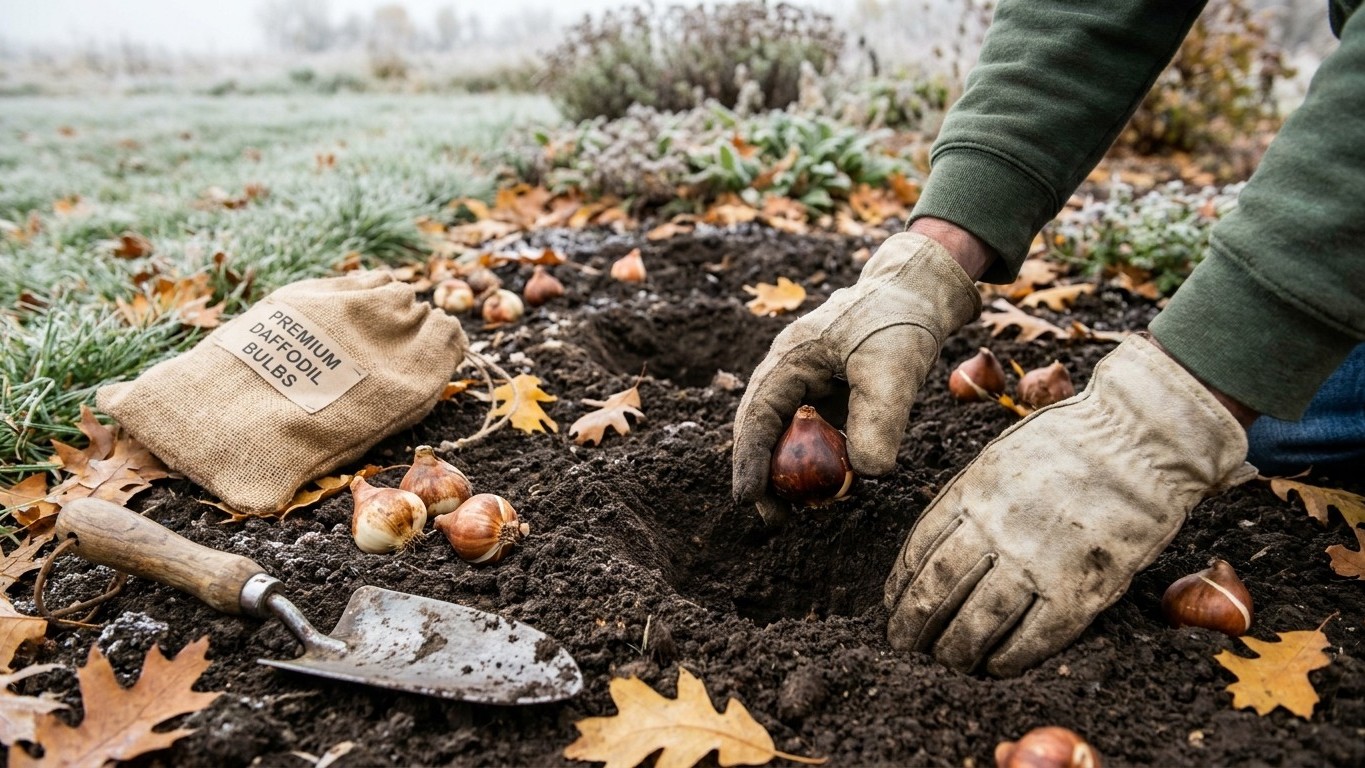

Spring-flowering bulbs can absolutely thrive in North Dakota, but not all of them will come back year after year. The deciding factor isn’t drought or wind, it’s whether the ground gets cold enough, long enough, to trigger a flower instead of just a leaf. Here’s what survives the wait, and what doesn’t.
When to plant bulbs in North Dakota

Timing in this state runs on the calendar, not the calendar’s excuses. The average first fall frost at the Fargo reference station lands between September 25 and October 5, according to NOAA’s 1991-2020 Climate Normals. That date marks the point where soil temperatures start their steady slide toward freezing, and it’s the anchor for every bulb-planting decision that follows, whether bulbs go into garden beds or, as covered in Growing Spring Bulbs in Containers in North Dakota, into pots that can be moved to shelter.
The rule of thumb gardeners use nationwide is to get bulbs in the ground about six weeks before the soil freezes solid, not before the first light frost. In North Dakota, that puts the working window somewhere in the stretch from early October through roughly the first half of November, depending on how the season is running. Soil needs to have cooled below the mid-60s Fahrenheit before bulbs go in. Plant too early, while the ground is still warm, and a bulb can push top growth before winter arrives. That growth freezes back, and the bulb spends its stored energy recovering instead of flowering the following spring.
The other end of the window matters just as much
Plant too late, once the ground has already locked up hard, and roots never get the chance to establish before dormancy sets in. A bulb with weak or absent root growth going into winter tends to emerge stunted in spring, if it emerges at all. Root development, not top growth, is the entire point of fall planting. That’s why gardeners are told to plant “cool but not frozen” soil rather than watching a single date on a calendar.
One thing worth being blunt about: the September 25 to October 5 first-frost window is an average, built from thirty years of data. Half of all years in that record fell earlier than the average, and half fell later. Treat the date as a guide for when to start watching the soil, not as a guarantee of what any single autumn will do. A gardener who waits for a specific date and ignores the actual ground conditions that year is gambling against a coin flip that’s been described, misleadingly, as a rule.
Whether your winter is cold enough
This is the question that actually decides whether spring bulbs planted in North Dakota flower at all. Spring bulbs aren’t just cold-tolerant, they’re cold-dependent. Most species need a sustained stretch of twelve to fourteen weeks with soil temperatures below roughly 45 degrees Fahrenheit before they can build a flower bud inside the bulb. Skip that requirement and the bulb often still grows, it just produces leaves with no bloom, or a flower stalk so short it never clears the foliage. Gardeners who don’t want to leave that outcome to chance can replicate the same chilling period under controlled conditions by Forcing Spring Bulbs Indoors in North Dakota. That number, twelve to fourteen weeks below 45F, is the yardstick every bulb catalog and every regional planting guide is quietly built around, whether or not it says so out loud.
North Dakota doesn’t come close to falling short on this. The state sits in USDA Hardiness Zones 3a to 4b, and the coldest-month mean daily minimum at the Fargo reference station is 0.2 degrees Fahrenheit, per NOAA Climate Normals. Winter here runs cold from around mid-November through March, a stretch that clears the twelve-to-fourteen week chill requirement by a wide margin, not by a few days.
What that margin actually buys a gardener
A surplus of cold this large means two practical things. First, the list of workable spring bulbs is long, since almost nothing sold as a spring-flowering bulb needs more chilling than North Dakota’s winter naturally provides. Second, pre-chilling, the practice of refrigerating bulbs for about twelve weeks before planting to simulate a cold winter, is unnecessary here. That step exists for gardeners in warmer states like Florida or coastal Texas, where the ground never gets cold enough on its own. Doing it in North Dakota would be extra work solving a problem the winter has already solved.
| Bulb | Weeks of cold required | What North Dakota delivers | Verdict |
|---|---|---|---|
| Tulips | 12–14 weeks below 45F | ~18–20 weeks, Nov–Mar | Meets requirement with margin, no pre-chilling needed |
| Daffodils | 12–14 weeks below 45F | ~18–20 weeks, Nov–Mar | Meets requirement with margin |
| Dutch crocus | 8–12 weeks below 45F | ~18–20 weeks, Nov–Mar | Exceeds requirement easily |
| Hyacinths | 10–12 weeks below 45F | ~18–20 weeks, Nov–Mar | Meets requirement, though hardiness range is the limiting factor here |
| Alliums | 8–10 weeks below 45F | ~18–20 weeks, Nov–Mar | Exceeds requirement easily |
If a gardener were somewhere with a marginal or short chill season, this is the point where the honest advice gets uncomfortable: buy pre-chilled bulbs, or chill them yourself for twelve weeks in a refrigerator, kept well away from ripening fruit, since the ethylene gas apples and pears give off will kill the flower bud inside a stored bulb. None of that applies in North Dakota. The cold here is the one variable a gardener doesn’t have to manage.
Which bulbs suit North Dakota
Cold tolerance is the second filter after chill hours, and it works differently: it’s about whether the bulb survives the winter at all, not whether it flowers once it does. The following bulbs have hardiness ranges that comfortably cover Zone 3a-4b and cold requirements this state clears without effort:
- Tulips — hardy zones 3 to 7
- Daffodils — hardy zones 3 to 8
- Dutch crocus — hardy zones 3 to 8
- Alliums — hardy zones 3 to 8
- Siberian squill (Scilla) — hardy zones 2 to 8
- Grape hyacinth (Muscari) — hardy zones 3 to 8
- Snowdrops (Galanthus) — hardy zones 3 to 7
A few bulbs sold in the same garden center displays will disappoint, and it’s worth knowing exactly how before spending money on them. Dutch hyacinths carry a hardiness range of zones 4 to 8, which puts them right at the edge in the state’s Zone 3a pockets, generally the northern and western counties. In an open, wind-exposed bed there, expect winterkill or a bulb that fades after its first season. In a sheltered spot with a mulch layer, closer to a Zone 4b reading, hyacinths often perennialize fine. Dutch iris, hardy zones 5 to 9, is a flat no across the entire state; it will rot or freeze out over a normal North Dakota winter. Ranunculus and anemone, hardy roughly zones 7 to 10, aren’t cold-hardy bulbs in this climate at all. They’ll grow the first year if planted, then vanish, since the ground here freezes far past what their root systems can survive.
None of these hardiness ranges are hard lines. A hyacinth tucked against a south-facing foundation wall, with snow cover holding through the coldest weeks, can outlast the same variety planted in an open, wind-scoured bed a hundred feet away. Microclimate decides the edge cases; the zone map only describes the average.
What digs them up here
Squirrels and voles are selective, and the selection comes down to chemistry rather than appetite. Daffodils and every bulb in the onion family contain compounds that make them bitter or mildly toxic, so rodents generally leave them alone. Tulips, crocus, and hyacinths carry no such defense, which makes them a genuine food source once the ground is disturbed and the bulbs are fresh in the soil.
- Bulbs squirrels and voles typically take: tulips, crocus, hyacinths
- Bulbs they generally leave alone: daffodils, alliums, snowdrops, Siberian squill, grape hyacinth
For the bulbs on the vulnerable list, one measure actually holds up: laying a sheet of galvanized wire mesh flat over the planting area, pinned down at the edges, left in place until the ground freezes solid. It blocks digging during the exact window when a bulb bed smells freshest to a squirrel, and it can come off once winter locks the soil. Repellent sprays and granules get sold heavily this time of year, but they wash off with the first rain or snowmelt and need reapplying constantly to do anything. Wire mesh doesn’t wash off.
Where to check for your own county
Every figure above, the frost dates, the coldest-month minimum, the hardiness zone range, comes from the Fargo reference weather station. North Dakota spans a wide stretch of latitude and two full USDA hardiness zones, so a planting window built around one city can run two to three weeks off in either direction once you cross the state. Counties in the northwest tend to run colder and freeze earlier than the Fargo figures suggest; some southeastern pockets run slightly milder.
The state’s land-grant extension service, NDSU Extension, publishes county-level guidance that adjusts for exactly this kind of variation. A local county extension office can confirm the actual average first frost date for your specific area, not just the airport station’s version of it, which matters most for gardeners near the edges of the state’s hardiness zone split.