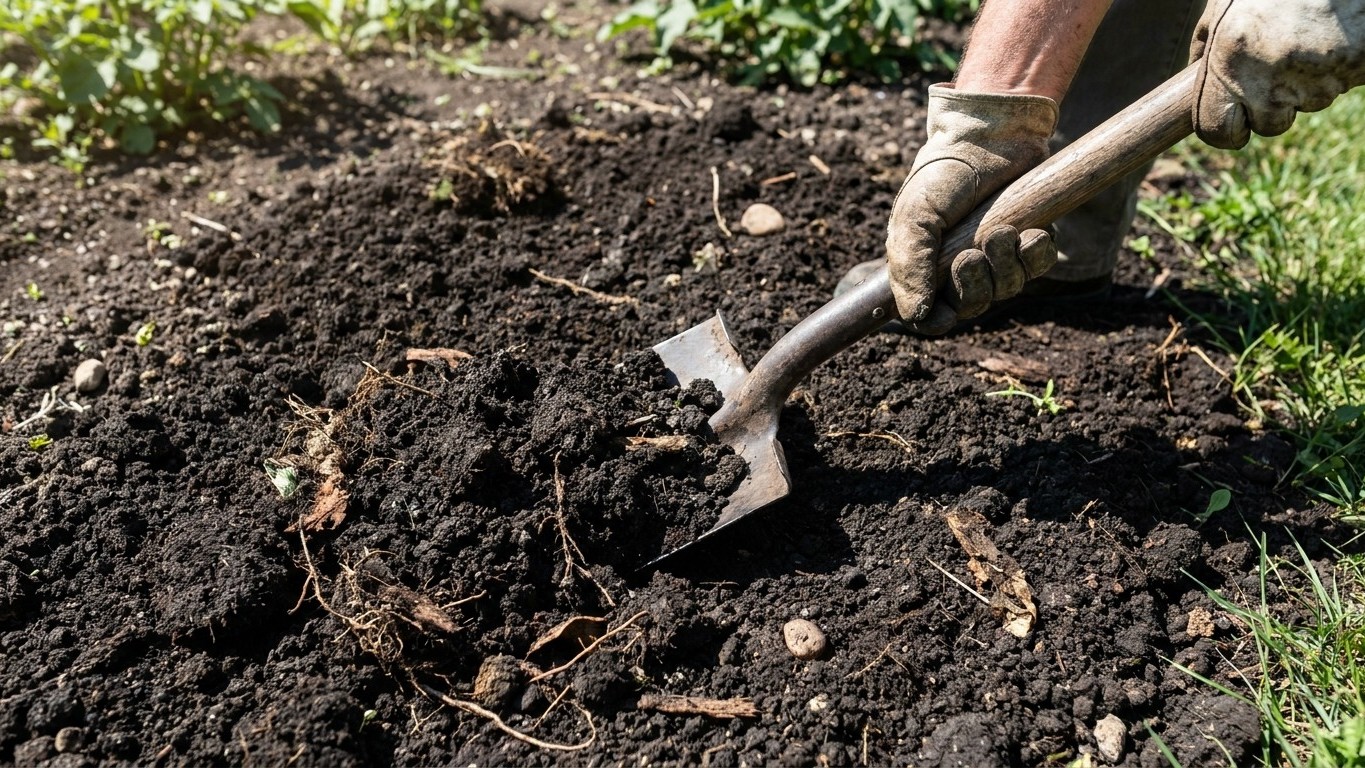

Dig a spade into most Iowa ground and you’ll hit something dark, crumbly, and heavier than you expected. That’s the Tama series talking, the soil USDA names as representative of the state. It runs slightly acid, holds a lot of silt, and drains well on paper, but the number that matters most for your garden is the one only a soil test can give you. Here’s what the state soil actually looks like, and what to do once you know your own.
What is under your garden

The Tama series is a Mollisol, the deep, dark prairie soil that built the Corn Belt. Centuries of tallgrass roots dying back every year loaded this ground with organic matter, and that’s why it looks almost black when you turn it over. USDA NRCS lists it as the soil representative of Iowa, and the numbers below come straight from the Soil Survey Geographic Database, averaged across 246 mapped components of the series.
| Reading | Value |
|---|---|
| Surface pH | about 6.5 (slightly acid) |
| Sand | 4 percent |
| Silt | 70 percent |
| Clay | 26 percent |
| Organic matter | about 3.5 percent |
| Drainage class | well drained |
That’s a clayey, silt-heavy soil with a pH close to neutral and organic matter most gardeners elsewhere would envy. It’s also, and this matters, a description of one mapped series among hundreds that exist across the state. If your house sits on a river bottom, a hillside, or a lot where a builder scraped the topsoil and brought in fill, your ground has almost nothing in common with the numbers above. The Tama profile tells you what the region’s soil tends to do, not what your raised bed or backyard plot is doing right now.
Reading your own dirt in five minutes
Two quick checks tell you more than staring at the ground ever will. First, the ribbon test: grab a moist handful of soil, squeeze it between your thumb and forefinger, and push it upward into a ribbon. Soil high in clay forms a long, slick ribbon, sometimes over two inches before it breaks. Sandy soil won’t ribbon at all. Silty soil feels smooth, almost soapy, and forms a short, fragile ribbon.
Second, the jar test. Fill a clear quart jar about a third full with soil, add water to near the top, shake hard, and let it sit overnight. Sand settles first and forms the bottom layer, silt settles next, and clay stays suspended longest, forming the top layer once everything drops. Measure each band and you’ll have a rough percentage breakdown of your own ground, no lab required. It won’t match a USDA soil report to the decimal, but it will tell you if you’re gardening in something closer to Tama’s clay-heavy silt or a completely different animal.
Testing before you amend
Buying lime or sulfur before you test is like buying reading glasses before an eye exam. You might be right. You’re more likely wasting money, and in the case of pH amendments, you can push soil in the wrong direction and take seasons to undo it. A soil test measures what your eyes can’t: actual pH, phosphorus and potassium levels, and often organic matter percentage, all specific to your yard rather than to a county-wide series average.
Given the Tama series runs about 6.5, a gardener on typical central Iowa ground can reasonably expect a surface pH somewhere in the slightly acid to neutral range. Expecting isn’t knowing. Fill dirt, decades of lawn fertilizer, or a garden built over old construction debris can shift that number in either direction, and there’s no way to tell without a test.
Sampling correctly matters as much as testing at all. A single scoop from one spot can mislead you if that spot happens to be unusually acidic or compacted. Here’s the routine most extension services recommend:
- Walk the garden bed and take 8 to 10 small core samples from different spots, avoiding unusual areas like old brush piles or animal runs.
- Dig each core to the depth roots actually occupy, typically 6 to 8 inches for vegetable beds, shallower for lawns.
- Break up clumps and mix all the cores together in a clean bucket.
- Let the composite sample air-dry if instructed, then pull about a pint or two into a labeled bag or the lab’s sample box.
- Note the bed’s history (crop, past amendments) on the submission form so the lab can interpret results correctly.
Amending it
The Tama series sits at about 6.5, which is close enough to neutral that most vegetables and ornamentals need no correction at all. But your own test may come back higher or lower, and the fix depends entirely on which direction the number points.
If your soil tests acid, below about 5.5
Lime is the tool here, not sulfur. Acid soil locks up phosphorus so roots can’t reach it, and it stunts brassicas like broccoli and cabbage, which prefer a more neutral range. Ground limestone raises pH, but slowly. Expect the change to unfold over a season or two, not weeks, since lime has to react with soil moisture and break down before it shifts the number. Skip pelletized “fast-acting” products promising overnight results; they still work on the same timeline once you account for reaction speed in real garden soil.
If your soil tests alkaline, above about 7.3
Lime has no business going anywhere near this ground, ever. Adding it pushes pH higher and makes the underlying problem worse. The honest fix is elemental sulfur worked into the top few inches, paired with regular additions of organic matter like compost, which buffers pH gently over time. High pH also locks iron out of reach for plant roots, and that’s exactly what yellow leaves with green veins (a classic iron chlorosis symptom) are telling you. Correcting pH is the long-term fix; a foliar iron spray is the short-term patch while sulfur does its slower work.
If your soil tests heavy on clay
At 26 percent clay, Tama series ground already leans heavy, and many Iowa yards run similar or higher. Organic matter, compost, aged leaves, chopped straw, is the fix, worked in gradually every season. Never add sand to clay soil hoping to lighten it; the combination behaves more like concrete than loam. And never work clay soil while it’s wet. Compacting wet clay creates clods that can take a full season to break down naturally.
If your soil tests sandy
Sandy soil drains too fast for most vegetables to establish deep root systems before nutrients wash through. Organic matter again does the heavy lifting, holding both water and nutrients in place. Expect to water more often, in shorter sessions, rather than deep-soaking infrequently, because sandy profiles simply won’t hold a big single watering the way clay does.
Clay corrections and pH corrections both take patience: figure one to three seasons before you see the full effect. Compaction fixes and watering adjustments show results almost immediately.
Drainage and compaction
The Tama series is classed as well drained, meaning water moves through the profile at a reasonable pace without pooling for days. That’s good news on paper, but “well drained” describes a mapped series, not necessarily the compacted strip along your driveway or the low corner of your yard where snowmelt collects every spring.
Test your own drainage with a simple percolation check. Dig a hole about a foot deep and a foot wide, fill it with water, and let it drain completely once (this saturates the surrounding soil). Refill it and time how long it takes to drop, say, six inches. A drop of one to two inches per hour is decent for most garden plants. Faster than three inches an hour and you’re dealing with sandy, fast-draining ground that will need more frequent watering. Slower than half an inch an hour signals compaction or heavy clay, and standing water after rain becomes a real risk for root rot.
Compaction from foot traffic, wheelbarrows, or heavy equipment squeezes air pockets out of soil, and roots struggle to push through what’s left. Double digging, the old practice of turning soil two shovel-depths down, has fallen out of favor because it disrupts soil structure and microbial life more than it helps, and the compaction often returns within a season anyway. On genuinely compacted or poorly draining ground, a raised bed filled with quality soil mix is frequently the better bet than years of amendment and hoping. There’s no shame in building up instead of fighting down.
- Well-drained, moderate percolation: proceed with standard garden bed prep and normal watering schedules.
- Fast percolation (sandy, dries out quick): add organic matter, mulch heavily, water shorter and more often.
- Slow percolation or standing water after rain: consider a raised bed, avoid deep-rooted plants that hate wet feet, and keep heavy equipment off the area entirely.
Local help
Iowa State University Extension and Outreach runs soil testing through county offices statewide, and the process is affordable enough that skipping it to save a few dollars rarely makes sense. Submit a sample through your county extension office, and staff there will walk through the results with you, translating lab numbers into an actual amendment plan for your yard. Find your local office through Iowa State University Extension and Outreach.
Common questions
Is all Iowa soil the same as the Tama series?
No. Tama is the series USDA lists as representative of the state, but Iowa contains hundreds of mapped soil series. River bottoms, hillsides, and any lot altered by construction can differ completely from Tama’s numbers.
Do I need to lime my Iowa garden every year?
Only if a soil test shows acid pH and confirms lime is needed. Applying lime without testing risks pushing neutral or alkaline soil in the wrong direction, and pH corrections should be guided by lab results, not assumptions based on regional averages.
Why does my soil form a long ribbon when I squeeze it?
A long, slick ribbon usually means high clay content, similar to the 26 percent clay figure recorded for the Tama series. Clay-heavy soil benefits from regular organic matter additions and should never be worked while wet.
What does yellowing between green leaf veins mean?
That pattern, called interveinal chlorosis, often points to iron deficiency caused by high soil pH locking iron out of reach for roots. A soil test confirming alkaline pH, paired with elemental sulfur applications over time, addresses the root cause rather than just the symptom.