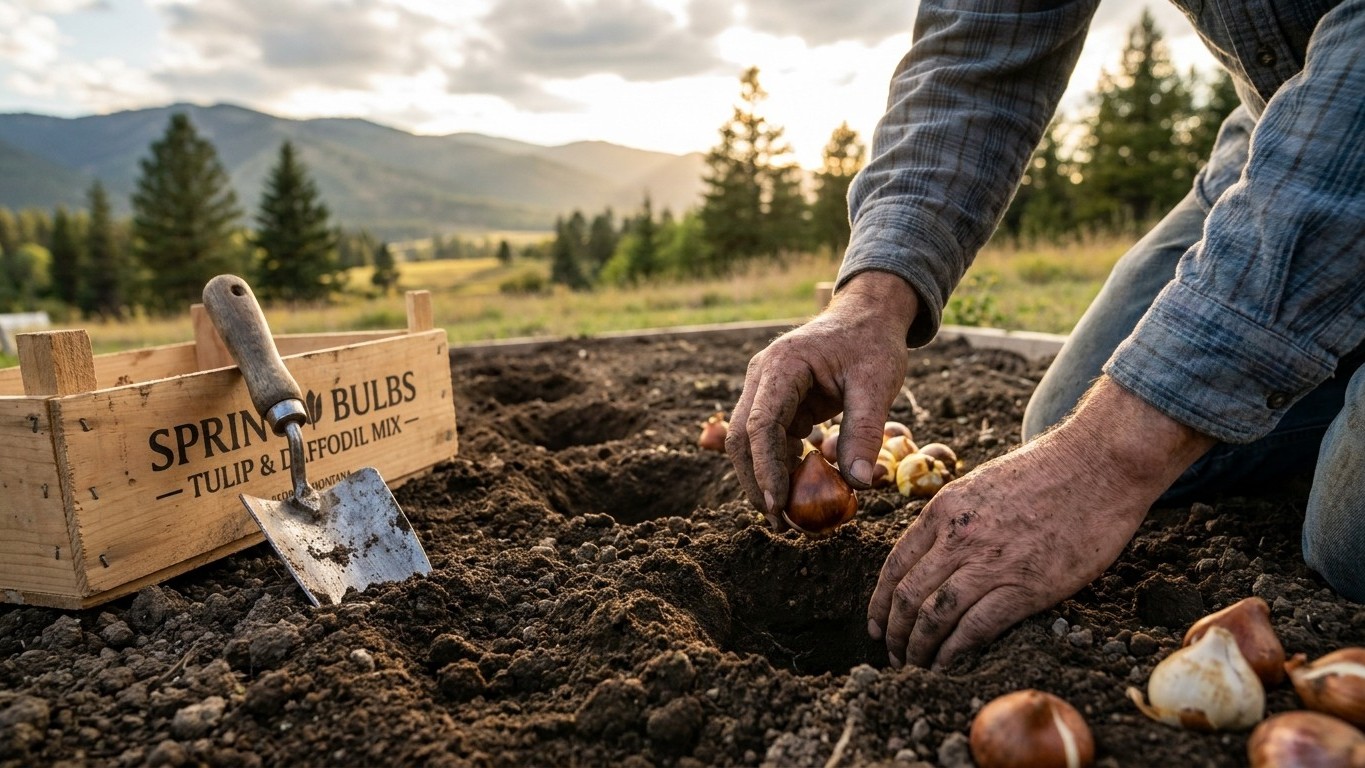

Spring bulbs go into Montana ground on a tighter calendar than most catalogs admit, and the deciding factor isn’t the calendar at all: it’s whether your particular patch of state gets cold enough, long enough, to force a flower out of a dormant bulb. Some varieties clear that bar with room to spare. Others never had a chance here.
When to plant bulbs in Montana

The window for getting spring bulbs into the ground runs from mid-August into late September across most of Montana, timed to land roughly six weeks ahead of the average first fall frost. NOAA’s 1991-2020 climate data puts that frost between October 1 and October 14 for the Billings area, which is one of the milder valleys in the state. Working backward six weeks from that date gives you the safe planting stretch: bulbs need that lead time to grow roots before the ground locks up, even though nothing shows above the soil surface until spring.
Why the timing matters at both ends
Plant too early, while soil is still warm from summer, and a bulb can push top growth before winter arrives. That growth gets killed by the first hard freeze, and the bulb spends its stored energy recovering instead of building next year’s flower. Plant too late, after the ground has already gone cold, and the bulb never develops the root system it needs. It may still bloom the first spring on stored reserves alone, but it comes up weak, and often skips a year afterward or fails outright.
Worth saying plainly: October 1 to October 14 is an average range built from thirty years of data, not a guarantee. Roughly half of all years bring frost earlier than that window, and half bring it later. A gardener in a low-lying mountain valley elsewhere in Montana can see frost weeks ahead of Billings, in any month of the year in some pockets. Treat the date as a planning anchor, not a deadline carved in stone, and lean toward the earlier end of the window if your site tends to run cold.
Whether your winter is cold enough
This is the question that decides whether a bulb blooms at all, and it gets skipped more often than it should. A spring bulb needs a sustained cold spell before it will flower: most varieties require twelve to fourteen weeks with soil temperatures below about 45F. Skip that requirement and the bulb still grows leaves, but the flower stalk stays stunted or never forms. The chemistry inside the bulb that triggers bloom simply doesn’t switch on without enough sustained cold, which is the same principle behind Forcing Spring Bulbs Indoors in Montana when gardeners want blooms ahead of the outdoor season.
Montana clears that bar without effort. The USDA Plant Hardiness Zone Map, built from average annual extreme minimum temperatures across 1991-2020 normals, places the state across zones 3a to 6a, among the coldest hardiness ranges in the continental U.S. More directly useful for this question is the mean daily minimum temperature for the coldest month at the Billings reference station: 17.9F. That’s a full 27 degrees below the 45F ceiling a bulb needs to break dormancy, and Montana’s winter holds temperatures that low or lower for months, not weeks. The twelve-to-fourteen-week requirement gets met several times over before spring even starts to think about arriving.
What that margin buys you
A wide cold margin means Montana gardeners can plant almost any spring bulb sold as hardy in their zone without special handling. No refrigerator chilling, no digging bulbs up in fall to store indoors, no guessing whether the ground will do the job. That’s a real advantage over milder states, where gardeners have to fake winter by refrigerating tulip and hyacinth bulbs for twelve weeks before planting, kept away from apples, pears, or any ripening fruit, since the ethylene gas fruit gives off kills the flower bud sitting dormant inside the bulb. In Montana, that whole extra step is unnecessary. The ground does the work on its own.
| Bulb | Cold required | What Montana delivers | Verdict |
|---|---|---|---|
| Tulips | 12-14 weeks below 45F | Soil stays below that mark from roughly October through March | Reliable bloom, no pre-chilling needed |
| Daffodils (Narcissus) | 12-14 weeks | Same long cold season | Reliable, often naturalizes for years |
| Crocus | 8-15 weeks, depending on species | Comfortably exceeded | Reliable |
| Hyacinths | 13-15 weeks | Comfortably exceeded | Reliable |
| Alliums | 8-10 weeks | Comfortably exceeded | Reliable |
Which bulbs suit Montana
Given the hardiness range of 3a-6a and a cold season that runs long and deep, most of the standard spring bulb catalog is a safe bet here. The bulbs below list their published USDA hardiness range alongside their name, so you can check any bulb you’re considering against Montana’s zone before you buy it.
- Tulips (zones 3-7)
- Daffodils / Narcissus (zones 3-8)
- Crocus (zones 3-8)
- Hyacinths (zones 4-8)
- Alliums (zones 3-8)
- Snowdrops (Galanthus) (zones 3-7)
- Fritillaria (zones 3-8)
- Grape hyacinth (Muscari) (zones 3-8)
Hardiness ranges are not a hard line, though. A tulip rated to zone 3 can still struggle in an exposed, wind-scoured spot on a ridge, while the same bulb thrives against a south-facing foundation wall a few miles away that traps heat and blocks wind. Microclimate matters as much as the zone map.
Some bulbs sold in the same garden center displays will disappoint here regardless of placement. Freesia (zones 9-10), ranunculus (zones 8-10), and anemone coronaria (zones 7-10) are routinely marketed alongside true spring bulbs, but none of them survive a Montana winter in the ground. Plant them and they either rot from the cold and wet before spring, or never come up at all. If you want that look, treat them as annuals, lift them each fall, or skip them entirely. And even among the hardy bulbs, watch for a related but different letdown: many fancy double or parrot tulip varieties put on one spectacular show their first spring, then fade to nothing the following year, regardless of climate. Species tulips and Darwin hybrids naturalize far more reliably over time.
What digs them up here
Squirrels and voles are selective, and the reason comes down to chemistry rather than appetite. Some bulbs contain compounds that make them bitter or mildly toxic to rodents, while others are essentially bulb-shaped snacks.
- Bulbs squirrels and voles take: tulips, crocus, grape hyacinth (muscari)
- Bulbs they generally leave alone: daffodils / narcissus, alliums, fritillaria, snowdrops, hyacinths
Daffodils and everything in the onion family carry compounds that make them unpalatable or outright toxic to rodents, which is why they’re rarely disturbed once planted. Tulips and crocus carry no such defense, and they’re consistently the two most-dug bulbs in any Montana yard with a squirrel population.
The one measure that actually holds up: lay galvanized wire mesh or hardware cloth flat over the planting area right after you dig in the bulbs, pinned down at the edges, and leave it in place until the ground freezes solid. Rodents dig for scent, not sight, and a physical barrier stops them cold. Repellent sprays and granules get pitched hard every fall, but they wash off with the first rain or watering and need constant reapplication to do anything at all.
Where to check for your own county
Montana stretches across roughly six degrees of latitude and spans four USDA hardiness zones, from 3a in the coldest mountain valleys to 6a in sheltered lower-elevation spots. Every figure in this guide, the frost date, the coldest-month minimum, comes from the Billings reference station, and Billings sits toward the milder end of that range. A planting window built around Billings can run two to three weeks off for a garden in Bozeman, the Bitterroot Valley, or up near Glacier Country, where frost arrives earlier and the ground locks up sooner.
Montana State University Extension maintains a statewide extension service with county offices that track local frost dates, soil conditions, and planting calendars specific to your elevation and valley. Before ordering bulbs based on a statewide average, a quick call or visit to your county office will tell you whether your local window runs earlier, later, or matches the dates given here.