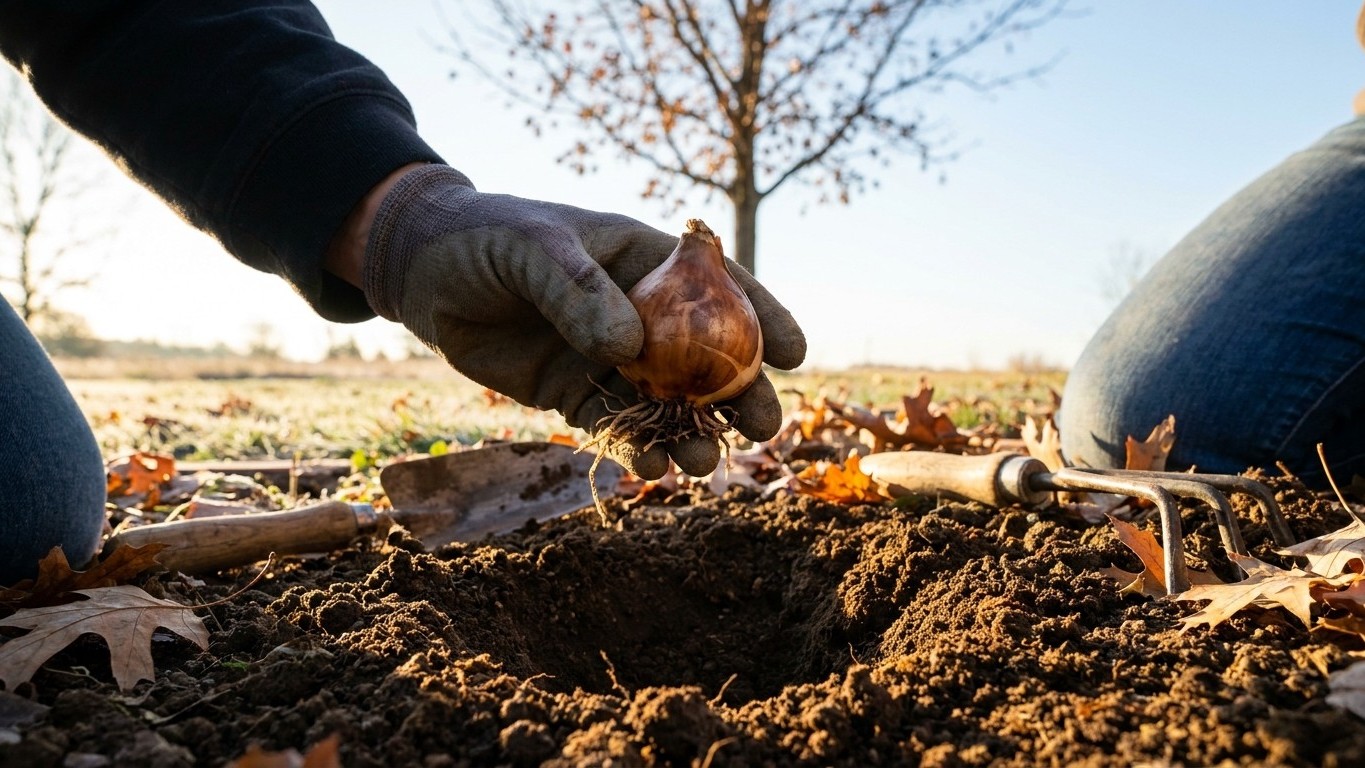

Fall is planting season for spring bulbs in Nebraska, but the real question isn’t when to dig the hole. It’s whether your winter delivers enough sustained cold to force a flower at all. Here’s how the timing works, and where the state’s climate helps or hurts.
When to plant bulbs in Nebraska

The target window sits about six weeks before the ground freezes solid, which anchors on the average first fall frost. For the Omaha reference station, that frost falls between October 15 and October 26, according to NOAA’s 1991-2020 Climate Normals. Working backward from that date, most Nebraska gardeners should be Planting Spring Bulbs from mid-September through late October, with the earlier end of that range better suited to the Panhandle and the later end workable in the Missouri River valley. Gardeners without in-ground beds can sidestep the timing pressure altogether by Growing Spring Bulbs in Containers in Nebraska, where soil temperature is easier to control.
Plant too early, while soil is still warm from summer, and the bulb wakes up. Tulips and daffodils sense that warmth and push top growth before winter arrives, and that growth gets killed back by the first hard freeze, weakening the bulb before it’s had a chance to root properly. The bulb survives, usually, but it starts the season already behind.
Plant too late, after the ground has begun to freeze at night, and the opposite problem shows up. Bulbs need four to six weeks of root development in cool-but-unfrozen soil before winter locks everything down. Skip that window and the bulb goes into winter with no root system, which means a weak bloom in spring, or in a hard winter, no bloom at all. Roots, not the shoot, are the whole point of fall planting.
The frost date is an average, not a guarantee
It’s worth being blunt about what “October 15 to October 26” actually means. That’s a 30-70% probability band for a 32F freeze at one weather station, built from thirty years of data. Half of all years land outside that window in one direction or the other. A gardener who waits for a specific calendar date and ignores the actual weather is gambling on an average. Watch the forecast, watch your own soil, and treat the date range as a planning tool, not a deadline carved in stone.
Whether your winter is cold enough
This is the question that decides whether spring bulbs work here at all, and it has nothing to do with whether the bulb survives winter. It’s about whether it flowers. A tulip or daffodil bulb needs a sustained cold period, typically 12 to 14 weeks with soil temperatures below about 45F, to complete the internal chemistry that produces a flower stalk. Skip that requirement and the bulb still comes up green in spring. It just won’t bloom, or it’ll bloom poorly, unless a gardener works around the chilling requirement through Forcing Spring Bulbs Indoors in Nebraskall send up a stunted stem too short to see above the mulch.
Nebraska doesn’t have a marginal case here. The coldest-month average daily minimum at the Omaha reference station is 15.2F, which describes air temperature, not soil, but it signals a winter that keeps ground temperatures below 45F for a stretch far longer than the 12 to 14 weeks any spring bulb needs. This is a state that clears the chilling requirement several times over, across nearly every part of it, not by a narrow margin that could tip the wrong way in a mild year.
What that margin buys is simple: no pre-chilling, no refrigerator drawer, no workaround. Gardeners in warmer states, where winters don’t reliably drop soil below 45F for three months, have to buy pre-chilled bulbs or chill them at home for twelve weeks in a refrigerator, kept away from ripening fruit because the ethylene gas fruit gives off kills the flower bud forming inside the bulb. Nebraska gardeners skip that step entirely. The ground does the work.
| Bulb | Cold needed to flower | What Nebraska’s winter delivers | Verdict |
|---|---|---|---|
| Tulips | ~14 weeks below 45F | Coldest month averages 15.2F; soil stays below 45F for months | Clears easily, no pre-chill needed |
| Daffodils | ~12-13 weeks below 45F | Same | Clears easily |
| Hyacinths | ~13-14 weeks below 45F | Same | Clears easily |
| Crocus | ~8-10 weeks below 45F | Same | Clears easily, often first to bloom |
| Alliums | ~10-12 weeks below 45F | Same | Clears easily |
A gardener who plants the right bulb in a place that can’t chill it has wasted the money. Nebraska is the opposite problem, if it’s a problem at all: nearly every spring bulb sold at a garden center here will get more cold than it needs.
Which bulbs suit Nebraska
Nebraska spans USDA Hardiness Zone 4a to 5b, based on the 2023 map’s 1991-2020 average extreme minimum temperature. That range covers the vast majority of bulbs marketed for fall planting, and combined with the deep, reliable cold discussed above, most standard spring bulbs perform well here without special handling.
- Tulips (Tulipa), zones 3-8
- Daffodils (Narcissus), zones 3-9
- Crocus, zones 3-8
- Hyacinths (Hyacinthus), zones 4-8
- Alliums, zones 3-8, depending on species
- Snowdrops (Galanthus), zones 3-7
- Grape hyacinth (Muscari), zones 3-8
What disappoints here
A hardiness range is never a hard line, and the bulbs below fail more often at the edges of Nebraska’s colder pockets, exposed hilltops or unsheltered north-facing beds, than in a protected foundation planting. But the pattern is consistent enough to name.
Anemone blanda, hardy to zones 5-9, sits right at the edge of Nebraska’s zone 4a areas. In a sheltered city yard it can persist for years; in an open rural planting it often dies out after one winter, leaving a gap where the display used to be. Ranunculus and freesia, both rated for zones 8-10, are a different story entirely. These aren’t marginal in Nebraska, they’re simply not winter hardy here at all. Planted in fall like a tulip, they’ll either rot in the ground over a wet winter or, if the winter is dry enough to spare them, come up once and never return. Garden centers sometimes sell them alongside true hardy bulbs, and that’s where the disappointment starts.
What digs them up here
Squirrels and voles don’t raid every bulb bed equally, and the reason comes down to chemistry rather than appetite. Daffodils and every member of the onion family contain compounds that are toxic or simply unpleasant to rodents, so they get left alone. Tulips, crocus, and hyacinths carry none of that natural defense, and they’re often the first thing dug up within days of planting.
- Squirrels and voles avoid: daffodils, alliums, snowdrops, fritillaria
- Squirrels and voles target: tulips, crocus, hyacinths
The one measure that consistently works is physical, not chemical: lay a sheet of galvanized wire mesh or hardware cloth directly over the planting area, pinned down at the edges, and leave it in place until the ground freezes solid. Rodents dig by scent in the weeks right after planting, before frost seals the soil, and a mesh barrier stops them cold during exactly that window. Repellent sprays and granules get marketed heavily every fall, but they wash off with the first rain or snowmelt and need reapplication often enough that most gardeners give up on them by December.
Where to check for your own county
Every figure above, the frost date, the coldest-month minimum, the hardiness zone, comes from data centered on Omaha. Nebraska stretches across several degrees of longitude and crosses more than one hardiness zone, from the Panhandle’s higher elevation and earlier frosts to the milder river valleys in the southeast. A planting window built around one reference city can run two to three weeks off at either edge of the state.
For a planting calendar tuned to your own county, the University of Nebraska-Lincoln Extension is the resource to use. As the state’s land-grant extension service, it maintains local frost data and county-level guidance that accounts for elevation and microclimate differences a statewide average can’t capture. A call or visit to your county extension office is the fastest way to confirm whether your own soil and frost timing match what’s described here, or whether you should shift planting by a week or two in either direction.