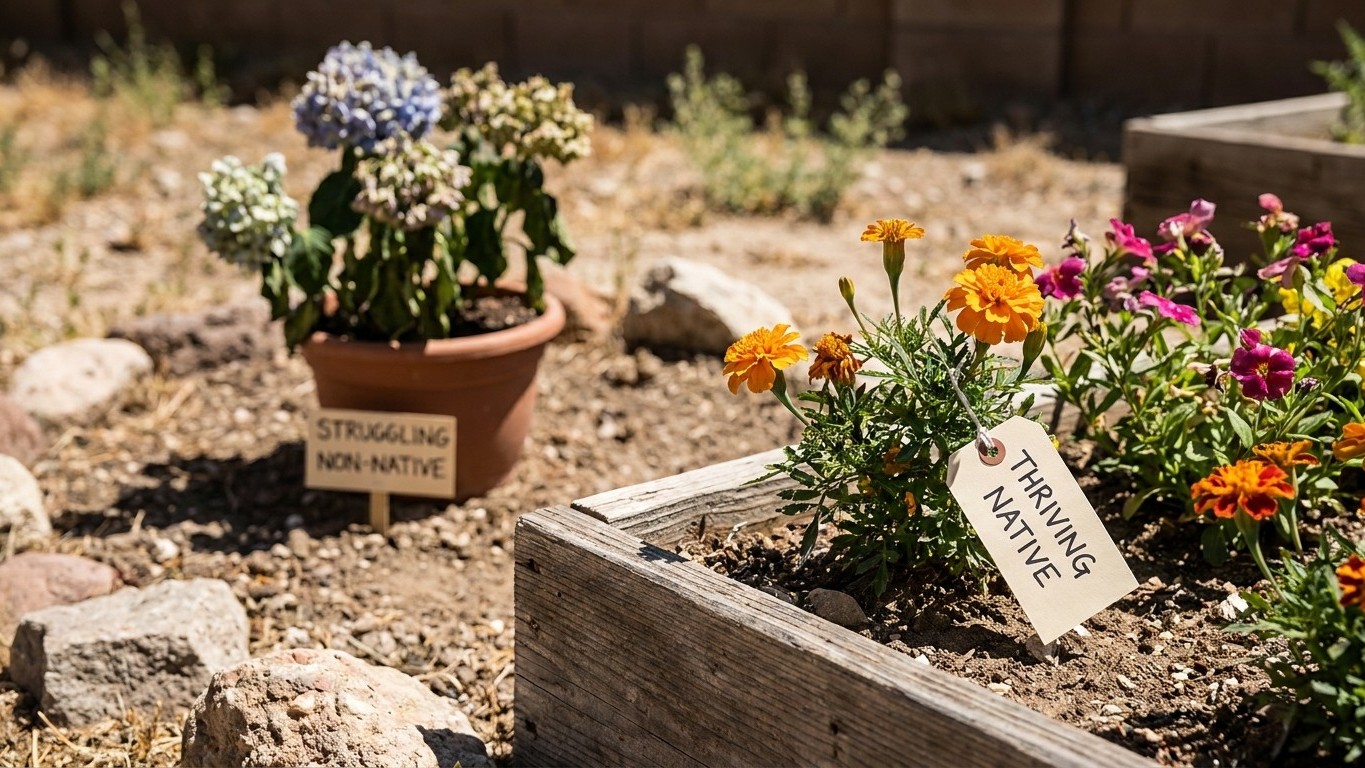

Flowers that actually thrive in Nevada are the ones built for extremes: long stretches of heat, thin winter cold at elevation, and huge swings between day and night temperatures. The USDA Plant Hardiness Zone Map puts the state anywhere from zone 4a in the high mountain valleys to zone 10a around Las Vegas, so the right flower depends entirely on where you’re standing. Check your own zone and elevation against the state map before you buy anything off a nursery table.
What thrives in Nevada

Heat load, not winter cold, is what kills flowers across most of Nevada. Salvia, lavender, and Russian sage shrug off the dry summers that finish off prettier plants, while silver-leaved foliage and drought-storing succulents like sedum and agave barely blink through a dry week. Up in the mountain valleys, though, real zone 4a winters flip the rules entirely, and peonies, bearded iris, and columbine actually need that hard freeze to bloom well the following year.
Heat load and drought decide more than cold does
For most of the state, water scarcity and heat load rule out more flowers than winter cold ever will. Families that carry real drought tolerance include the Mediterranean herbs, salvia, lavender, and Russian sage among them, along with silver or gray-leaved plants whose fuzzy or reflective foliage cuts water loss in direct sun. Succulents like sedum and agave store their own reserves and barely notice a dry week. Deep-rooted prairie natives such as penstemon and blanketflower reach moisture other roots can’t. Drought tolerance is the single biggest filter for a Nevada border, more decisive than bloom color or height, because irrigation water in the desert valleys is both limited and expensive.
Cold hardiness still matters at elevation
In the mountain valleys and the far north of the state, the USDA’s zone 4a rating means real winter cold, not just an occasional frost. Perennials that reliably survive there need genuine cold hardiness bred into them, not just heat tolerance: peonies, bearded iris, and columbine all take a hard freeze in stride and actually need a cold winter to bloom well the following year. A plant tag’s hardiness zone is the first thing to check, and the second is whether that zone number was set for a mild coastal climate or a dry interior one, since dry cold is often survivable where damp cold is not.
Native plants worth the space
Plants native to the wider Great Basin and Mojave region evolved with the same heat, the same thin rainfall, and the same wide temperature swings that make imported garden flowers struggle here. Once established, a native typically needs far less supplemental water than a nursery hybrid bred for a wetter climate, because its root system and leaf structure were shaped by drought in the first place. That “established” qualifier matters: most natives still need regular watering through their first one to two seasons while the root system develops, and skipping that step is the most common reason a native planting fails.
Species worth seeking out
- Desert marigold, a silvery-leaved perennial with cheerful yellow daisy flowers that blooms through the hottest months
- Blanketflower (Gaillardia), a Great Basin and Intermountain West native with red-and-yellow petals around a dark center
- Globemallow, an orange-flowered perennial common across the desert Southwest that tolerates poor, rocky soil
- Rabbitbrush, a fall-blooming shrub with clouds of small yellow flowers, valuable because it feeds pollinators late in the season when little else is flowering
- Penstemon species native to the Intermountain West, with tubular flowers that draw hummingbirds and native bees
What natives bring beyond low water use is a working relationship with local pollinators. Native bees, many of them ground-nesting species specific to the desert Southwest, are often shaped to the exact flower forms of plants like penstemon and globemallow in ways that imported ornamentals can’t replicate. A border with even a few of these species tends to bring in more hummingbirds and native bee activity than one planted entirely with hybrid annuals, and it does so on a fraction of the water. Buy natives from a nursery that sources regional seed stock rather than a generic wildflower mix, since “native” on a seed packet sometimes means native to a different part of the country entirely.
Perennials that come back

Whether a perennial “comes back” in Nevada depends on matching its hardiness rating to your actual zone, not the state’s zone range as a whole. In the Las Vegas area, at the zone 10a end of the state’s span, plants like lantana and some salvia species behave as true woody perennials, holding their structure through a mild winter. Move those same plants to a zone 5 or 6 mountain valley and they die back to the ground every winter, or die outright, and get grown as annuals instead even though the tag says perennial.
Reliable across most of the state
A shorter list survives the cold end of Nevada’s range reliably: Russian sage, yarrow, and catmint are hardy to roughly zone 4, which covers even the coldest mountain valleys the state has. Coreopsis and black-eyed Susan follow close behind, hardy into zone 3 or 4 depending on the specific cultivar, and both self-seed readily once established. These are the backbone plants for a Nevada perennial border precisely because they don’t require the gardener to guess which side of the state’s hardiness divide they’re standing on.
Reading a plant tag against your zone
The hardiness number on a nursery tag tells you the coldest zone a plant survives outdoors year-round, nothing more. A tag reading “hardy to zone 7” means that plant needs winter protection, a container move indoors, or replanting each spring anywhere colder than zone 7, which covers most of Nevada outside the immediate Las Vegas valley. Lavender is the classic case: English lavender cultivars are usually rated to about zone 5, which holds in Reno and Carson City, while some of the showier French and Spanish lavenders drop out below zone 8 and only reliably overwinter in the warmest desert valleys.
Putting a border together
A border reads well when height, bloom timing, and color repeat in a pattern the eye can follow, and that’s true in a Nevada desert garden as much as anywhere else. Put the tallest plants, Russian sage or hollyhock, at the back or center of an island bed, mid-height perennials like yarrow and blanketflower in the middle band, and low, spreading plants such as creeping thyme or dwarf coreopsis along the front edge where they soften the hardscape.
Sequencing bloom through the season
Nevada’s long, hot summer means a border planted for one big spring show will look bare by July. Layer bloom times instead: spring bulbs and columbine open first, penstemon and globemallow carry the early summer, yarrow and Russian sage hold through the worst heat of midsummer, and rabbitbrush closes out the season into fall. Aim for at least one plant blooming in every month of the growing season rather than concentrating everything into a single spring flush.
Repetition, spacing, and patience
Repeating the same two or three colors at intervals along a border does more for a cohesive look than adding one plant of every color available. Space new perennials at their mature width, not their nursery-pot width, even though the bed will look sparse for the first year or two. That empty-looking gap is doing its job: crowding plants in early to fill space now usually means digging half of them back out in two years once they’ve grown into each other. Gardeners moving from a wetter climate often make this mistake first, since a border that looks generous in April can be badly overcrowded by August once everything has filled in under Nevada’s growing season length.
Gardeners just across the state line face a similar split climate, and the same logic of matching plant to microclimate rather than to a single state average applies there too, as covered in Flowers That Actually Thrive in Utah, and the Ones That Struggle. At the opposite extreme, the same cold-hardy genera that anchor a Nevada zone 4a planting, Russian sage and yarrow among them, are close to the only flowers hardy enough to survive much further north, a comparison drawn out in Flowers That Actually Thrive in Northwest Territories, and the Ones That Struggle.
Local help
The University of Nevada Cooperative Extension runs Master Gardener programs across the state’s counties, and they’re the right first call for a plant list matched to your specific elevation rather than the state’s zone range as a whole. Extension offices keep locally-tested variety lists that account for whether you’re gardening in the Las Vegas valley, the Reno-Carson City corridor, or one of the high mountain valleys in between. For more on gardening elsewhere in the state, see our broader Nevada guides.
Common questions
Why do my flowers from the plant tag not survive here?
Most often the tag’s hardiness zone doesn’t match your actual location. Nevada spans USDA zones 4a to 10a, so a plant hardy where you bought it, especially if bought at a big-box store shipping the same stock statewide, may be rated for a milder zone than your yard actually sits in.
Do I need to water native plants at all once they’re established?
Established natives need far less water than nursery hybrids, but “none” is rarely accurate outside of a wet year. Most desert natives still appreciate an occasional deep soak during the longest, hottest stretch of summer, even after their first two seasons in the ground.
Can I grow the same flowers in Las Vegas and Reno?
Some, but not most. The two cities sit at opposite ends of the state’s hardiness range, and a plant that overwinters as a true perennial in Las Vegas often has to be replanted as an annual in Reno, or vice versa for anything that needs a hard winter chill to bloom.
When should I plant flowers outdoors in Nevada?
It depends heavily on where in the state you garden, since frost timing varies by months between the low desert valleys and the mountain elevations. Check your county’s exact frost dates with your local University of Nevada Cooperative Extension office rather than relying on a single statewide date.
Related guides
- Flowers That Actually Thrive in Oregon, and the Ones That Struggle
- Flowers That Actually Thrive in Idaho, and the Ones That Struggle
- Flowers That Actually Thrive in Utah, and the Ones That Struggle