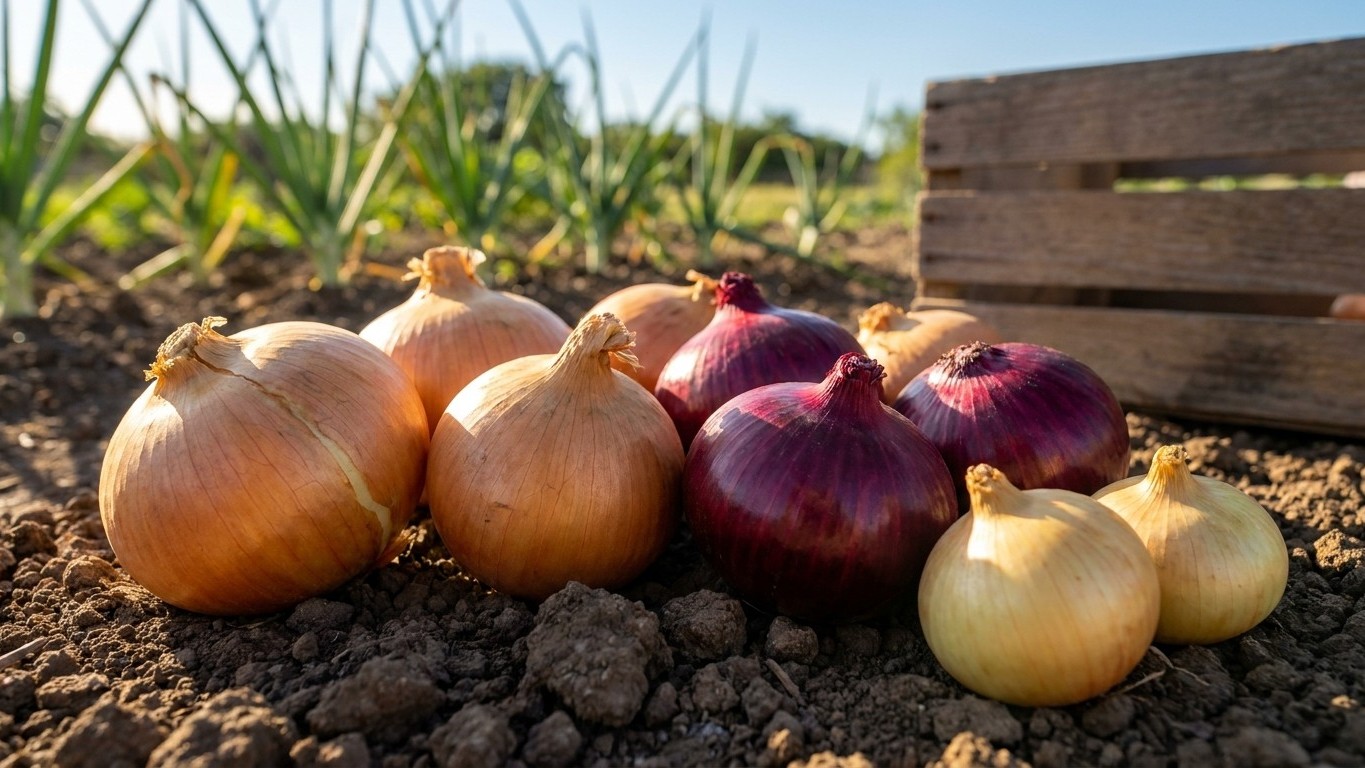

At Houston’s latitude, roughly 30 degrees north, only short-day onions reliably form bulbs. Five documented varieties match this territory outright: Gabriella, Madalyn, Red Sensation, Texas Grano 1015Y, and Vidora. Long-day and most intermediate-day types will grow lush tops here and never bulb at all, because the trigger they need, over 14 hours of summer daylight, simply doesn’t happen this far south.
How long your longest day is

The reference point for this territory sits at 29.98 degrees north, the latitude of the Houston weather station (IAH) that also supplies the frost data below. On the longest day of the year, that location gets 13 hours and 56 minutes of daylight. That single number decides almost everything else in this article.
Onions don’t bulb because the weather warms up. They bulb because the day gets long enough, a response tied to daylight hours, not temperature. Short-day varieties start switching from leaf growth to bulb growth once they see about 12 hours of light, a threshold documented by Clemson Cooperative Extension’s Home & Garden Information Center. At 13 hours 56 minutes, this territory clears that threshold with room to spare, well before the calendar reaches the solstice. That’s the good news: short-day onions here won’t just bulb, they’ll bulb early and reliably, and knowing When to Plant Onions in Texas makes the most of that early bulbing window.
Long-day onions need something this territory can’t give them, typically 14 to 16 hours of daylight at the peak of summer. That gap of just over an hour might sound trivial, but an onion plant doesn’t round up. If the day never reaches its threshold, the bulbing signal never fires.
Texas is a big state, big enough that this single figure doesn’t describe the whole thing. A gardener near the Red River is several degrees of latitude north of Houston, and daylight hours climb with latitude. Someone gardening near Amarillo or Texarkana should check their own city’s coordinates and longest-day daylight total rather than assume the Gulf Coast number applies to their yard. The Panhandle, in particular, sits closer to the boundary where intermediate-day varieties start to make sense, though even there, true long-day onions remain out of reach. If you’re near the state’s northern edge, treat the Houston figure as a floor, not a fact about your own garden.
Which varieties bulb in Texas
Five short-day varieties have published latitude ranges that cover 29.98 degrees north without qualification: Gabriella (20-35N), Madalyn (20-35N), Red Sensation (25-35N), Texas Grano 1015Y (25-35N), and Vidora (25-35N). These are the safe bets for a garden at this latitude, and for a deeper look at each option, see The Best Onion Varieties for Texas; it’s not a coincidence that Texas Grano types carry the state’s name in their catalog listing.
Two more sit close enough to a published boundary that they fall into a blurred zone rather than a clear yes. Red Rock (30-36N) and White Castle (30-38N) both list a lower bound just above this territory’s 29.98 degrees. That’s close enough that either variety may still bulb here, especially in a warm year or a slightly earlier planting, but a gardener trying them should understand they’re planting at the edge of the documented range, not in the middle of it.
What happens when the wrong variety goes in the ground
Twenty-four varieties on record have published ranges that start well north of this latitude, meaning the day here never gets long enough to trigger them. That list includes long-day types like Ailsa Craig, Bridger, Frontier, New York Early, Patterson, Powell, Red Carpet, Redwing, Rossa di Milano, Safrane, Talon, and Walla Walla Sweet, along with intermediate-day types such as Cabernet, Calibra, Candy, Elsye, Expression, Monastrell, Red Long of Florence, Red Long of Tropea, Scout, and Sierra Blanca, plus long-day Barolo and Blush.
A gardener who’s bought a bag of sets at a supermarket and watched them grow tall, green, and completely bulbless has likely already met one of these varieties. Because the plant never gets its daylight cue, it keeps putting energy into leaves all summer. Then the heat arrives, the plant stresses, and instead of a bulb sitting at the surface, you get a soft, rotting stem with nothing worth harvesting underneath. It isn’t a small onion or a slow onion. It’s no onion, and no amount of extra water or fertilizer changes that, because the problem is daylight, not care.
When to plant onions in Texas
Because this territory clears the short-day threshold so easily, planting timing here follows a different calendar than it does farther north. Instead of waiting for spring, gardeners at this latitude typically plant onions in the fall, letting the plant establish roots and some top growth through the mild winter before the lengthening spring days trigger bulbing.
The frost dates from NOAA’s 1991-2020 Climate Normals for the Houston station (IAH) give the frame for that timing. The average window for the first fall freeze runs from December 1 to December 19, and the average last spring freeze falls between February 4 and March 1. Onion transplants and sets are generally tolerant of light frost once established, which is part of why a fall planting works at all in a place with a winter this mild.
Averages aren’t guarantees
Those dates describe a 30 to 70 percent probability band for a 32-degree freeze at one specific weather station, not a promise. IAH itself runs about two weeks cooler than Houston’s Hobby Airport, which sits closer to the coast, so even within the same metro area, the safe window shifts. A gardener relying on these figures should treat them as a planning guide, watch an actual forecast as the date approaches, and keep row cover on hand for a surprise cold snap rather than assuming the averages will hold every year.
It’s also worth repeating that this is a Houston-specific window. Texas stretches across four USDA hardiness zones, and the Panhandle freezes months earlier in fall and months later in spring than the Gulf Coast does. A planting calendar built on IAH data has no business being used for a garden near Lubbock or Amarillo. If you’re gardening outside the Gulf Coast region, look up your own station’s climate normals rather than borrowing this one.
Sweet onions or onions that keep
What lands in a Texas garden at this latitude leans toward sweet, and that comes with a real cost: those onions won’t last long in the pantry. The University of Missouri Extension puts it plainly, noting that as a rule, sweet onions do not store as well as more pungent types.
The reason is chemical, not a matter of variety quality. An onion’s bite comes from volatile sulfur compounds, and those same compounds double as a preservative, slowing the bulb’s breakdown in storage. A sweet variety produces fewer of them, which is exactly what makes it pleasant raw on a sandwich, but it also means the cell walls break down faster once the onion is out of the ground. There’s no way to get the mild flavor and the long shelf life from the same bulb; the chemistry that gives you one takes away the other.
This trade-off tracks with day length across the country. Short-day varieties, the ones suited to this latitude, generally run sweeter and milder, while long-day varieties, grown farther north where the summer days run longer, tend toward the sharper, more pungent flavor that also keeps for months. A gardener at 29.98 degrees north growing Texas Grano 1015Y or Vidora should plan to eat most of the harvest within a couple of months of pulling it, not stack it in a pantry basket expecting it to still be good in March. That’s not a failure of storage technique. It’s built into the variety, the same way the daylight at this latitude is what made that variety bulb in the first place. A root cellar or a mesh bag in a cool closet will stretch things out somewhat, but the honest plan for a Gulf Coast harvest is to use it fresh, share it, or work it into salsas and pickles rather than betting on long-term storage.