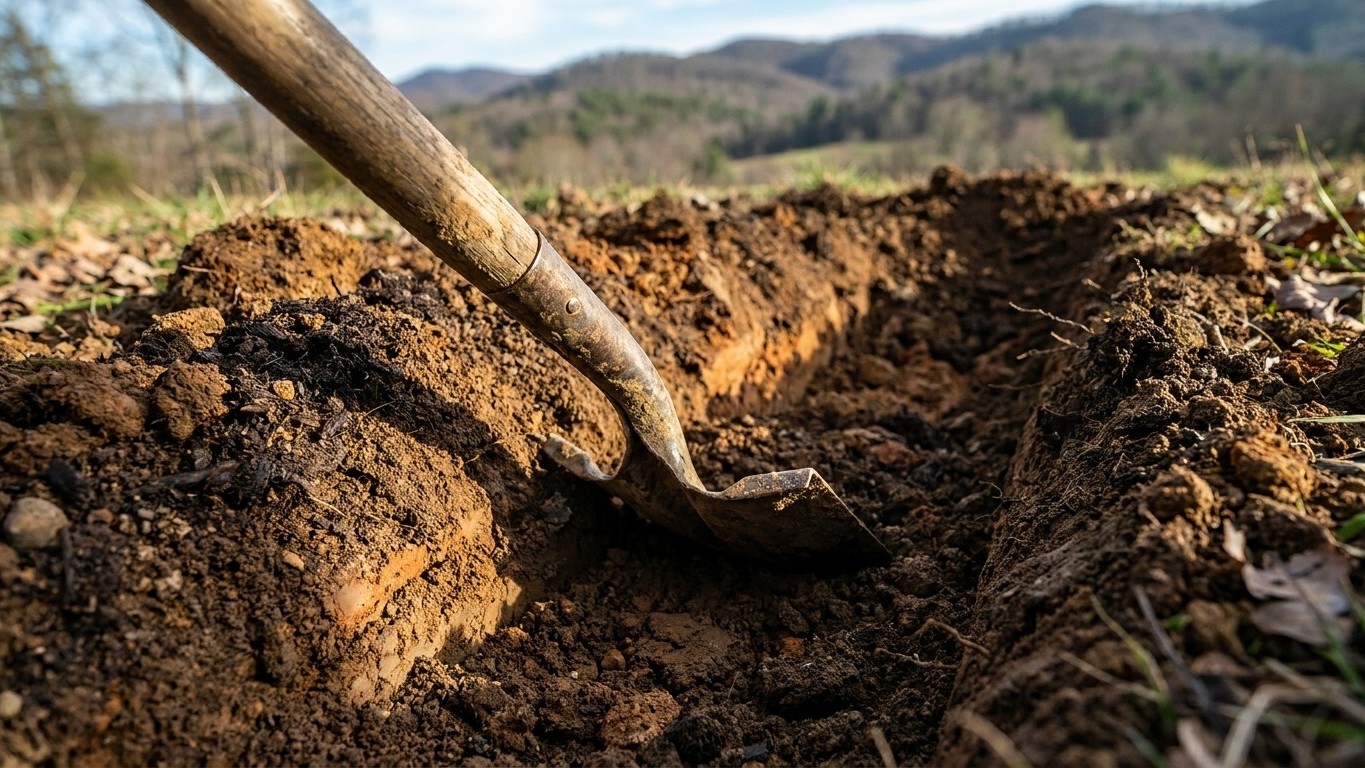

Dig a shovel into ground almost anywhere in West Virginia’s hill country and you’re likely hitting the Monongahela series, the soil the state named its official representative in 1997. It’s acidic, silty, and older than most of the farms built on top of it. Here’s what that means for your garden, and what to do about it.
What is under your garden

The Monongahela series is West Virginia’s official state soil, and it belongs to a soil order called Ultisols: old, heavily weathered, leached ground that’s been losing nutrients to rainfall for thousands of years. Ultisols are naturally acid and naturally poor, which is exactly the profile USDA measurements show for this series. The surface horizon runs strongly acid at a pH of about 5.0. Texturally it’s a loam to silt mix: 27 percent sand, 18 percent clay, and 54 percent silt, the kind of ground that holds together without turning to brick. Organic matter sits around 3.0 percent, respectable for a soil this old, and drainage is rated moderately well drained, meaning water moves through but not in a hurry.
| Reading | Value |
|---|---|
| Surface pH | about 5.0 (strongly acid) |
| Sand | 27 percent |
| Clay | 18 percent |
| Silt | 54 percent |
| Organic matter | about 3.0 percent |
| Drainage class | moderately well drained |
Now the honest part. This is the soil that represents West Virginia in the official sense, the one a committee of soil scientists picked because it’s widespread and characteristic of the state’s hill country. It is not the soil in every backyard from Wheeling to Bluefield. River bottoms run sandier and drain faster. Ridge tops can be thinner and rockier. And if a builder scraped your lot, brought in fill, or graded a foundation pad, you’re gardening in something that has nothing in common with a 10,000-year-old soil profile. Subdivision dirt is its own category entirely, usually compacted subsoil with none of the structure or organic matter a mature soil builds up.
So don’t take the number 5.0 as your number. Test your own ground instead, and you can do a rough version in five minutes.
Reading your own soil in five minutes
Grab a handful of moist soil and squeeze it between thumb and forefinger, pushing it upward into a ribbon. If it won’t ribbon at all and falls apart, you’ve got a sandy soil. If it ribbons an inch or two before breaking, that’s loam, similar territory to the Monongahela series itself. If it ribbons past two inches and feels slick, you’re dealing with heavy clay. Then run the jar test: fill a clear jar a third full of soil, top it with water, shake hard, and let it sit overnight. Sand drops first and settles on the bottom within minutes, silt settles next over a few hours, and clay stays suspended longest, forming the top layer by morning. Measure the layers and you’ve got a rough percentage breakdown of your own ground, no lab required.
Testing before you amend
Guessing at soil amendments is one of the more expensive habits in gardening. Lime a soil that’s already near neutral and you push it toward the alkaline range where iron and manganese become unavailable to plants. Skip lime on truly acid ground and your fertilizer dollars get wasted, because phosphorus locks up chemically before roots ever reach it. A soil test costs a few dollars and tells you exactly where you stand: current pH, phosphorus and potassium levels, sometimes organic matter percentage. Your eyes can’t measure any of that. Dark soil doesn’t mean fertile soil, and pale soil doesn’t always mean poor soil.
Given the regional pattern, a West Virginia gardener can reasonably expect acid ground, somewhere in the 5.0 to 6.0 range on unamended soil. But expecting isn’t knowing, and hill soils vary block to block depending on parent rock and past land use.
Here’s how to pull a sample that actually represents your garden, not just one lucky (or unlucky) spot:
- Choose one area to test at a time, keeping vegetable beds, lawn, and ornamental beds separate since they get different treatment.
- Pull 8 to 10 cores per area using a trowel or soil probe, going down 6 to 8 inches, the depth where most vegetable and flower roots actually feed.
- Mix all the cores together in a clean bucket, breaking up clumps and removing rocks, roots, and mulch.
- Let the mixed sample air dry on newspaper for a day if it’s wet, since labs prefer a dry sample.
- Bag about a pint of the mixed soil and label it with the area name and date.
- Submit it through your county extension office along with the short form asking what you’re growing there.
The results come back with a specific pH reading and specific nutrient levels for your ground, not a state average. That’s the number you amend against.
Amending it
Once you know your actual pH, the correction follows a clear logic. For ground that tests near the state soil’s baseline of about 5.0, well below the 5.5 threshold where most vegetables and lawns start struggling, lime is the tool, and sulfur has no business anywhere near it.
Lime for acid ground
Acid soil below 5.5 locks up phosphorus in forms roots can’t absorb, and it makes life miserable for brassicas like broccoli and cabbage, which are sensitive to low pH and clubroot disease thrives in exactly this range. Ground limestone raises pH by neutralizing soil acidity, but it works on a timeline measured in seasons, not weeks. Lime needs to dissolve and react through the soil profile, and that process typically takes six months to a year to show its full effect. Apply it in fall so winter freeze-thaw cycles help work it in before spring planting. Never apply sulfur to soil already this acid; that only pushes pH lower and makes the underlying problem worse.
Organic matter for the clay fraction
At 18 percent clay, the state soil isn’t heavy clay, but plenty of West Virginia gardens run higher. Heavy clay holds nutrients and water well but drains slowly and compacts easily underfoot. The fix is organic matter, compost, aged leaf mold, worked in every season, which opens up pore space and lets roots and water move. Resist the old advice to add sand to clay; the two combine into something closer to concrete than soil. And never work clay while it’s wet, since that’s when compaction does the most lasting damage. This is a three-season project, not a one-time fix.
Organic matter for the sandy fraction
At 27 percent sand, the state soil holds moisture reasonably well, but sandier pockets drain fast and lose nutrients with every rain. Compost and organic mulch again do the work, adding water-holding capacity that pure sand lacks. Expect to water shorter and more often rather than deep and infrequent, since sandy ground simply can’t bank moisture the way loam does. Unlike clay, sandy soil often responds within a single growing season once organic matter is worked in.
Drainage and compaction
The Monongahela series carries a moderately well drained rating, meaning water moves through the profile at a workable pace but doesn’t disappear instantly the way it does in pure sand. In practice, that means standing water after a hard rain should soak in within a few hours, not linger for days. If your garden holds puddles overnight, something other than natural drainage is at work, usually compaction.
Test it yourself with a percolation test. Dig a hole 12 inches deep and about the same across, fill it with water, and let it drain completely once to saturate the surrounding soil. Refill it a second time and time how fast the water level drops. A rate of 1 to 2 inches per hour is workable for most garden plants. Under half an inch per hour signals a drainage problem, often a compacted subsoil layer or dense clay pan that water can’t push through.
Compaction from foot traffic, riding mowers, or construction equipment packs soil particles together and squeezes out the air spaces roots need. Double digging, the old practice of turning soil two shovel-depths down, has fallen out of favor because it disturbs soil structure and microbial life more than it helps; most extension agronomists now recommend surface amendment and minimal disturbance instead. When a percolation test comes back slow and the ground has been driven on or built on, a raised bed is often the more honest answer than three years spent fighting a compacted subsoil. It’s not a failure to install one.
- Do: add organic matter yearly and keep foot traffic on paths, not beds
- Avoid: tilling or digging when soil is wet, and avoid parking equipment on garden soil
- Consider elsewhere: deep-rooted perennials and shrubs in spots with consistently slow drainage, where vegetables would sit in wet feet
Local help
West Virginia University Extension runs the state’s soil testing program through county offices statewide. Submit a sample and get back a pH and nutrient report specific to your plot, not a regional estimate. Staff at the county office typically walk through the results with you and translate the numbers into an actual amendment plan. Find your county contact and program details at extension.wvu.edu.
Common questions
Is all West Virginia soil acidic?
Much of it runs acid because of the state’s geology and rainfall pattern, but acidity varies by location and by how the land has been used. Testing your own soil is the only way to know your actual number.
How long does lime take to work?
Expect six months to a year for lime to fully raise soil pH, since it needs to dissolve and react through the soil profile. Fall application, ahead of spring planting, gives it the most time to work.
Can I skip testing and just add compost every year?
Compost helps almost any soil and rarely causes harm, but it won’t correct a serious pH imbalance on its own. Testing tells you whether lime or sulfur is also needed and how much.
Why does my new-construction yard seem worse than my neighbor’s older garden?
Graded and filled lots often have subsoil exposed at the surface, stripped of the organic matter and structure that natural soil builds up over centuries. It typically needs more amendment and more time than established ground nearby.