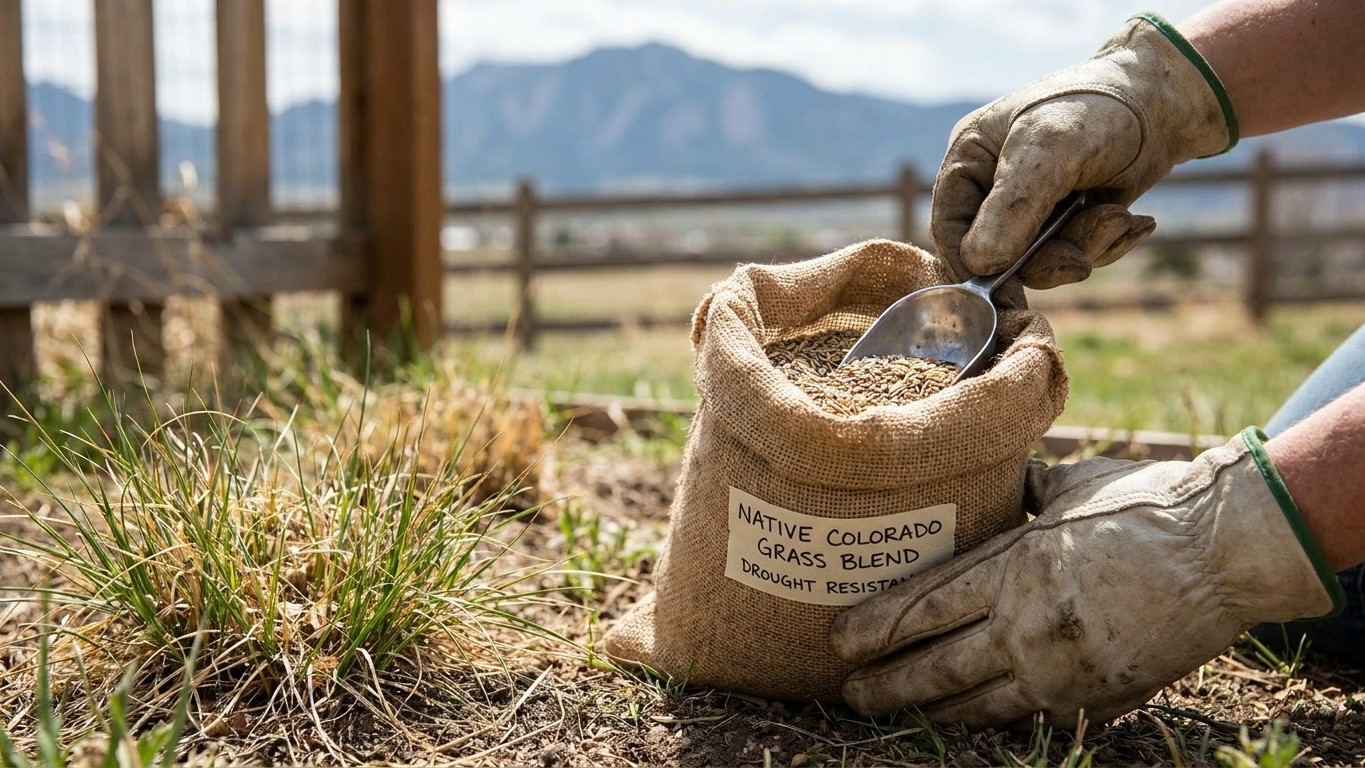

Colorado’s front-range climate splits every lawn choice into the same trade: green grass in fall, or tougher grass through July’s heat, never both from one seed. Cool-season types like tall fescue and Kentucky bluegrass hold their color into autumn but need steady water to survive summer; warm-season types like zoysiagrass and bermudagrass shrug off the heat but sit brown for months once the first frost hits. There’s no way around that trade, only a choice. Decide which season you’d rather sacrifice, and let that answer point you to the right seed.
The short answer for Colorado
There is no single best grass seed for a Colorado lawn, because the Front Range around Denver falls in what turf researchers call a transition zone: warm enough in summer to stress cool-season grass, cold enough in winter to stress warm-season grass. Clemson Cooperative Extension (HGIC 1214) lists five species grown here for exactly this reason: tall fescue, Kentucky bluegrass and perennial ryegrass on the cool-season side, zoysiagrass and bermudagrass on the warm-season side. Penn State Extension also names tall fescue, Kentucky bluegrass and perennial ryegrass among the standard cool-season lawn species, confirming the same short list.
A cool-season lawn stays green through spring, holds color into fall, and is still green when Denver’s first freeze arrives between September 30 and October 12 in a typical year, per NOAA’s 1991-2020 climate normals. Its cost shows up in July: without regular irrigation it thins and browns under sustained heat.
A warm-season lawn does the opposite. It grows fastest and toughest through the hottest, driest weeks of summer, then goes dormant at that same first fall frost and stays a tan-brown color until it greens back up the following late spring. That’s roughly five to six months of brown lawn on the Front Range, which is the real price of summer toughness.
Which one is best depends on what you’re optimizing for: a green lawn from fall through late spring, or a lawn that needs less water and mowing through the hottest weeks of summer. Elevation, irrigation access and how far you are from Denver all shift that answer, which is why the figures above are anchored to the Denver area specifically rather than the whole state.
Working through the year

Ranked by how well each grass actually performs on a typical Front Range lawn, cool-season options come first, because most Colorado properties are irrigated enough to support them and most owners want green lawn in fall, not summer.
Tall Fescue

Tall fescue is the safest default for most Denver-area lawns. It roots deeper than Kentucky bluegrass, which lets it pull through hot stretches with less supplemental water, and it still holds color into the fall frost window Denver sees between September 30 and October 12, per NOAA’s 1991-2020 normals. The cost: it doesn’t spread by rhizome the way bluegrass does, so bare patches from foot traffic or grubs need to be reseeded rather than filling in on their own. Clemson’s Tall Fescue Maintenance Calendar (HGIC 1219) lays out the mowing, feeding and overseeding schedule for the species once it’s established.
Kentucky Bluegrass

Kentucky bluegrass gives the classic dense, fine-textured, deep green lawn and self-repairs through underground rhizomes. Its cost is water. It’s the thirstiest of the three cool-season grasses and shows drought stress fastest once July heat sets in.
Perennial Ryegrass

Perennial ryegrass germinates faster than either of the above, which is why it’s usually sold blended into a fescue or bluegrass mix rather than seeded alone. It buys quick cover on bare soil, but its heat tolerance is the weakest of the cool-season group, and it thins out first when summer gets long and dry.
Zoysiagrass

Zoysiagrass is dense enough to choke out most weeds on its own and tolerates drought once established, which trims summer watering. The cost is the brown season. Clemson’s Zoysiagrass Maintenance Calendar (HGIC 1217) times its first mowing and feeding to well after spring greenup, because it wakes up slower than the cool-season grasses do. Seed-grown zoysia is also slow to fill in, so most Colorado installs go in as sod or plugs instead of seed.
Bermudagrass

Bermudagrass is the toughest of the five against heat and drought and the cheapest to seed. It’s also the least cold-hardy, and a hard winter on the plains can thin or kill stands that were already struggling. Clemson’s Bermudagrass Maintenance Calendar (HGIC 1216) calls for feeding only once it’s actively growing in late spring. Feeding it earlier or later than that schedule invites exactly the kind of stand loss bermudagrass is prone to in this climate.
| Species | Season type | Main advantage | Main cost |
|---|---|---|---|
| Tall Fescue | Cool-season | Deep roots, moderate drought tolerance | Doesn’t self-repair, needs reseeding |
| Kentucky Bluegrass | Cool-season | Self-repairing, dense green | Highest water need |
| Perennial Ryegrass | Cool-season | Fast germination | Weakest heat tolerance |
| Zoysiagrass | Warm-season | Dense, drought tolerant once established | Long brown season, slow from seed |
| Bermudagrass | Warm-season | Most heat and drought tolerant | Least cold-hardy, longest brown season |
What changes across Colorado
Every figure above is measured at or near Denver, sitting at 5,280 feet on the plains. The rest of the state runs on a different clock.
Mountain towns at higher elevation see a much shorter growing season than Denver’s. Frost can arrive there in what’s still summer on the plains, which narrows the window for establishing any new grass, cool-season or warm-season, and makes warm-season species a riskier bet the higher you go. They may not have enough warm days left to establish before the first freeze shows up.
The western slope runs on the opposite pattern. Lower-elevation valleys there see a longer stretch of warm weather than the Denver area does, which favors the warm-season species, zoysiagrass and bermudagrass, more than the plains do, and can push the cool-season lawn’s July stress period longer as well.
Within the Front Range itself, a lawn in full sun on a south-facing slope dries out and heats up faster than the same species planted in afternoon shade, regardless of which grass it is. That’s a site difference, not a regional one, but it changes the practical answer for two houses on the same street.
None of this changes which five species are realistic choices, that list holds statewide. It changes the timing: when to seed, when growth stops for the year, and how much margin you have if a planting runs late. Coloradans outside the Denver area should treat the frost window above as a starting point and confirm it against local records before committing to a fall seeding date.
The mistakes this climate punishes
Colorado’s transition-zone climate is unforgiving of timing mistakes that would barely register somewhere with one dominant grass type.
- Overseeding cool-season grass in the heat of summer. Seed sown in the hottest weeks germinates poorly and what does come up gets scorched within weeks; the fix is seeding in spring or ahead of the fall frost window instead.
- Feeding a warm-season lawn late into fall. Nitrogen applied to zoysiagrass or bermudagrass as they should be hardening off for dormancy pushes soft new growth that winterkills, and the dead patches don’t show until the following spring greenup.
- Mowing a cool-season lawn too short during a hot, dry stretch. Scalped grass loses the leaf area it needs to shade its own roots, and the stress shows as browning and thinning within a couple of weeks rather than right away.
- Treating a dormant warm-season lawn as dead. A tan, brown lawn from first frost through spring is normal dormancy, not a dying lawn, and ripping it out or oversaturating it with water in the middle of winter wastes money and can invite fungal problems once it does warm up.
- Planting a warm-season species somewhere the season is too short to establish it. In mountain towns with a much shorter frost-free window than Denver’s, bermudagrass and zoysiagrass may not root deeply enough before the first freeze, which shows up as a lawn that never filled in at all.
Most of these mistakes trace back to one habit: applying a single calendar to a state that grows two different kinds of grass on two different clocks. The Colorado Lawn Care Calendar, Month by Month breaks the year down by task and by season type, which is the fastest way to check whether a given week is right for your particular grass.
Checking this against your county
Everything above is anchored to Denver’s climate data. A property in a mountain valley, on the western slope, or even just at a higher elevation within the same county can run weeks ahead of or behind that schedule. Before buying seed or setting a fall seeding date, check current local recommendations with Colorado State University Extension, which can confirm frost timing and species performance for your specific area.
If you haven’t worked through the basics of watering, mowing height and soil prep yet, start with the fundamentals in Colorado Lawn Care before choosing a species, since the right grass for a given yard depends partly on how much irrigation and maintenance that yard actually gets.
Common questions
Can I mix cool-season and warm-season grass seed in the same lawn?
Not in the same stand. The two types green up and go dormant on opposite schedules and need different mowing heights, so a mixed stand ends up looking patchy for most of the year. If you want both, keep them in separate, clearly bordered areas rather than blending the seed.
Will Denver frost dates apply to my mountain property?
No. NOAA’s 1991-2020 climate normals used above are measured at Denver, sitting at 5,280 feet. Mountain towns at higher elevation see frost far earlier in the year and a much shorter frost-free season, so treat the Denver window as a starting point only and confirm local timing before seeding.
How long does a warm-season lawn actually stay brown here?
Roughly from the first fall frost, which falls between September 30 and October 12 in a typical Denver-area year per NOAA, until it greens back up the following spring. That’s the trade-off for its summer toughness, and the brown color is dormancy, not a dead lawn.
Is tall fescue or Kentucky bluegrass a better choice for a Front Range lawn with limited irrigation?
Tall fescue generally handles limited water better because it roots deeper, while Kentucky bluegrass tends to show drought stress sooner in July heat. Neither will look its best through a long dry stretch without at least some supplemental watering.