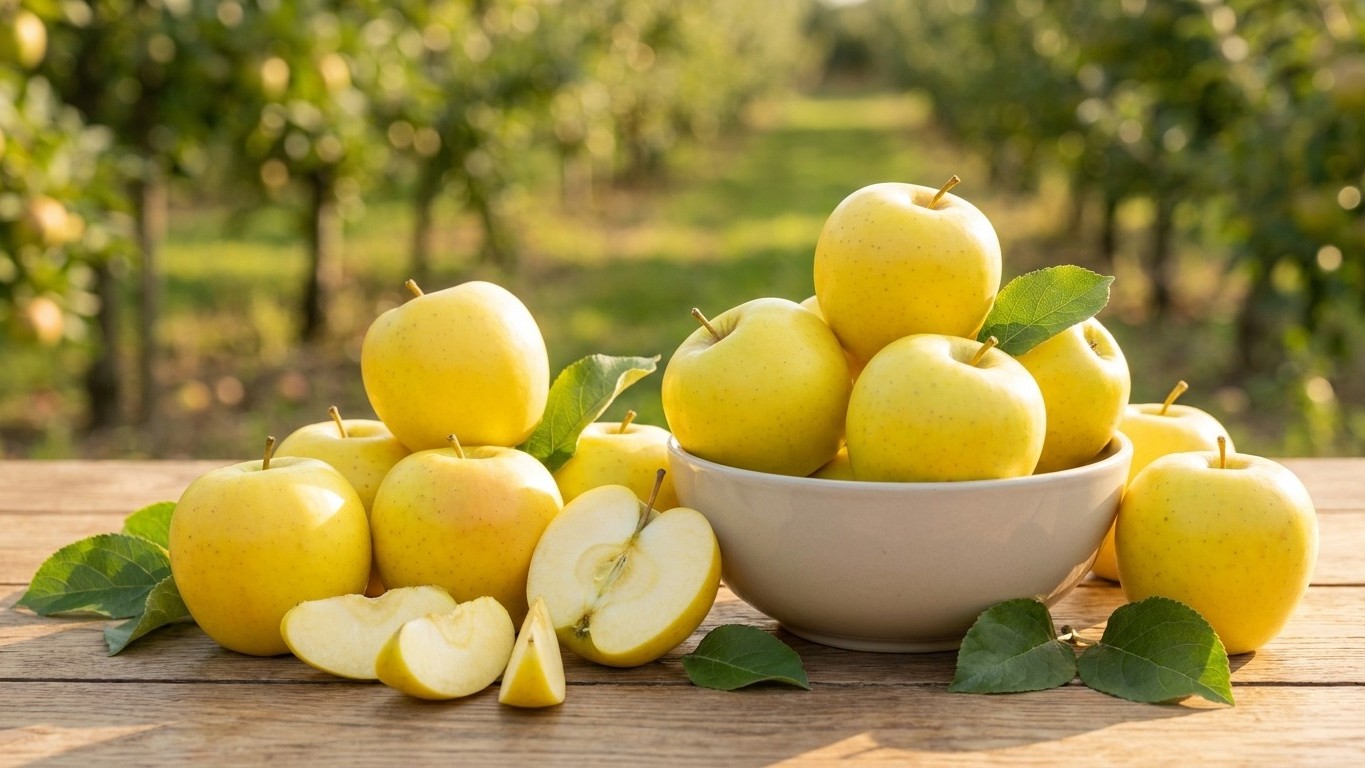

Dorsett Golden ripens with sweet, mild, firm yellow flesh and almost no tartness, best eaten fresh rather than baked. It sets fruit with pollen from the Anna apple, needs only 250 to 300 chill hours, and flowers early in the season (bloom group A) according to Clemson HGIC and UF/IFAS extension data. Here’s what that means for a home orchard.
What Dorsett Golden actually is

- When it ripens: not given as a calendar date in the sourced fact sheets, though its early bloom group points to an early harvest window relative to other apples in the same garden.
- What it tastes like: sweet and mild, with firm yellow flesh and little acidity.
- What it is good for: fresh eating.
- How Long It Keeps: not published in the sourced material.
That last two points matter more than they look. A sweet apple with little acidity is a dessert apple, not a pie apple, and the difference is chemical rather than a matter of preference. Acidity is what lets a slice hold together through baking heat; without it, low-acid flesh tends to collapse into sauce faster than a tart variety would. Dorsett Golden’s flesh profile, firm and mild, points a grower toward the fruit bowl rather than the pie dish, and toward slicing for salads or eating out of hand rather than cooking down.
None of the sourced material lists an alternate market name for Dorsett Golden, so a shopper buying it under that name is buying the variety itself, not a rebrand of something else sold under a different label elsewhere.
The variety’s bloom group, A, is worth flagging here even though it belongs more properly to the pollination conversation below. Bloom group is a relative order of flowering, not a fixed date. In a warm Florida spring or a mild California one, group A varieties open first among apples grown nearby; the calendar date shifts with the climate, but the order among varieties in the same yard does not. That relative timing is exactly what makes cross-pollination between two varieties possible or impossible, and it is the reason bloom group shows up again in the next two sections.
Will it grow where you are
Hardiness zone
The sourced fact sheets for Dorsett Golden don’t publish a USDA hardiness zone range for this variety. What UF/IFAS does publish is a regional framing: the guidance covers apple growing in north and north-central Florida specifically, which tells a grower more about climate than a zone number alone would. Hardiness zones describe winter cold tolerance; they say nothing about whether a tree gets cold enough, which is the second and often overlooked filter.
Winter chill
Dorsett Golden needs 250 to 300 chill hours, according to UF/IFAS MG368, the extension publication covering apple growing in north and north-central Florida. Chill hours count the accumulated time a tree spends below roughly 45°F during dormancy, and a tree that doesn’t get enough of them can leaf out unevenly, flower sparsely, or skip fruiting almost entirely the following spring. A requirement of 250 to 300 hours is low by apple standards; most northern varieties want 700 to 1,000 hours or more. That low number is exactly why Dorsett Golden shows up on lists for the Gulf Coast, the Deep South, and other regions with mild winters where classic Northern apples simply never accumulate enough cold to fruit reliably. A grower in a genuinely cold-winter state doesn’t need to worry about chill hours at all; the concern runs the other direction, toward gardens where winter barely bites.
What to plant beside it
Nearly all apple varieties crop better with a compatible partner nearby, and Dorsett Golden is no exception. The sourced material names one confirmed partner:
- Anna
Anna works as a pollinator because it shares the same early bloom window, bloom group A, so the two trees have open flowers at the same time for bees to move pollen between them. Timing overlap is the whole game in apple pollination; a partner that blooms three weeks later or earlier than Dorsett Golden simply won’t have open flowers when Dorsett Golden does, no matter how compatible the varieties are genetically.
No other partner variety appears in the sourced fact sheets, and no exclusion (a parent variety unable to pollinate its own seedling, for instance) is named for Dorsett Golden either. That doesn’t mean Anna is the only tree on earth that could do the job. It means Anna is the pairing that’s actually documented, and it’s the one worth planting if a grower wants a result backed by extension research rather than a guess. For anyone weighing other candidates or building out a small orchard with more than two trees, the general logic of matching bloom groups and confirming known-compatible pairs is covered in more detail on our apple pollination guide.
A practical note for low-chill regions specifically: because both Dorsett Golden and Anna were selected for warm-winter climates, a grower in north Florida or a similar zone gets a pairing that’s suited to the same conditions on both ends, rather than one tree thriving and the other struggling to break dormancy.
Growing it well
Disease pressure
The sourced fact sheets don’t publish a fire blight rating for Dorsett Golden specifically. That’s a gap worth naming rather than papering over with a guess. Fire blight is a bacterial disease common in warm, humid apple-growing regions, spreading fastest during wet, warm bloom periods, so a grower in the Gulf Coast or Deep South where this variety is typically planted should still watch new growth each spring for the blackened, wilted “shepherd’s crook” shoot tips that signal an active infection, and prune affected wood back into healthy tissue promptly regardless of a variety’s documented rating.
Growth habit and cropping
Mature tree size depends on rootstock, not on the Dorsett Golden variety itself; no rootstock is specified in the sourced material, so no mature height can be given here without inventing one. What the sourced data does establish is the early bloom timing (bloom group A) and the low chill requirement, both of which push this tree toward an early-season growing rhythm in warm climates. Whether Dorsett Golden tends toward biennial bearing, alternating a heavy crop one year with a light one the next, isn’t addressed in the sourced fact sheets either, so a grower should watch their own tree’s pattern over a few seasons rather than assume one either way. The same goes for thinning: no specific thinning guidance is published for this variety, though thinning young fruit to reduce crowding is standard practice across most apple varieties to improve fruit size and reduce the strain that can contribute to biennial bearing in trees that are prone to it.
Picking it and keeping it
The sourced fact sheets don’t give a specific harvest date for Dorsett Golden, which puts the burden on the grower’s own judgment rather than a calendar. The standard sequence for checking ripeness on any apple, applied here in the absence of a published date, runs in order:
- Lift and twist a fruit gently where it meets the branch; a ripe apple separates easily, while one that resists and has to be pulled or cut isn’t ready yet.
- Cut one fruit open and check the seeds; brown or dark seeds signal ripeness, while pale or white seeds mean more time is needed.
- Check the ground color, the background color visible between any blush or stripe; a shift from green toward yellow generally tracks with ripening in yellow-skinned apples like this one.
Storage
No storage duration is published in the sourced material for Dorsett Golden. As a general rule across apple varieties, fruit developed for early-season, warm-climate growing tends to hold for a shorter window than late-season Northern apples bred for winter cellar storage, so a grower is better served planning to eat or process this crop promptly after harvest rather than counting on months of cold storage.
Common questions
Does Dorsett Golden need another apple tree to produce fruit?
Nearly all apple varieties, including this one, crop better with a compatible pollinator nearby. Anna is the confirmed partner named in the sourced fact sheets.
Can I bake with Dorsett Golden apples?
It’s better suited to fresh eating. Its low acidity means slices tend to soften and lose shape faster during baking than a tart variety would hold up.
How cold can it get where I live and still grow this apple?
No hardiness zone range is published for this variety. The more useful number is its chill requirement, 250 to 300 hours, which points it toward mild-winter regions rather than genuinely cold ones.
Is Dorsett Golden the same apple sold under a different name?
No alternate market name appears in the sourced material for this variety.
Why does bloom group matter if I already have a pollinator tree?
Bloom group tells you whether two trees have open flowers at the same time. Dorsett Golden and Anna share bloom group A, so their flowering windows overlap even though the exact calendar dates shift depending on the local climate.