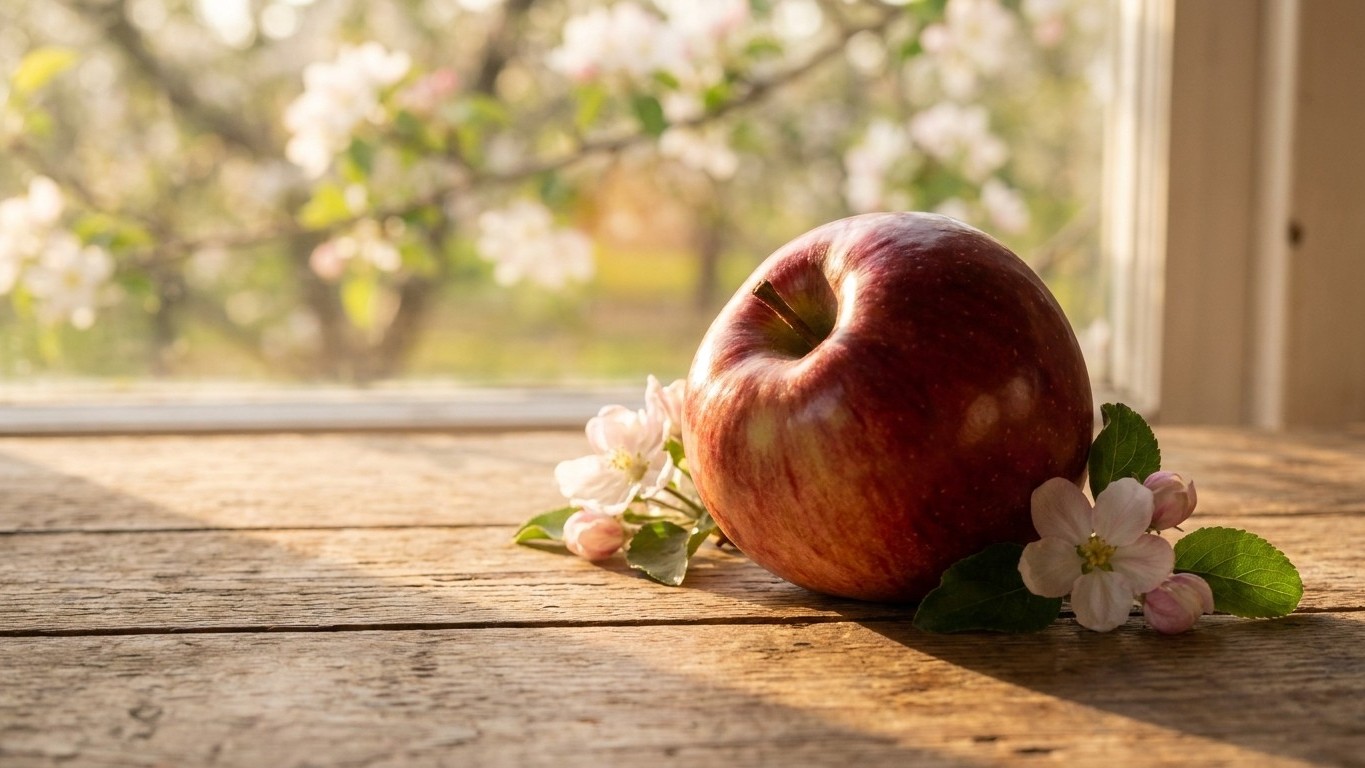

Mollie’s Delicious tells you a lot in its name: it’s grown for flavor first, not for shipping distance or shelf life records. It ripens in the fall, eats sweet and aromatic with juicy flesh, and pollinates with a specific list of partners you’ll want in the yard before you plant it. Here’s what a grower actually gets, and what it takes to get fruit.
What Mollie’s Delicious actually is

Mollie’s Delicious doesn’t carry a marketing alias the way Mutsu is sold under the name Crispin, or Pink Lady is sold as Cripps Pink. What’s on the nursery tag is what you’re planting, no second name to track down at the grocery store. That said, here’s the shorthand a grower actually needs:
- When it ripens: a fall-season apple; the exact calendar date isn’t standardized across regions, so growers rely on physical ripeness cues rather than a fixed date (covered below).
- What it tastes like: sweet and aromatic, with juicy, tender flesh.
- What it’s good for: fresh eating, pies, and sauce.
- How Long It Keeps: storage duration isn’t published in the source used for this page; treat it as a fall apple meant for reasonably prompt use rather than long-term cold storage, and confirm with your local extension office if you’re planning bulk storage.
The eating quality comes straight from Clemson Cooperative Extension’s variety table (HGIC 1350): sweet, aromatic, juicy, tender flesh. That’s a dessert apple’s profile, and it explains why the same source lists Mollie’s Delicious for fresh eating alongside pies and sauce. The reason a pie apple and a purely fresh-eating apple aren’t always interchangeable comes down to physics, not preference: flesh that holds its shape when heated, and acidity strong enough to survive baking without turning flat. Mollie’s Delicious apparently does both jobs, tender out of hand and structured enough for a pie filling, which is a fairly versatile combination for a home orchard that doesn’t want a different tree for every use.
Will it grow where you are
Hardiness
The source used for this page doesn’t publish a hardiness zone range for Mollie’s Delicious. That’s worth flagging rather than papering over: apple varieties vary enough in cold tolerance that a number from a different variety, or a guess, could steer a buyer wrong. Before ordering a tree, check the zone rating printed on the nursery’s own tag or catalog listing for the exact stock you’re buying, since rootstock and regional sourcing can shift that figure slightly from one supplier to the next.
Winter chill
Hardiness zone answers whether the tree survives winter. Winter chill answers something different: whether it gets enough accumulated cold hours to break dormancy properly and flower on schedule the following spring. Apples in general lean toward the higher-chill end of fruit trees, which is why they’re a staple crop in the northern and mountain states and a much trickier bet in the Deep South or low-desert Southwest, where winters often don’t deliver enough cumulative cold. No chill-hour figure for Mollie’s Delicious specifically is published in the source used here, so treat that number, too, as something to confirm locally rather than assume. A grower in a marginal-chill region is better served asking a nearby extension office or an established local orchard whether this variety performs reliably in their specific climate, since a shortfall in chill hours shows up as patchy, delayed, or uneven bloom rather than an outright crop failure.
What to plant beside it
This is where the facts are specific, and it’s the part worth writing down before a nursery trip. Mollie’s Delicious falls into bloom group B, a relative flowering order documented by Clemson HGIC 1350 and UGA Circular 740. That grouping shifts on the calendar depending on climate, but the order among varieties stays consistent, which is what makes pollen-partner matching reliable from one region to the next.
Varieties documented as capable of pollinating Mollie’s Delicious include:
- Fuji
- Gala
- Ginger Gold
- Granny Smith
- Jerseymac
- Red Delicious
- Yates
One exclusion matters more than it might seem. Mutsu flowers at the same time as Mollie’s Delicious, so on paper the timing looks perfect. But Mutsu’s pollen is sterile, meaning it can’t fertilize anything, Mollie’s Delicious included. Planting only those two trees together produces blossoms on schedule and no fruit, because the one variety in bloom range can’t actually do the job. If Mutsu is already in the yard, it still needs one of the varieties above (or a similar compatible partner) nearby to bear its own crop, and Mollie’s Delicious still needs a different, fertile partner regardless of what else is blooming at the same time.
Nearly all apple varieties crop better with a compatible partner nearby rather than relying on their own pollen, even the ones described as partly self-fertile. A neighbor’s tree within bee range, or even a well-timed crabapple, can sometimes fill that role, but for a predictable, heavy crop, matching one of the named varieties above is the safer bet. For the mechanics of bloom timing and how pollinizer distance affects fruit set, see our full apple tree pollination guide.
Growing it well
Fire blight
The source used for this page doesn’t assign Mollie’s Delicious a fire blight susceptibility rating, so there’s no specific number to translate here. That’s a gap worth treating seriously rather than assuming a low or moderate risk by default. Fire blight itself is a bacterial disease that spreads fast in warm, wet spring weather right around bloom time, and it shows up as blackened, wilted shoot tips that curl over into a shape often described as a shepherd’s crook. Any apple grower, regardless of variety, benefits from watching new growth closely in humid spring conditions and pruning out infected wood well below the visible damage, disinfecting shears between cuts.
Growth habit and biennial bearing
Specific habit details (tree spread, vigor, branching pattern) aren’t published in the source used for this page either, and none of those characteristics are determined by the variety alone in any case. Rootstock decides mature tree size and vigor far more than the fruiting variety does, so a mature height figure only means something once it’s paired with a named rootstock, something worth confirming directly with the nursery at purchase.
Biennial bearing, the tendency of some apple trees to produce a heavy crop one year and a light one the next, isn’t documented specifically for Mollie’s Delicious in the cited source. It’s a widespread trait across apple varieties generally, though, and the standard remedy is thinning: removing excess young fruit early in the season so the tree isn’t stretched thin setting next year’s flower buds while ripening this year’s crop. A grower who notices an unusually heavy set is better off thinning proactively rather than waiting to see whether the following year comes up short.
Picking it and keeping it
No specific harvest-window date for Mollie’s Delicious is published in the source used for this page, which makes the physical ripeness cues more useful than a calendar guess anyway. Rather than picking on a fixed date, check the fruit itself, in this order:
- Lift and twist a fruit gently. If it separates from the spur with a slight twist, it’s ready; if it resists and has to be pulled or cut, it needs more time.
- Cut one open and check the seeds. Ripening apples show seeds turning from pale green or white toward brown or dark brown.
- Check the ground color, the background color beneath any red blush, as it shifts from a hard green toward a softer green-yellow or cream.
Storage
Storage duration for Mollie’s Delicious isn’t specified in the source used here. As a general fall-apple practice, cool, humid storage (a basement root cellar or a refrigerator’s crisper drawer) slows ripening far more effectively than a countertop bowl, and separating apples from other produce limits ethylene exposure that speeds softening. For a specific expected shelf life, a local extension office or the nursery that supplied the tree is the more reliable source than a general estimate.
Common questions
Can Mollie’s Delicious pollinate itself?
Like nearly all apple varieties, it crops better with a compatible partner nearby rather than relying only on its own pollen. Planting one of the documented pollinizers, such as Gala or Red Delicious, gives a far more reliable crop.
Will planting a Mutsu tree next to it solve the pollination problem?
No. Mutsu blooms at the same time as Mollie’s Delicious, but its pollen is sterile, so it can’t fertilize Mollie’s Delicious or set fruit on its own. A third, fertile variety is needed if Mutsu is part of the pollination plan.
Is Mollie’s Delicious better for pies or for eating fresh?
Clemson Cooperative Extension lists it for both. Its juicy, tender, aromatic flesh works for fresh eating, and it’s also documented for pies and sauce, a combination that comes down to the flesh holding structure under heat while still tasting sweet raw.
What hardiness zone is Mollie’s Delicious rated for?
The source used for this page doesn’t publish a specific zone range. Check the rating on the nursery’s own tag or listing for the exact tree being purchased, since that can vary slightly by rootstock and supplier.
How do I know when to pick it, if there’s no exact date?
Use the lift-and-twist test, check the seed color inside a sample fruit, and watch the ground color shift from green to a softer green-yellow. Those three cues together are more reliable than any single calendar date.