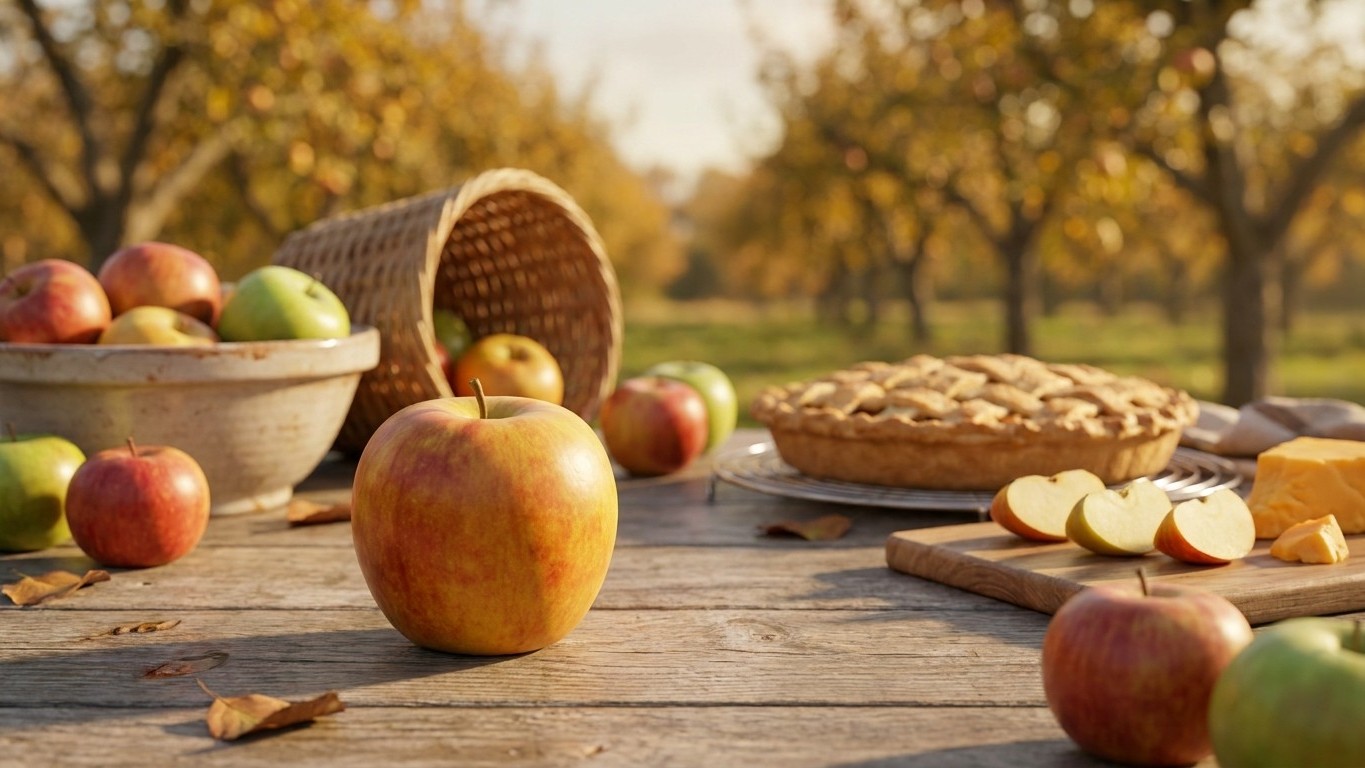

Suncrisp is a mid-to-late-season apple prized for a sweet-tart bite with a distinctive pear-like note and flesh dense enough to hold up in the oven. It ripens mid to late October, needs a documented pollination partner you’ll have to source elsewhere, and asks for more disease vigilance than a lot of newer varieties on the market.
What Suncrisp actually is

- When it ripens: mid to late October
- What it tastes like: sweet-tart, with a pear-like aromatic note and very firm flesh
- What it’s good for: firm enough for baking, with acidity that develops rather than fades in storage
- How Long It Keeps: not published as a specific duration in the source used for this page, though the acidity behavior points to decent keeping quality
The tasting notes are what set Suncrisp apart on a cider table or a cheese board. Most sweet apples lose their edge within a few weeks; Suncrisp is described as sweet-tart with a pear-like note, according to USU Extension’s Apple Production guide for the Utah home garden. That aromatic layer is unusual enough that people who grow it tend to mention it before they mention the sweetness.
The firm flesh matters more than it sounds. A soft apple collapses into applesauce the moment it hits oven heat, losing its shape and turning the acid flat and one-note. Suncrisp’s texture holds its structure through baking, and its acidity actually develops in storage instead of mellowing out the way it does in many varieties. That’s the physical reason it works for pies and crisps: the tartness a baked apple needs is still there weeks after picking, not just on harvest day.
None of that means Suncrisp is a snack-only or bake-only apple. It sits in the middle ground, firm enough to slice fresh and tart enough to hold its own against sugar and cinnamon in a crust. That flexibility is the main reason home orchardists plant it rather than a single-purpose variety that excels at one job and does nothing else well.
Will it grow where you are
Hardiness zones
Suncrisp is rated for USDA hardiness zones 4 through 7, according to USU Extension. That’s a wide band, running from cold-winter states like Minnesota and northern Wisconsin down through the mid-Atlantic and into the warmer edge of zone 7 in places like coastal Virginia or the Ozarks. If your winter lows regularly drop below zone 4 territory, or if you’re gardening in the deep heat of zone 8 and up, this variety sits outside its documented range.
Winter chill
Hardiness zone is only half the equation. Apple trees also need a minimum number of hours below about 45°F each winter to break dormancy properly and flower on schedule. This is the filter that trips up a lot of gardeners in the Deep South and parts of California, where winters are mild enough to satisfy the USDA zone map but too short on cold hours to wake the tree up right.
A specific chill-hour figure for Suncrisp isn’t published in the source used for this page, so it would be a guess to give one. What is clear from the hardiness range is that this variety belongs to a colder-climate profile than a low-chill apple bred for the Southeast or Southern California. If you garden in zones 4 through 7, and especially anywhere with a real winter, Suncrisp is working within its documented range. Anyone gardening warmer than that should treat the chill question as unresolved rather than assume it’ll be fine.
What to plant beside it
Nearly all apple varieties crop better with a compatible partner nearby, and Suncrisp is no exception in principle. But the source used for this page does not publish a specific list of pollination partners for Suncrisp. Rather than guess at a name and risk sending you to a nursery for the wrong tree, it’s worth saying plainly: the partner list is not documented here.
What is documented is Suncrisp’s bloom timing, which is mid-season. That’s useful on its own. Any variety you plant beside it needs to overlap in bloom, since pollen only travels between flowers that are open at the same time. A mid-blooming apple, or one with a bloom period wide enough to bridge into mid-season, gives you a fighting chance even without a confirmed match on record.
Two things to keep in mind before you plant on that basis alone. First, bloom overlap is necessary but not sufficient. Genetic compatibility matters too, and a parent variety generally cannot pollinate its own seedling even if both are in flower at the same moment, so knowing a tree’s parentage before assuming it’ll do the job is worth the extra step. Second, a crabapple with a long, overlapping bloom window is a reliable backup when you can’t confirm a full-size partner variety, and many home orchardists lean on one for exactly this kind of gap.
If you’re planning a small orchard and want the pollination question settled before you buy, the safest move is to check a dedicated apple pollination guide for confirmed mid-season partners and cross-reference bloom charts before committing to a single tree. Planting Suncrisp alone, on the assumption it’ll manage on its own pollen, is the riskiest version of this decision.
Growing it well
Fire blight susceptibility
Suncrisp is rated susceptible to fire blight, according to USU Extension. In the garden, that shows up as blackened, wilted shoot tips that curl into a shape often described as a shepherd’s crook, usually appearing in spring or early summer after a warm, wet bloom period. It spreads fast through open blossoms and can move down into larger limbs if it isn’t caught early. A susceptible rating means pruning out infected wood promptly, well below the visible damage, and avoiding heavy nitrogen fertilization, which pushes the soft new growth the bacteria prefers.
Growth habit
A specific growth habit for Suncrisp isn’t detailed in the source used for this page, so it’s not something to state as settled fact. What can be said generally is that mature tree size is set by rootstock, not by the variety grafted onto it, so two Suncrisp trees on different rootstocks can end up dramatically different heights. Anyone shopping for a tree should ask which rootstock it’s grafted to rather than assume the variety name tells them anything about final size.
Biennial bearing and thinning
Whether Suncrisp itself leans toward biennial bearing, heavy crops one year and light the next, isn’t documented in the source used here either. As a general practice across firm, mid-to-late-season apples, thinning young fruit to one apple per cluster in late spring reduces the strain that tends to trigger an off year, and it’s a reasonable habit to build in regardless of whether this specific variety has a documented tendency toward it.
Picking it and keeping it
Harvest for Suncrisp falls mid to late October, per USU Extension. That’s a real window, not a single date, and the exact day depends on your local season. Rather than watching a calendar, check the fruit directly using this sequence:
- Lift and twist an apple gently upward. If it separates from the spur with little resistance, it’s ready; if it clings and you have to pull hard, give it more time.
- Cut one apple open and check the seeds. Pale or greenish seeds mean the fruit is still immature; brown seeds are the standard sign of ripeness.
- Check the ground color, the background color beneath any red blush. A shift from green toward yellow or cream typically signals the fruit is approaching or at peak ripeness.
Storage
A specific storage duration for Suncrisp isn’t published in the source used for this page. What is documented is a useful clue: its acidity develops rather than fades in storage, which points toward decent keeping qualities compared to varieties whose flavor flattens out within a few weeks. Standard cold storage practice for firm, late-season apples, cool temperatures around 32 to 40°F and high humidity, is the safest approach until a variety-specific figure is confirmed.
Common questions
Is Suncrisp a good apple for fresh eating?
Yes. Its sweet-tart flavor with a pear-like aromatic note works well eaten out of hand, and the very firm flesh holds up to slicing without going mushy.
Can I plant just one Suncrisp tree and still get apples?
Nearly all apple varieties crop better with a compatible partner nearby. Suncrisp’s specific partner list isn’t published, so plan on a second mid-blooming variety or a crabapple rather than relying on a single tree.
Does Suncrisp need spraying for disease?
It’s rated susceptible to fire blight, which means active monitoring during and after bloom, prompt pruning of infected shoots, and avoiding excess nitrogen that encourages the soft growth the bacteria favors.
What zone is best for growing Suncrisp?
It’s rated for USDA hardiness zones 4 through 7. A specific winter chill requirement isn’t published, so gardeners in mild-winter regions should treat that as an open question rather than an assumption.
How do I know when to pick Suncrisp apples?
Use the lift-and-twist test first, then check seed color and ground color if you’re unsure. Harvest generally falls mid to late October, but the fruit itself is the more reliable signal than the calendar.