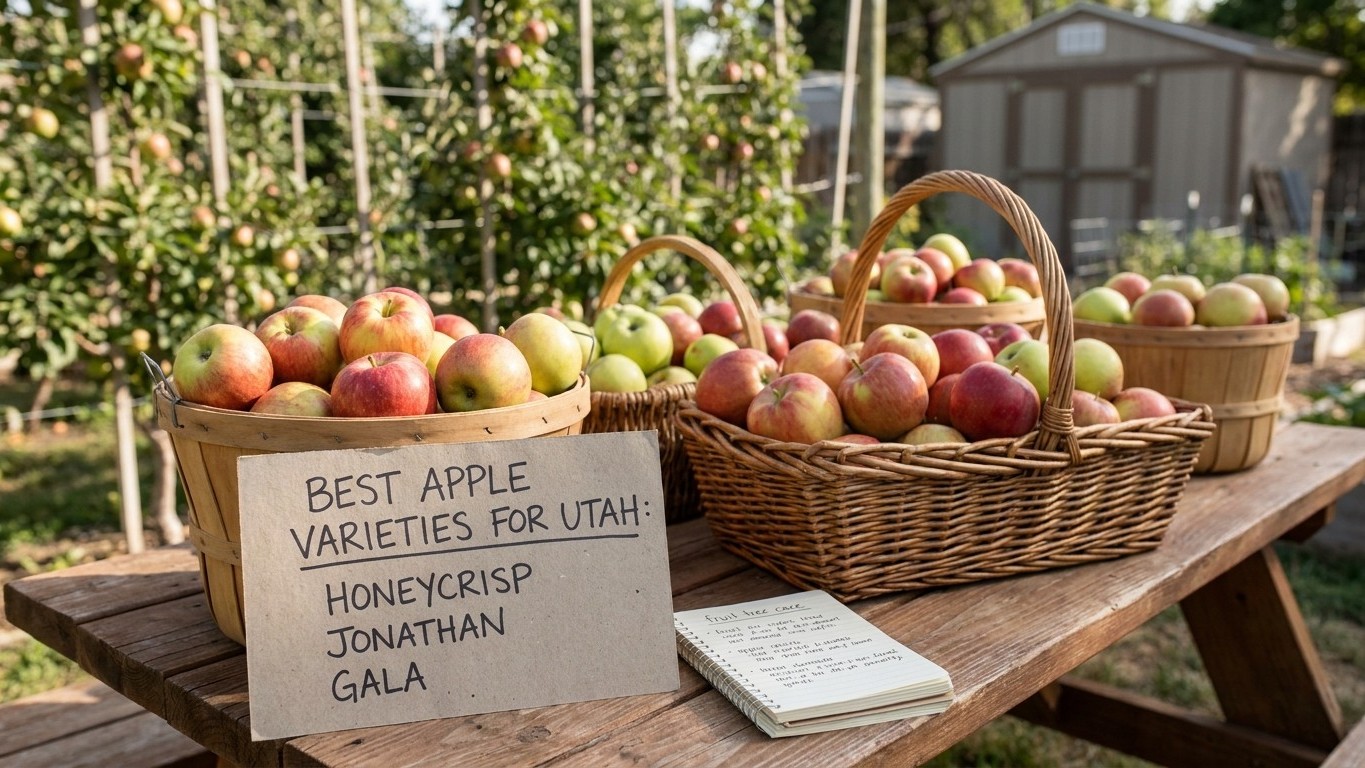

Utah apples live or die on one thing: whether your tree blooms before or after your last spring frost, and that frost date is not the same in Cache Valley as it is on the Salt Lake benches. Pick an early-blooming variety in a cold pocket and you’ll lose the blossoms most years — pick a mid-to-late bloomer and you’re betting on odds that actually favor you. The one thing to do before buying anything: walk your own ground, find where the cold air settles at night, and match your variety’s bloom timing to that spot, not to a valley-floor date that isn’t yours.
The short answer for Utah
For most of Utah’s populated valleys along the Wasatch Front, the safer pick is a cold-hardy dessert apple that blooms mid-season rather than early. NOAA NCEI’s 1991-2020 normals put Salt Lake City’s last spring freeze between April 12 and April 29, and a variety that opens its blossoms at the front end of that window is gambling on the earlier date holding. A mid-to-late bloomer gives the flowers more days of cover before the freeze odds drop off.
That answer depends on three things, and all three change by location. The first is hardiness, meaning whether the wood itself survives winter. Salt Lake City’s 21.6°F figure is a monthly average of daily lows, not the record cold snap, so a tree needs margin well below that number to be a safe bet, and higher valleys need more margin still. The second is winter chill, the accumulated cold hours a tree needs before it will flower on schedule. Utah’s winters are cold enough that chill is rarely the limiting factor along the Wasatch Front, but it becomes relevant in the warmer pockets of the southwest, where a low-chill selection bred for a mild climate elsewhere can bloom erratically if the winter doesn’t deliver enough cold.
The third is bloom timing itself, set against the local frost window. A tree that flowers before the probable last freeze date is exposed every year the freeze lands late. One that flowers after it is exposed less often, but “after” only means anything once you know your own county’s window, since Salt Lake City’s April 12 to April 29 range describes one valley and nowhere else in the state exactly matches it.
Working through it

Ranking realistic choices for Utah means ranking categories, not brand names, because the traits that matter (bloom timing, chill requirement, cold hardiness) are published for apple types generally and vary by cultivar within each type. Here’s how the three broad bloom groups stack up against Salt Lake City’s own frost data, understanding that a colder county pushes every column later.
| Bloom group | Timing relative to last frost | Chill requirement | Best fit in Utah |
|---|---|---|---|
| Early-blooming dessert type | Often opens near the start of the freeze window | Typically lower | Riskiest along the Wasatch Front; workable only in the mildest low-elevation pockets |
| Mid-season dessert type | Opens closer to the middle or back half of the window | Moderate to high | Best general fit for Salt Lake City-elevation valleys and similar sites |
| Late-blooming type, including crabapple pollenizers | Opens after most freeze risk has passed | High | Useful as backup bloom and pollination insurance in higher, colder valleys |
Bloom timing matters more than the calendar date
A tree doesn’t know what day it is. It responds to accumulated warmth, so the same variety can bloom a week or more apart from one spring to the next. That’s why The Utah Apple Calendar, Stage by Stage anchors every stage on the tree’s own development, from dormancy through green tip, pink, bloom, petal fall, and fruit set, rather than on a fixed month. Reading the stage instead of the date is what keeps you from spraying, thinning, or worrying about frost at the wrong moment.
Chill and hardiness are two separate filters
It’s worth repeating because growers conflate them: hardiness decides whether the tree lives through winter, and chill decides whether it flowers on schedule once winter is over. A tree can be hardy enough to survive a Cache Valley winter and still bloom raggedly if it doesn’t get the chill accumulation it was bred for, and a low-chill tree can flower reliably but split its bark in a hard freeze if it isn’t hardy enough for the site. You need both boxes checked, not one.
What changes across Utah
Salt Lake City’s frost dates describe a mild valley floor, and most of the state sits higher and colder than that. Cache Valley and other high mountain valleys in the north gain elevation fast, and a later, more grudging spring there means the same bloom-timing math needs to be recalculated with a later, unknown local frost date rather than borrowed from Salt Lake City. The benches above a valley floor also run warmer at night than the low ground below them, because cold air drains downhill and pools in the flats, so two orchards a few hundred feet apart in elevation can see very different frost outcomes on the same night.
The Great Salt Lake itself has a moderating effect on the immediate shoreline, tempering the coldest nights close to the water compared with sites further from it at the same elevation. Southern Utah, including the St. George area, sits at much lower elevation and finishes its winter earlier and milder than the Salt Lake City normals used in this article, which shifts both the frost window and the chill-hour math in the opposite direction from a high mountain valley. None of these adjustments have a single number attached in this piece, because Salt Lake City is the only reference station used here. The right move for a specific address is to treat every figure above as a starting point and adjust it toward “later and colder” going up in elevation, or “earlier and milder” going south and down.
The mistakes this climate punishes
Three mistakes show up in Utah orchards year after year, and each one is a bloom-timing or hardening mistake rather than a bad-luck event.
- Planting an early-blooming variety on a valley floor that already runs colder at night than the surrounding benches.
- Buying a low-chill tree marketed for a mild-winter region and expecting it to flower cleanly in a cold Utah winter.
- Feeding or pruning late enough in the season that new growth is still soft when the first fall freeze arrives.
The first mistake shows up as blossoms browning and dropping with no fruit set, and it tends to appear in the years the freeze lands at the late end of the probability window, meaning a grower can go two or three years without noticing the problem before a late freeze exposes it. NOAA NCEI’s 1991-2020 normals put Salt Lake City’s window at April 12 to April 29, and an early bloomer opening in the first half of that range is exposed on every one of those late-freeze years.
The second mistake shows up as patchy, uneven bloom rather than outright tree death, since Utah’s winters are usually cold enough to satisfy even a high-chill requirement. It matters most in the state’s warmest low-elevation pockets, where a mild winter can fall short of what a tree needs.
The third mistake is a timing error rather than a variety error. Late nitrogen or a late summer prune pushes soft new shoots that haven’t hardened off by the time the first fall freeze arrives. NOAA NCEI’s normals put that date at Salt Lake City between October 18 and October 29, and soft growth caught by that freeze dies back and opens the tree to canker the following season. The fix is stopping fertilizer and heavy pruning well ahead of that window rather than close to it, a step covered in more depth in the season-by-season steps in Growing Apples in Utah.
Checking this against your county
Every figure in this article is tied to Salt Lake City, and the caution attached to each one in the source data says plainly that most of the state runs colder and higher, with the southwest running warmer. Before buying a tree, check your own county’s frost dates and any variety guidance published by USU Extension, whose county offices are the right first call for hardiness and chill questions specific to your address. If your county isn’t near a NOAA reporting station, the extension office can usually point you to the nearest one and to how far its numbers are likely to drift from yours.
Common questions
Will an apple tree even survive a Utah winter?
Most apple trees with reasonable cold hardiness survive a typical Wasatch Front winter without trouble. The bigger risk in this climate isn’t the coldest night of January, it’s a late spring freeze catching an early bloom, since Salt Lake City’s last freeze date runs as late as April 29 under NOAA’s normals.
Do I need two apple trees for pollination?
Most apple varieties need a different apple or a crabapple blooming nearby at the same time to set fruit well, since few are reliably self-fertile. A neighbor’s tree within bee range can sometimes cover this, but if you’re planting on an isolated lot, plan on two compatible trees or a crabapple pollenizer from the start.
My tree bloomed fine but never set fruit. What happened?
The two most common causes are a late frost damaging the open flowers before they could be pollinated, or no compatible pollenizer blooming at the same time. Check whether a freeze landed during your bloom week, since a flower that looks fine the next morning can still have had its internal parts killed by a light frost.
Are the low-chill apple varieties sold by mail-order nurseries worth trying in Utah?
They’re a gamble outside the state’s warmest, lowest pockets, because Utah winters generally deliver more cold than a low-chill tree is bred to expect, which tends to produce uneven, spread-out bloom rather than a clean flush. If you’re in a warm low-elevation spot and want to try one anyway, check with USU Extension first for anything documented for your specific county.