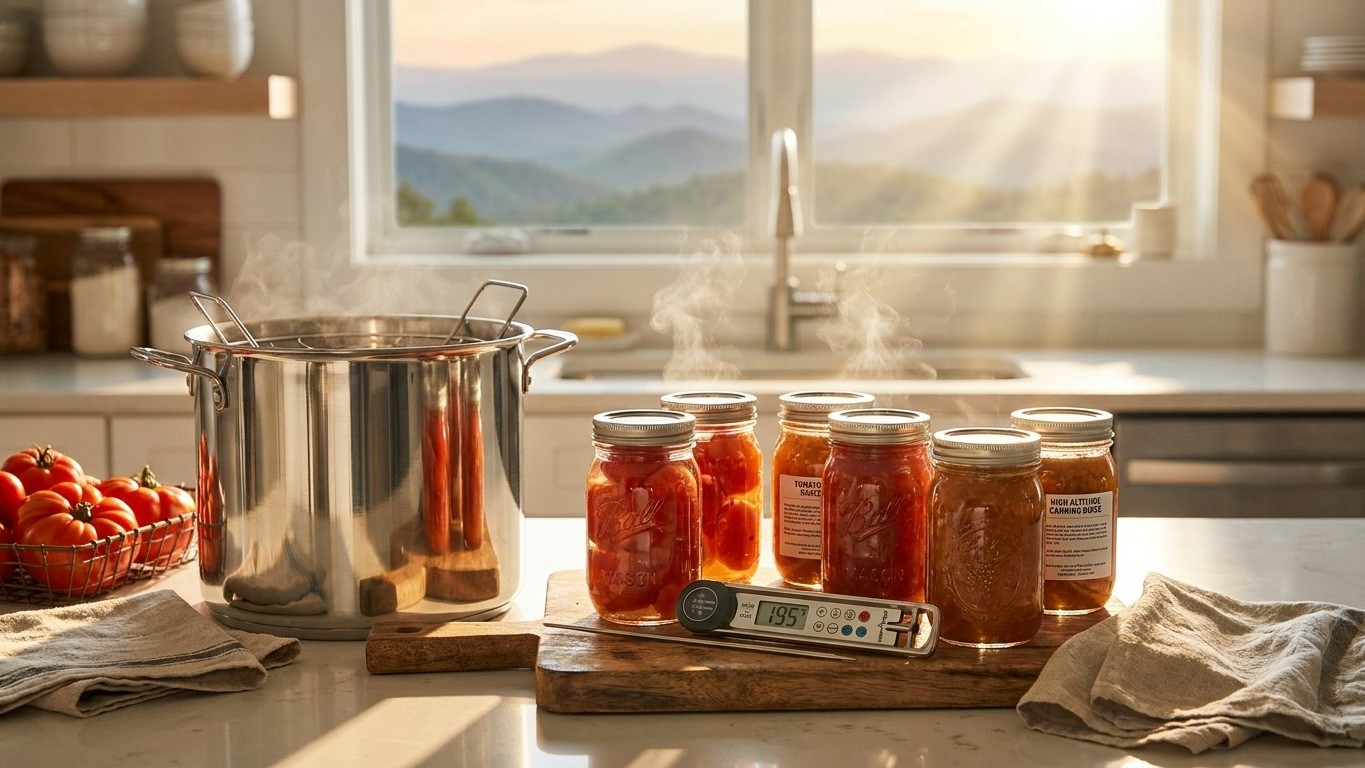

Most Georgia kitchens sit low enough that elevation never enters the conversation. But drive up toward Blairsville, Helen, or the higher reaches of the Blue Ridge foothills, and that assumption stops holding. Whether altitude changes your canning process depends entirely on where your kitchen sits, not on which state address is on your driver’s license.
The short answer

Atlanta sits at roughly 1,050 feet above sea level. At that elevation, water boils somewhere between 208°F and 212°F, according to the USDA Complete Guide to Home Canning as published by the National Center for Home Food Preservation. Atlanta falls into the elevation band spanning 0 to 2,000 feet, which is the lowest tier that canning guidance recognizes.
That’s Atlanta’s number, not Georgia’s. A state doesn’t have a single elevation, and treating a city figure as if it applied statewide is exactly the kind of shortcut that gets people into trouble. Georgia runs from sea-level marshland along the coast up past 4,700 feet at its highest points in the north Georgia mountains. Someone canning tomatoes in Savannah and someone canning the same tomatoes in Rabun County are not working with the same boiling point, even though they’re both Georgians.
Does 1,050 feet actually change anything?
For a reader at or near Atlanta’s elevation, the honest answer is: probably not much, if at all. The 0 to 2,000 foot band is generally treated as the baseline in tested recipes, the zone where standard processing times and standard pressures apply without modification. If your kitchen sits anywhere in that range, a tested recipe written for general use is likely written with you in mind.
The picture changes fast once you climb. Somewhere between 2,000 and 3,000 feet, boiling-water canning times typically start needing an upward adjustment. Push past a mile high, and pressure canners need more pressure, not just more patience. The mechanism behind that shift is worth understanding on its own, because it explains why “just boil it longer and harder” isn’t the fix people assume it is.
Why a lower boil is a weaker process
Water boils when its vapor pressure matches the pressure of the air pushing down on it. At sea level, that atmospheric pressure is high enough that water has to reach 212°F before it turns to vapor fast enough to boil. Climb higher and the air thins out. Less air overhead means less pressure holding the water down, so it boils at a lower temperature. At 10,000 feet, water boils at around 194°F. It’s still boiling, rolling and bubbling exactly the way it does at sea level. It’s just doing it 18 degrees cooler.
That temperature difference is the entire story. Canning works by holding food at a temperature high enough, for a duration long enough, to destroy the microorganisms that would otherwise spoil the jar or, worse, produce the toxin behind botulism. A boil at 194°F simply doesn’t deliver the same lethal punch as a boil at 212°F, even though both look identical in the pot. Fewer organisms die per minute. The process is weaker, full stop.
Here’s the part that trips people up: boiling water harder doesn’t make it hotter. Once water reaches its boiling point at a given elevation, more heat under the pot just makes it boil more violently, throwing off more steam and splashing more liquid. The temperature of the water itself doesn’t climb past that boiling point. Cranking the burner is not a substitute for altitude adjustment. It never was.
What actually compensates for a cooler boil is exposure, not intensity. In a boiling-water canner, that means leaving jars in the pot longer, giving the lower temperature more time to do the same job a hotter boil would finish faster. In a pressure canner, the fix works differently: raising the pressure inside the sealed canner raises the temperature the food reaches, since pressure and boiling point rise together in a closed system. More pressure at altitude gets the interior of the jar back up to the temperature the tested process assumes, even though the water outside is boiling cooler than it would at sea level.
Finding your own elevation
Atlanta’s figure is a reference point, not a substitute for your own address. Before adjusting anything, find out where you actually stand.
- Start with the National Center for Home Food Preservation’s “Find Your Elevation” page, built specifically for canners who need this number and don’t know where else to look.
- If you’d rather use a map, check a USGS topographic map for your county, which lists elevation contour lines down to your neighborhood.
- Call your county’s University of Georgia Cooperative Extension office. Extension agents field this exact question regularly and can usually give you a number on the spot.
- Check a GPS device or smartphone with elevation readout, keeping in mind that consumer GPS altitude readings can drift by a couple hundred feet.
- Look up your town’s elevation through the U.S. Geological Survey’s online geographic databases, which list official elevations for incorporated towns and cities.
- Once you have a number, match it to the elevation band your tested recipe or the NCHFP references, since processing adjustments are organized by range, not by exact foot count.
What goes wrong
- An under-processed jar that looks perfectly normal. A jar canned at altitude without the right adjustment can seal, seal tight, and sit on the shelf looking exactly like a safe one. There’s no visual cue for insufficient processing. The fix is prevention: match your process to your actual elevation band before you ever fill a jar, not after.
- A recipe pulled from a sea-level source. Plenty of recipes online and in older community cookbooks were written for 0 to 1,000 feet and never mention altitude at all. Using one unmodified in a mountain kitchen quietly weakens the process. Cross-check any recipe against a current tested source that lists elevation adjustments before following it.
- A pressure gauge read as if elevation didn’t exist. Dial gauges and weighted gauges respond to elevation differently, and a canner operator who sets pressure purely from habit, without checking their own elevation band, can under-process an entire batch. Have dial gauges tested annually through your extension office, and always confirm the pressure for your elevation band before starting the canner.
- Assuming the whole county shares one elevation. North Georgia in particular has valleys and ridgelines that differ by a thousand feet or more within a few miles. Don’t borrow a neighbor’s elevation number; confirm your own kitchen’s.
Where the exact adjustment comes from
This page won’t hand you a processing time or a pressure setting, and that’s deliberate. The right adjustment depends on the specific food, the jar size, and the tested recipe behind it, not on elevation alone. Two different foods at the same elevation can carry two different adjustments.
For the actual figures, go to the National Center for Home Food Preservation and look up the tested recipe for whatever you’re canning. It will list the adjustment for your elevation band directly. The reason this matters more than it might seem: botulinum toxin, the danger an under-processed low-acid jar can harbor, has no taste and no smell. A jar can look, smell, and taste completely fine and still not be safe. Guessing isn’t a risk worth taking with something undetectable.
Common questions
Does Georgia’s coast need any altitude adjustment for canning?
Coastal Georgia sits at or near sea level, comfortably inside the 0 to 2,000 foot band that generally requires no altitude adjustment. Standard tested processing times typically apply there without modification.
What elevation in Georgia actually requires adjusting canning times?
Adjustments generally begin somewhere above 1,000 feet for boiling-water canning, and the amount increases as elevation climbs further. Rather than guessing, check your specific elevation against the tested recipe’s published adjustment table.
Can I use the same jar of canned tomatoes recipe at 1,050 feet and at 3,000 feet?
Not without changes. The recipe itself, the acidity, the jar size, all stay the same, but the processing time or pressure needs to reflect the higher elevation, since a cooler boiling point at 3,000 feet delivers a weaker process than the same time would at 1,050 feet.
Is a dial gauge or a weighted gauge better for canning at higher Georgia elevations?
Both work fine when correctly set for elevation, but they’re adjusted differently. Weighted gauges typically require a specific weight for higher elevation bands, while dial gauges require reading a specific pressure number for that band. Have dial gauges checked for accuracy through your local extension office before canning season.