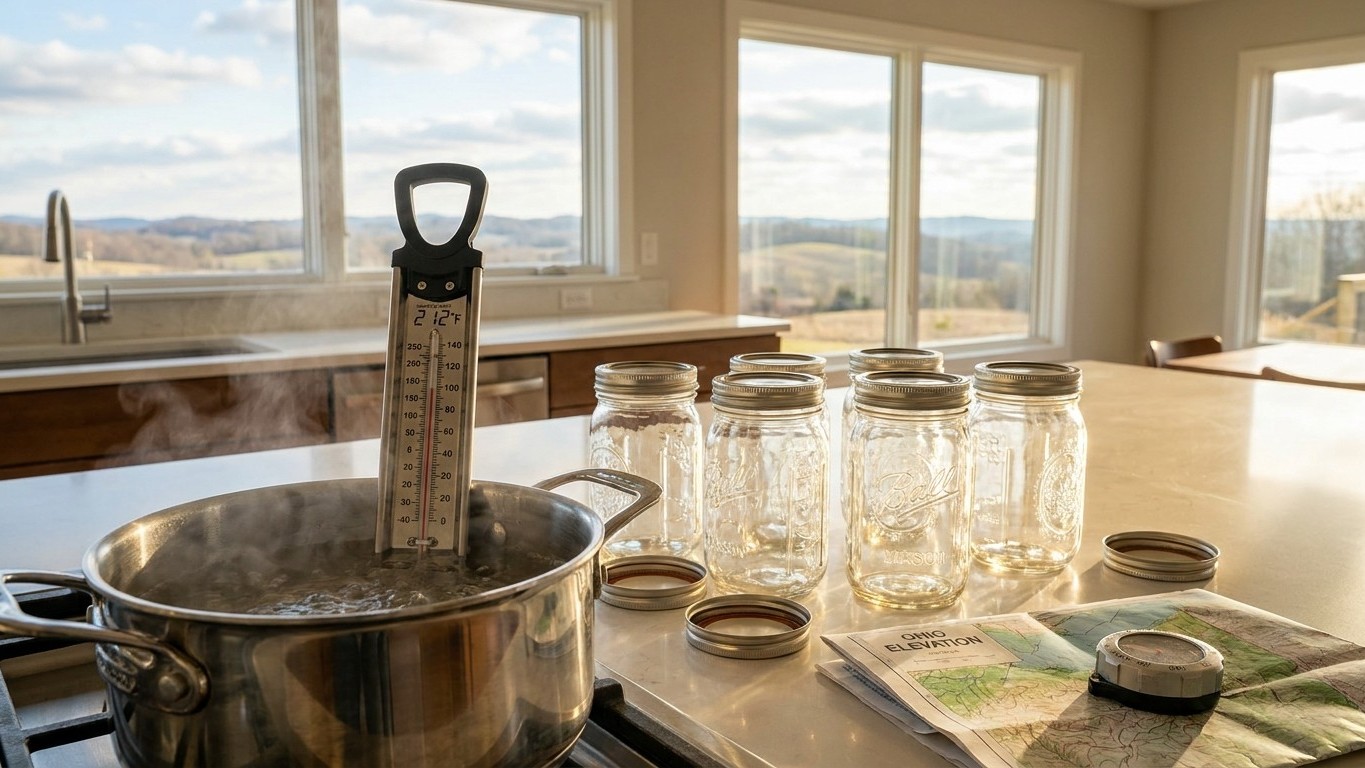

Columbus sits at 771 feet, and water there boils somewhere between 208°F and 212°F depending on the day’s barometric pressure. That’s the reference point most Ohio canning guidance uses, but it’s not your elevation unless you happen to live in the capital. For most home canners across the state, this elevation band means no altitude adjustment is required, but the answer changes fast once you climb into hill country or drop into a river valley.
The short answer

Ohio doesn’t have a single elevation any more than it has a single climate. The 771-foot figure for Columbus is a reference city measurement, not a statewide average, and it comes from geographic elevation data, not a canning source. What matters for your jars is where your kitchen sits, because canning safety guidance is built around published boiling-point bands, and Columbus falls into the lowest one: 0 to 2,000 feet.
At sea level, water boils at 212°F. At Columbus’s 771 feet, it boils somewhere in that 208°F to 212°F range, close enough to sea level that the tested processing times published for boiling-water canning and the tested pressures for pressure canning at that band apply without modification. This is the good news for a large share of Ohio’s population centers, which sit in river valleys and lowland plains well within that first band.
But “close to sea level” isn’t the whole story for the state. Ohio’s terrain runs from flat glacial plains in the northwest to rolling, hillier ground in the southeast, and pockets of higher ground exist outside the major metro areas. If your home sits meaningfully above Columbus’s 771 feet, you may cross into a different elevation band, and that changes what a tested recipe requires. The point isn’t to memorize Columbus’s number and assume it covers you. It’s to recognize that the number is a starting reference, not a substitute for checking your own site.
Here’s how the boiling point shifts as elevation climbs, using the figures that are actually published rather than guessing at what happens in between:
| Location or elevation | Approximate boiling point |
|---|---|
| Sea level | 212°F |
| Columbus, OH (771 ft, reference city) | 208°F to 212°F |
| 10,000 feet | 194°F |
Why this matters before you even open a recipe
Every tested canning recipe assumes a boiling point. Recipes developed and tested by USDA and land-grant extension programs specify processing times or pressures calibrated to sea-level or near-sea-level boiling. When your actual boiling point runs cooler than that assumption, because you’re higher up, the same processing time delivers less heat to the jar’s contents. That’s the entire reason altitude adjustments exist, and it’s why the Columbus figure is useful only as a starting point for Ohio canners, not a blanket answer.
Why a lower boil is a weaker process
The mechanism is simple, even if the consequences aren’t. As elevation increases, atmospheric pressure drops, and water needs less energy to turn to vapor. That means it boils at a lower temperature. At sea level, boiling means 212°F. Ten thousand feet up, boiling means 194°F. Same visual: bubbles, steam, a rolling pot. Very different amount of heat actually being delivered to the food inside your jars.
This is where a common misunderstanding trips people up. Cranking the burner higher doesn’t make boiling water hotter. Once water reaches its boiling point for that elevation, extra heat just makes it boil more vigorously, produce more steam, and evaporate faster. It does not push the temperature past that ceiling. A pot boiling hard on high heat at 6,000 feet is still topping out well below 212°F, no matter how aggressive the boil looks. There’s no way to compensate for altitude by turning up the stove.
Bacteria, spores, and enzymes don’t care how vigorous the boil looks. What destroys them is a combination of temperature and time. When the temperature drops because of elevation, the only way to deliver an equivalent lethal effect is to either add time at that lower temperature or increase pressure, which raises the achievable boiling point back toward what a tested process assumes.
That’s exactly what tested recipes do to correct for elevation. For boiling-water canning, the science-based fix is longer processing time at the same cooler boil, giving the heat more minutes to do what it can’t do faster. For pressure canning, the fix works differently: increasing the pounds of pressure in the canner raises the temperature the steam can reach inside the sealed vessel, pushing it back up toward the temperature tested recipes rely on, since pressure and boiling point are directly linked inside a sealed canner in a way they aren’t in an open pot.
Neither fix is optional once you’re outside the lowest elevation band, and neither is something to eyeball. The adjustment is specific to the elevation and specific to the recipe, which is why guessing at “a little extra time” or “a bit more pressure” isn’t a substitute for the tested figure. A cooler boil is a weaker process, full stop, and the compensation has to match it precisely.
Finding your own elevation
- Start with your address, not your city’s reputation for being “flat” or “hilly.” Elevation can vary by hundreds of feet within a single county, and even within a few miles of a town center.
- Use the National Center for Home Food Preservation’s Find Your Elevation page, built specifically so home canners can look up their own site rather than relying on a nearby city’s published figure.
- Enter your location as directed on that page to get a specific elevation reading for your property, not the county seat or the nearest airport, which may sit at a noticeably different height.
- Round to the elevation band your reading falls into. Canning guidance is organized by band, not by exact footage, so knowing which band you’re in is what actually matters for choosing a processing time or pressure.
- Keep that number where you’ll see it when you’re choosing a canning recipe, since it applies to every batch you process at that location, not just the one that prompted you to look it up.
If you can and preserve at more than one location, whether that’s your own kitchen and a family member’s farmhouse, or a cabin up in the hills, check the elevation for each site separately. Ohio’s terrain shifts enough that a twenty-minute drive can move you into a different band.
What goes wrong
- An under-processed jar that looks perfectly normal. A jar processed at a boiling-water time meant for sea level, but actually boiled at a higher elevation’s cooler temperature, can seal, seem shelf-stable, and still harbor surviving spores. There’s no visual sign of this failure. The remedy is using the elevation-adjusted time from a tested recipe every time, not just when something seems off.
- A recipe pulled from a sea-level source. Family recipes, older cookbooks, and recipes shared online often come from someone at or near sea level and don’t mention elevation at all. The remedy is treating any recipe without a stated elevation assumption as a sea-level recipe, then applying your own elevation’s adjustment on top of it using a tested source.
- A pressure gauge read as if elevation didn’t exist. Weighted and dial gauges on pressure canners are calibrated assuming a baseline, and the pressure that delivers a safe temperature at low elevation isn’t enough at higher elevation. The remedy is checking your canner’s dial gauge for accuracy and always applying the pressure figure for your actual elevation band, not the one printed as a default on the canner itself.
- Trusting “it’s always worked” as proof. A process that happened to seal jars safely in the past doesn’t guarantee the food inside was heated enough to be safe; it only means the seal held. The remedy is separating “the jar sealed” from “the process was adequate,” since they’re not the same thing.
Where the exact adjustment comes from
This page won’t hand you a processing time or a canner pressure, because those numbers depend on the specific food, the jar size, and your exact elevation band together, not on elevation alone. Giving a generic figure here would risk being wrong for your recipe, and a wrong figure is exactly how under-processing happens.
The tested adjustment for your food lives with the recipe itself. The National Center for Home Food Preservation, based at the University of Georgia, publishes elevation-adjusted processing times and pressures alongside its tested recipes, and that’s the source to check once you know your own elevation from the steps above.
The stakes make this worth the extra step. Botulinum toxin, the danger an under-processed low-acid jar can harbor, has no taste and no smell. A jar can look, smell, and taste completely normal and still be unsafe, which is why the adjustment has to come from a tested source rather than an estimate.
Common questions
Does Columbus’s elevation apply to my whole county?
No. The 771-foot figure is specific to Columbus as a reference point. Elevation within a single Ohio county can vary by a meaningful margin, so use your own address with the NCHFP elevation lookup rather than assuming a nearby city’s figure covers you.
If I live in Ohio, do I even need to worry about altitude adjustments?
Many Ohio locations fall within the lowest elevation band and need no adjustment for that reason, but that depends entirely on your specific site. Terrain in parts of the state runs higher than the lowland river valleys, so checking rather than assuming is the safer habit.
Can I just boil my jars longer to be safe, regardless of elevation?
Extra time beyond what a tested recipe specifies for your elevation isn’t a substitute for the correct figure, and it can also affect texture and quality. The safe approach is finding your actual elevation band and using the time or pressure tested for that band and that food.
Does a harder, more vigorous boil compensate for higher elevation?
No. Once water reaches its boiling point for a given elevation, additional heat doesn’t raise the temperature further, it just increases the rate of boiling and steam production. The only way to compensate for a cooler boiling point is more time in boiling-water canning or more pressure in pressure canning.