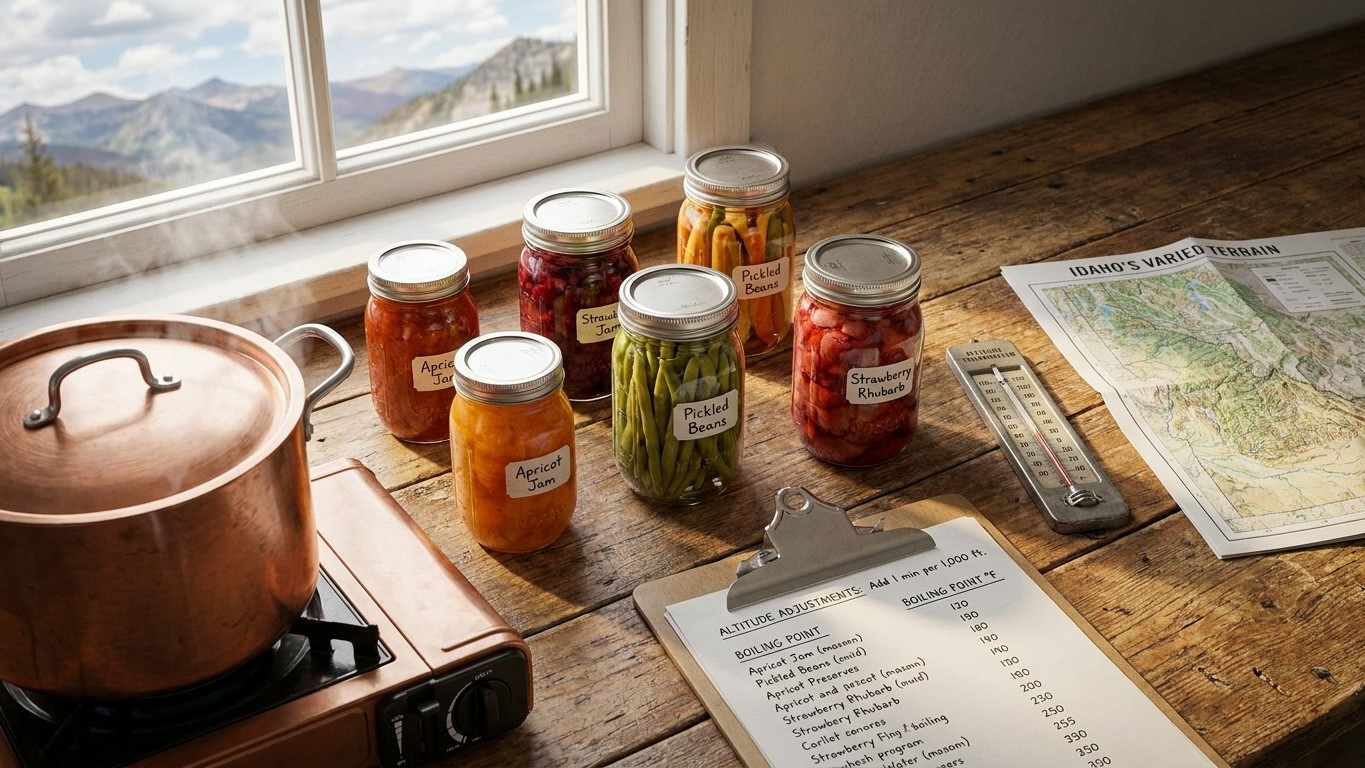

If you can at Boise’s elevation of 2,700 feet, you’re canning above the point where altitude starts mattering. That’s the reference point for most of southwestern Idaho, but it’s not Idaho’s elevation, because the state has no single one. Whether your own kitchen needs an adjustment depends on where you actually live, from river valleys near sea-level pressure to mountain towns thousands of feet higher.
The short answer

Boise sits at 2,700 feet, and at that height, water in an open pot boils somewhere between 204°F and 208°F, according to the USDA Complete Guide to Home Canning, as published by the National Center for Home Food Preservation. Compare that to the 212°F boil most canning recipes are written around at sea level. That four-to-eight-degree gap sounds small. It isn’t. It’s the difference between a canning process that’s been tested to destroy harmful microorganisms and one that falls short.
That elevation figure describes Boise specifically, not the state of Idaho as a whole. This matters more here than almost anywhere else in the country, because Idaho’s terrain runs from the Snake River Plain up into the Sawtooth and Bitterroot ranges, spanning elevations far above and below the 2,700-foot mark. A home canner in Lewiston, sitting near 1,400 feet, faces a different boiling point than one in Boise. Someone canning in Ketchum or McCall, well above 5,000 feet, faces a boiling point low enough that skipping the adjustment isn’t a minor risk, it’s a real one.
Does this change anything for you?
If your kitchen sits at 2,700 feet, or anywhere in the band roughly between 2,000 and 4,000 feet, the answer is yes. That band is exactly where boiling-water and pressure canning recipes start calling for their first adjustment tier. Below 1,000 feet, most tested recipes assume you need no adjustment at all. Above that line, and Boise is well above it, every batch you process needs to account for the fact that your boiling water is doing less work than the recipe assumed.
This isn’t a rounding error or an old wives’ tale passed down through canning circles. It’s built into how the USDA tests its recipes: each processing time or pressure is validated at a known boiling point, and when your actual boiling point drops, the math behind that validation no longer holds unless you compensate. The compensation itself, whether it’s added minutes or added pounds of pressure, comes from the tested recipe for your specific food, not from a general rule of thumb applied across the board.
Why a lower boil is a weaker process
Water has a ceiling. Once it starts boiling, adding more heat doesn’t push the temperature higher, it just makes the water boil more vigorously while staying at the same temperature. That ceiling drops as air pressure drops, and air pressure drops as elevation rises. At sea level, boiling water tops out at 212°F. Climb to 10,000 feet, and that same rolling boil only reaches about 194°F. In Boise’s elevation band, it settles between 204°F and 208°F, per the USDA’s published figures.
Heat is what destroys the microorganisms that spoil food or, worse, produce toxins inside a sealed jar. A boil that tops out several degrees cooler delivers less thermal destruction over the same span of minutes. That’s the entire mechanism behind altitude adjustments in canning: not a mysterious effect of thin air on the food itself, but a straightforward drop in the maximum temperature the water inside your canner can reach.
Why cranking up the heat doesn’t fix it
A common instinct is to turn the burner higher, assuming a harder boil means a hotter one. It doesn’t. Once water is boiling, it has already hit its ceiling for that elevation and pressure. Turning up the flame just makes it boil more violently, wastes energy, and can shake jars around inside the canner. The temperature stays exactly where physics puts it.
What actually compensates for a cooler boil is time, or pressure. In a boiling-water canner, tested recipes add extra minutes to the process at higher elevations, giving the cooler water longer to do the same job a hotter boil would do faster. In a pressure canner, the fix works differently: added pressure raises the boiling point of the water inside the sealed canner beyond what open-air boiling could ever reach, which is exactly why pressure canning exists as a separate method for low-acid foods in the first place. Either way, the adjustment isn’t cosmetic. It’s the entire safety margin the recipe was designed around, restored to match your actual kitchen.
Finding your own elevation
Boise’s 2,700 feet tells you nothing about your own kitchen unless you happen to live there. The National Center for Home Food Preservation publishes a page called “Find Your Elevation” precisely because so many canners assume their city or their state has one number, when in fact the number that matters is the one under their own stove.
- Start with your exact address or the nearest small town, not a regional or state-level estimate, since elevation can shift by hundreds of feet within a few miles in Idaho’s mixed terrain.
- Use the NCHFP’s “Find Your Elevation” tool or a comparable USGS elevation lookup to get a number in feet above sea level for that specific location.
- Compare that number against the elevation bands used in your tested recipe, typically grouped in tiers such as under 1,000 feet, 1,001 to 3,000, 3,001 to 6,000, and so on, depending on the source.
- Note which band you fall into, since that band, not your exact elevation number, is what determines your adjustment.
- Recheck if you move, can at a relative’s house in another town, or process food somewhere other than your usual kitchen, since even a short drive up into the foothills can shift you into a different band.
This sequence matters because skipping straight to “I live in Idaho, so I’ll add some extra time” is exactly the kind of shortcut that produces under-processed food. The state’s range, from valley floors to mountain towns, is too wide for any single shortcut to hold.
What goes wrong
- An under-processed jar that looks perfectly normal. A jar that sealed properly, sat on the shelf, and shows no bulging or off-smell can still harbor bacterial spores that survived a cooler boil. The fix isn’t a visual check, it’s using the correct time or pressure for your elevation band from the start, since appearance tells you nothing about whether the process reached the temperature it needed to.
- A recipe pulled from a sea-level source. Family recipes, older cookbooks, and recipes shared from friends in lower states often carry processing times calculated for elevations under 1,000 feet. Using that time unchanged in Boise or higher up in Idaho’s mountains means the food never got the extra minutes it needed. The remedy is checking the recipe’s assumed elevation and adjusting to a tested version for your actual band, through the NCHFP rather than guesswork.
- Reading a pressure gauge as if elevation didn’t exist. Some canners assume the pressure listed on a recipe applies everywhere. It doesn’t. Pressure canning at higher elevations requires higher pressure to reach the same effective sterilizing temperature, and a dial or weighted gauge canner needs to be set according to the elevation-specific pressure in the tested recipe, not the flat number printed for sea level.
Where the exact adjustment comes from
This page won’t give you a processing time or a canner pressure, because neither belongs here. Both come from the tested recipe for the specific food you’re canning, cross-referenced against your elevation band, and both are published by the National Center for Home Food Preservation for exactly that purpose.
The reason this can’t be approximated is that botulinum toxin, the danger behind under-processed low-acid canned food, has no taste and no smell. A jar can look, smell, and taste completely fine and still be unsafe. Guessing at an adjustment, or borrowing one from a different food or a different elevation, removes the margin that testing was designed to guarantee. For your food and your elevation band, go to the National Center for Home Food Preservation’s published guidance and use the figures listed there.
Common questions
Does all of Idaho need altitude adjustments for canning?
No. Elevation varies enormously across the state, and areas below roughly 1,000 feet typically need no adjustment under standard USDA guidance. Areas at or above Boise’s 2,700 feet, and especially the mountain towns well above that, do need one.
Is Boise’s elevation the same as Idaho’s elevation?
No. Boise is the reference city used here because it’s a major population center, but it sits in a specific elevation band, 2,000 to 4,000 feet. Idaho stretches from lower river valleys to mountain elevations far above that band.
Can I just add a few extra minutes to be safe?
Adding time without knowing the correct figure for your food and elevation band isn’t a safe substitute for using the tested adjustment. Too little added time doesn’t fix the risk, and there’s no way to know from the jar itself whether you guessed correctly.
Does pressure canning need altitude adjustments the same way boiling-water canning does?
Yes, but the adjustment works through pressure rather than time. Higher elevations require higher pressure settings in a pressure canner to reach the same effective temperature, and those pressure figures come from the tested recipe for the specific food, not from a general estimate.