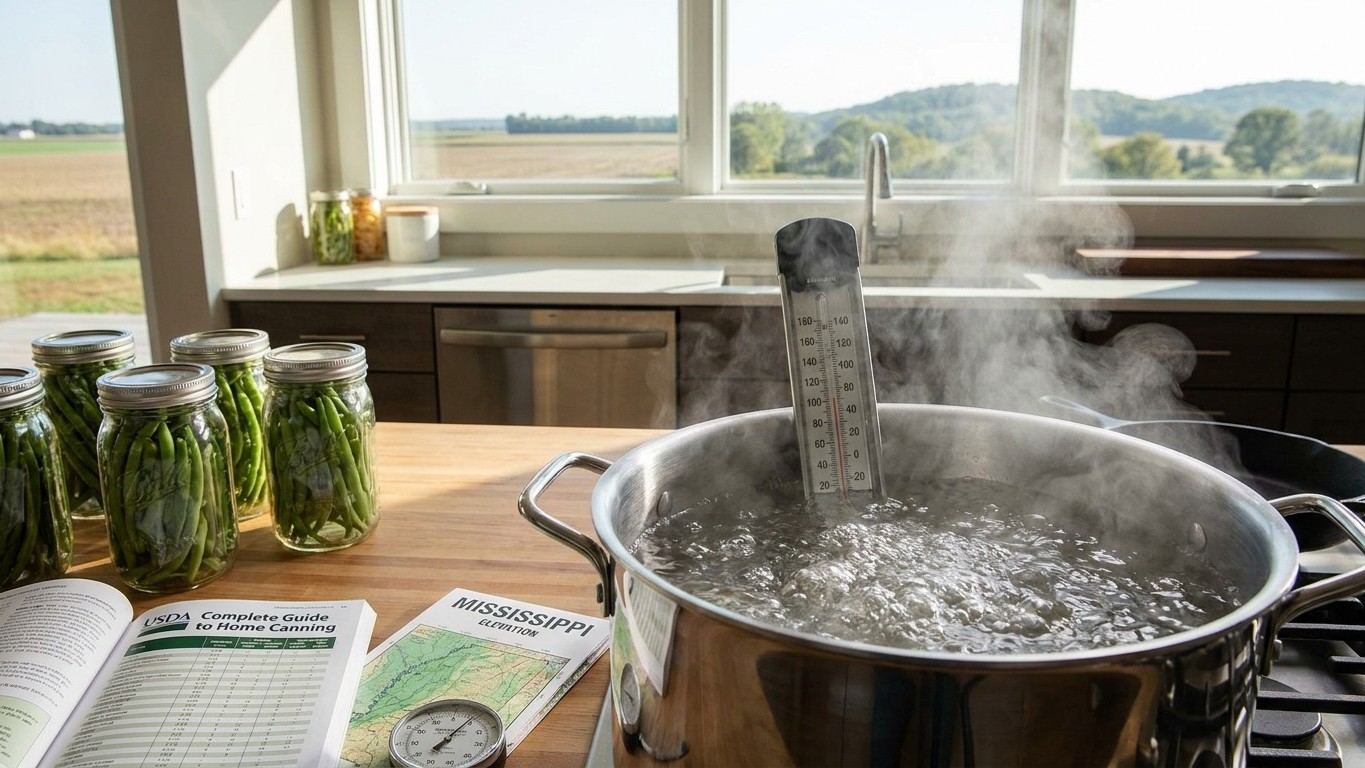

Jackson sits at 279 feet, where published boiling points run between 208°F and 212°F. That’s a low-altitude range, and most Mississippi canners, wherever they live in the state, fall inside a band that needs little to no adjustment. But “most” isn’t “all”, your own elevation, not Jackson’s, is what your recipe cares about.
The short answer

Jackson, the reference city for Mississippi in this guide, sits at 279 feet above sea level. At that height, water on your stove boils somewhere between 208°F and 212°F, according to the boiling-point figures published in the USDA Complete Guide to Home Canning. That’s barely a degree or two below the textbook 212°F of sea level. For a home canner standing in a Jackson kitchen, this is not an elevation that rewrites the rulebook.
Compare that to a jar of green beans processed in a mountain town at 6,000 feet, where the same water might boil closer to 198°F. That’s a 14-degree gap, and in food preservation, degrees are not decorative. A lower boiling point means the water inside your canner, no matter how vigorously it’s bubbling, simply isn’t reaching the same thermal intensity as it would at sea level. At 279 feet, that gap barely exists. At 6,000 feet, it’s the difference between a jar that’s safe and one that isn’t.
Why the state figure isn’t your figure
Mississippi is not a single elevation. The Delta lowlands near the river sit only a handful of feet above sea level, while the northeastern hill country and parts of the Tombigbee National Forest region climb into higher ground, still nowhere near a mile high, but enough to matter for the boiling point of water in a canner. Jackson, at 279 feet, is a useful reference point because it’s the state capital and a common population center, but it’s a stand-in, not a survey of the whole state. Someone canning tomatoes in the Delta and someone canning them in the hills are technically working with slightly different boiling points, even if both are well within the “low elevation” range.
The practical takeaway for the short answer: if you live at or near Jackson’s elevation, or anywhere in that 0 to 2,000 foot band, altitude is unlikely to be the reason a canning recipe fails. That doesn’t mean you skip checking your own number. It means the check will probably confirm what you’d expect, rather than surprise you.
Why a lower boil is a weaker process
Water has a ceiling. At a given elevation, once it reaches its boiling point, it cannot get hotter, no matter how long you leave the burner cranked or how hard the bubbles churn. That’s the part people misunderstand most often about pressure and altitude. A rolling, aggressive boil at 6,000 feet is still only about 198°F. A gentle, barely-there boil at sea level is already 212°F. Intensity of the bubbling tells you nothing about the temperature; the elevation does.
This matters because canning is, at its core, a heat-and-time equation designed to destroy microorganisms, including the spores of Clostridium botulinum, the organism behind botulism. Tested processing times assume a specific boiling temperature. When the water boils cooler, as it does at higher elevations, the same number of minutes delivers less lethal heat to the food inside the jar. The process becomes weaker even though the jar looks, sounds, and smells exactly the same coming out of the canner.
Two different tools compensate for this, depending on the method. In a boiling-water canner, used for high-acid foods like most fruits, jams, and pickles, the fix is time. You leave the jars in the boiling water longer, because you can’t raise the temperature of an open pot of boiling water past its elevation-determined ceiling. In a pressure canner, used for low-acid foods like vegetables, meats, and poultry, the fix is pressure. Increasing the pounds of pressure inside the sealed canner raises the temperature the food actually experiences, correcting for the fact that outside the canner, on the open stove, water simply won’t boil as hot as it would at sea level.
Neither fix is optional once your elevation crosses into a range that requires it, and neither can be swapped for the other. Boiling longer does nothing to help a pressure-canned recipe that needs more pounds of pressure, and cranking up pressure isn’t how boiling-water canning works at all. The method and the food determine which compensation applies, and the exact figure always comes from the tested recipe, not from a general rule of thumb.
Finding your own elevation
- Start with the address or ZIP code where you’ll actually be canning, since a home in the hills and a home in the lowlands a short drive apart can carry meaningfully different elevations.
- Use the National Center for Home Food Preservation’s “Find Your Elevation” page, which is built specifically for canners who need this number for processing adjustments rather than for general geography.
- Enter your location as the tool instructs and record the elevation it returns in feet, since that’s the unit tested canning recipes use.
- Compare that number to the elevation bands listed in your specific recipe or in the USDA Complete Guide to Home Canning, rather than assuming Jackson’s 279 feet applies to you.
- Write your elevation down somewhere you’ll see it again, on the inside of a cabinet door or in a canning notebook, since it applies to every batch you process, not just one recipe.
- Recheck it if you move, even locally, because a difference of a few hundred feet within the same county can be enough to shift which adjustment band you fall into.
What goes wrong
- An under-processed jar that looks perfectly normal. A jar canned at a cooler boiling point than the recipe assumed can seal properly, look clear, and show no spoilage signs, while still carrying a process too weak to destroy botulism spores. The remedy is checking your elevation before you can, not after, and following the time or pressure band that matches it.
- A recipe copied from a sea-level source. Recipes shared online or handed down from a relative canning near the coast may assume a 212°F boil with no adjustment built in. The remedy is treating any recipe without a stated elevation as a sea-level recipe and adjusting from there using your own elevation and the NCHFP guidance for that specific food.
- A pressure gauge read as if elevation didn’t exist. Both dial and weighted gauges need to be set for the elevation where the canner is actually operating, not for sea level by default. The remedy is confirming which gauge type your canner uses and setting pressure according to the band your elevation falls into, checking the dial gauge’s accuracy periodically since these can drift.
- Treating “low elevation” as “no elevation.” Even Jackson’s 279 feet is not zero, and a canner who assumes their number rounds down to sea level may skip a small adjustment their recipe actually calls for. The remedy is looking up the exact band your elevation falls into rather than assuming it away.
Where the exact adjustment comes from
This page won’t give you a processing time or a canner pressure, and no general article should. The correct adjustment depends on the specific food, the specific method, and your specific elevation, and that combination belongs to a tested recipe, not to a summary article. For the actual figures, go to the National Center for Home Food Preservation, which publishes tested processes with elevation adjustments built in for boiling-water and pressure canning alike.
The reason for this caution isn’t bureaucratic. Botulinum toxin has no taste and no smell. A jar that’s under-processed because of an uncorrected elevation gives no warning sign before it’s opened and eaten. Getting the number from a tested source, matched to your actual elevation, is the only way to know the process actually did its job.
Common questions
Does my elevation change if I only live a few miles from Jackson? It can. Elevation shifts with terrain, not just distance, so a few miles in hillier ground can move you into a different band than Jackson’s 279 feet. Check your specific location rather than assuming proximity to the capital tells you anything.
Is 279 feet high enough to need any adjustment at all? That depends on the specific recipe and method, since different tested processes set their own thresholds. Rather than guessing, look up your exact elevation on the NCHFP recipe for the food you’re canning.
Does boiling the water longer before I start canning help compensate for elevation? No. Water can’t exceed its boiling point for a given elevation no matter how long it boils beforehand. The compensation has to happen during the actual processing time or pressure, not in prep.
Why does the same recipe list different times for different states? Because tested recipes are built around elevation bands, and a state that spans low river ground and higher hill country, like Mississippi does, may include more than one band in its guidance. The band that applies is the one matching your elevation, not your state’s name.