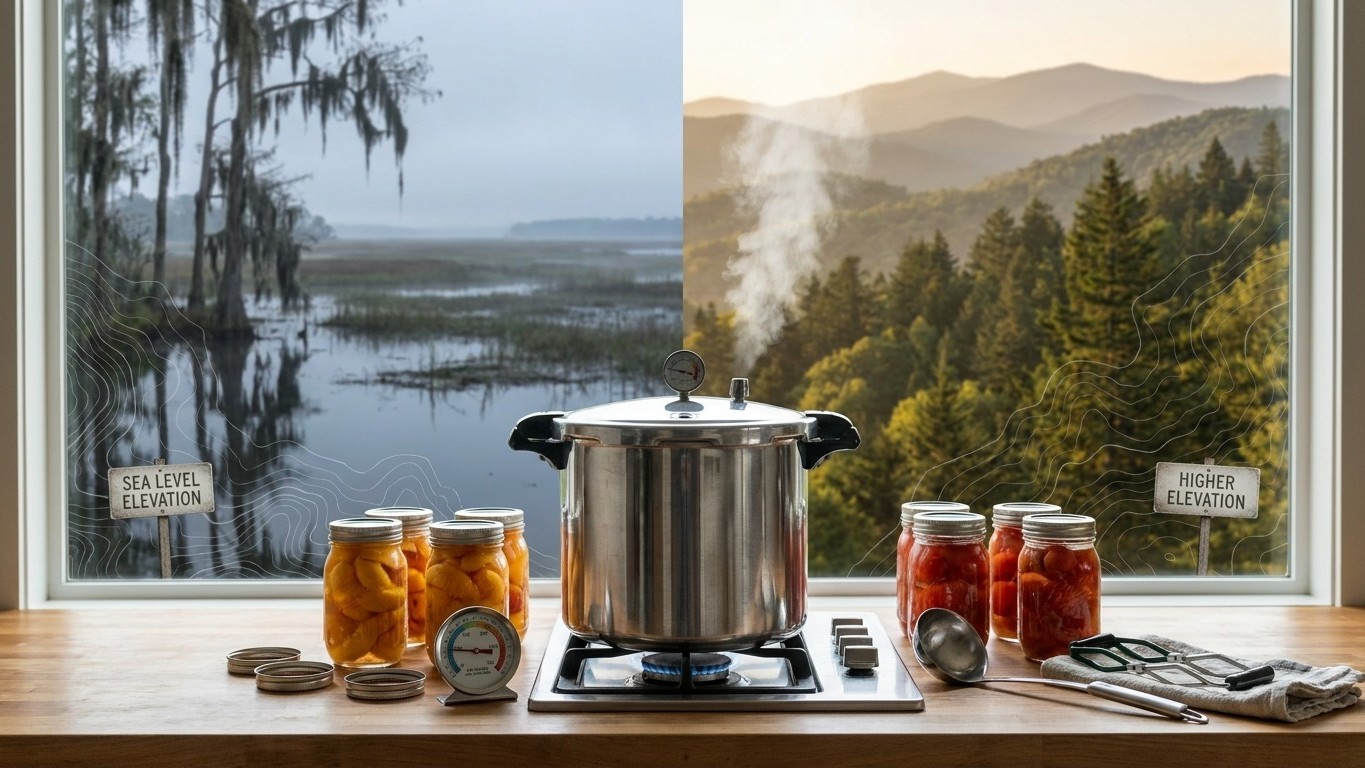

Charleston, the reference city for South Carolina in this guide, sits at 20 feet above sea level, where water still boils between 208 and 212 degrees Fahrenheit, essentially the same full boil the USDA assumes for standard processing times. Can at or near that elevation and no adjustment applies. But South Carolina runs from Lowcountry marsh to Blue Ridge foothills, and the number that matters is your own elevation, not Charleston’s.
The short answer

Charleston, the reference city used here for South Carolina, sits at 20 feet above sea level. Published boiling temperatures for the elevation band that includes Charleston, sea level up to 2,000 feet, run between 208 and 212 degrees Fahrenheit. That’s close enough to a full sea-level boil that home canners working in or near Charleston, Myrtle Beach, Hilton Head, or anywhere else close to the coast don’t need to adjust the processing time or pressure called for in a tested recipe.
South Carolina, though, is not one elevation. The state stretches roughly 300 miles from the barrier islands of the Lowcountry to Sassafras Mountain in Pickens County, which climbs past 3,500 feet. A figure like “20 feet” describes Charleston. It does not describe South Carolina. Treating a reference city’s elevation as a statewide number is the most common mistake canners make when they search for their state’s altitude and stop reading after the first line.
Where the answer changes
This matters because altitude adjustments for canning follow elevation bands, not state borders. The National Center for Home Food Preservation and USDA guidance sort the country into bands: roughly 0 to 1,000 feet, 1,001 to 3,000, 3,001 to 6,000, and so on upward, and each band carries its own instruction for boiling-water processing time or pressure-canner setting. Charleston’s 20 feet sits comfortably in the lowest band, where a 208 to 212 F boil is close enough to sea-level conditions that standard times hold. A canner working in the Upstate at 1,200 or 2,500 feet is already in a different band, even inside the same state.
So the honest answer to whether altitude changes canning in South Carolina is: it depends on where in South Carolina you’re standing, not on the state as a whole. Charleston’s numbers show what “no adjustment needed” looks like. Everything past that reference point is where the real work begins.
Why a lower boil is a weaker process
Water boils when its vapor pressure matches the surrounding atmospheric pressure. Atmospheric pressure drops as elevation rises, so water reaches its boiling point at a lower temperature the higher you go. At sea level, that’s 212 F. At 10,000 feet, it’s 194 F. That 18-degree gap is the entire reason altitude matters for canning: a boiling-water canner or the water inside a pressure canner never gets hotter than whatever temperature water boils at for that elevation, no matter how long the burner runs or how hard the pot rattles.
A lower boiling point means less heat reaching the food for the same amount of time. Bacterial spores, including the ones that produce botulinum toxin, need sustained heat to die. Cut the temperature by even a few degrees and the same processing time that killed spores at sea level may leave some alive at higher elevation. That’s why “boiling harder” is a myth worth retiring. Boiling water cannot exceed its boiling point at a given atmospheric pressure; cranking the heat just makes it boil more violently, not hotter.
| Elevation | Water boils at |
|---|---|
| Sea level | 212°F |
| 0–2,000 ft (Charleston’s band) | 208–212°F |
| 10,000 ft | 194°F |
What compensates for a cooler boil isn’t more heat, it’s more exposure. In a boiling-water canner, that means additional minutes at the boil, scaled to the elevation band. In a pressure canner, it means additional pounds of pressure, because pressure raises the boiling point of water inside the sealed canner beyond what a plain boiling pot can reach. Both fixes come from the same idea: since you can’t make the boil hotter by force, you either give it more time or you raise the pressure so the same water boils hotter than it would in the open air.
Finding your own elevation
Charleston’s 20 feet is a reference point, not a substitute for your own address. Before touching a tested recipe’s processing chart, find the elevation where your kitchen actually sits.
- Write down the exact address or zip code where the canning will happen, since elevation can shift by hundreds of feet within the same county.
- Go to the National Center for Home Food Preservation’s “Find Your Elevation” page, built specifically for canners who don’t already know their number.
- Enter your address or location and note the elevation figure it returns, in feet.
- Match that figure to the elevation band used in USDA canning guidance (roughly under 1,000 feet, 1,001 to 3,000, 3,001 to 6,000, 6,001 to 8,000, and 8,001 to 10,000 feet).
- Keep that band number where you’ll see it when you sit down with a tested recipe, since the adjustment applies at the recipe stage, not before.
- Recheck if you move or start canning somewhere else, since a summer kitchen at a lake house or a relative’s home in the Upstate can sit in a completely different band than your usual spot.
What goes wrong
- A jar that seals perfectly but was underprocessed. Nothing about a properly sealed lid tells you whether the contents got hot enough for long enough. If the processing time came from a sea-level assumption and your kitchen sits at 1,500 feet or higher, the jar can look flawless and still not have received an adequate process. The fix is checking your elevation band against the recipe’s chart before processing, not after.
- A recipe pulled from a sea-level source. Family recipes passed down for decades, or cookbooks written without an elevation note, often assume sea-level conditions by default. Using those times unmodified in the Upstate or foothills skips the exact adjustment the recipe needed. Cross-check any recipe’s stated times against your own band on a current NCHFP chart before you can a single jar.
- A pressure gauge read as if elevation didn’t exist. Dial gauges and weighted gauges don’t adjust the same way as elevation climbs, and a canner set to a psi that’s correct at sea level can fall short a few thousand feet up. Confirm which gauge type your canner uses and match the pressure setting to your elevation band, not just to the recipe’s headline number.
- Assuming a harder boil fixes a cooler one. Turning up the burner makes water boil more vigorously, not at a higher temperature. The only ways to compensate for a lower boiling point are more time or more pressure, both of which come from the tested recipe’s own elevation chart.
Where the exact adjustment comes from
This page won’t give you a processing time or a pressure setting, and no general article should. The right adjustment depends on the specific food, the jar size, and the exact tested recipe you’re using, and it belongs on the recipe itself, published by the National Center for Home Food Preservation. That’s the authority to check once you know your elevation band from the steps above.
The reason for this caution isn’t bureaucratic. Botulinum toxin, the risk an underprocessed low-acid or improperly acidified food carries, has no taste and no smell. A jar can look, smell, and taste completely normal and still be dangerous. Getting the elevation adjustment from the tested recipe itself, rather than guessing from a general guide, is the entire safeguard.
Common questions
Does Charleston’s elevation apply to the whole state of South Carolina?
No. Charleston is the reference city used to illustrate a low-elevation, no-adjustment scenario. Canners in the Upstate or foothills sit in higher elevation bands and need to check their own address.
Do I need to adjust canning times if I live within 30 miles of Charleston?
Elevation, not distance from a reference city, decides this. Look up your own address through the NCHFP elevation tool rather than assuming proximity to Charleston means the same boiling conditions.
Why does the same recipe need more time at higher elevation?
Because water boils at a lower temperature as elevation rises, and a cooler boil transfers less heat to the food over the same period. Extra time or extra pressure makes up the difference.
Can I just add extra time to be safe, without checking my elevation band?
No. Safe home canning depends on matching the exact adjustment published for your food and your elevation band, not on guessing at a buffer. Check the tested recipe on the National Center for Home Food Preservation site for the specific figure.