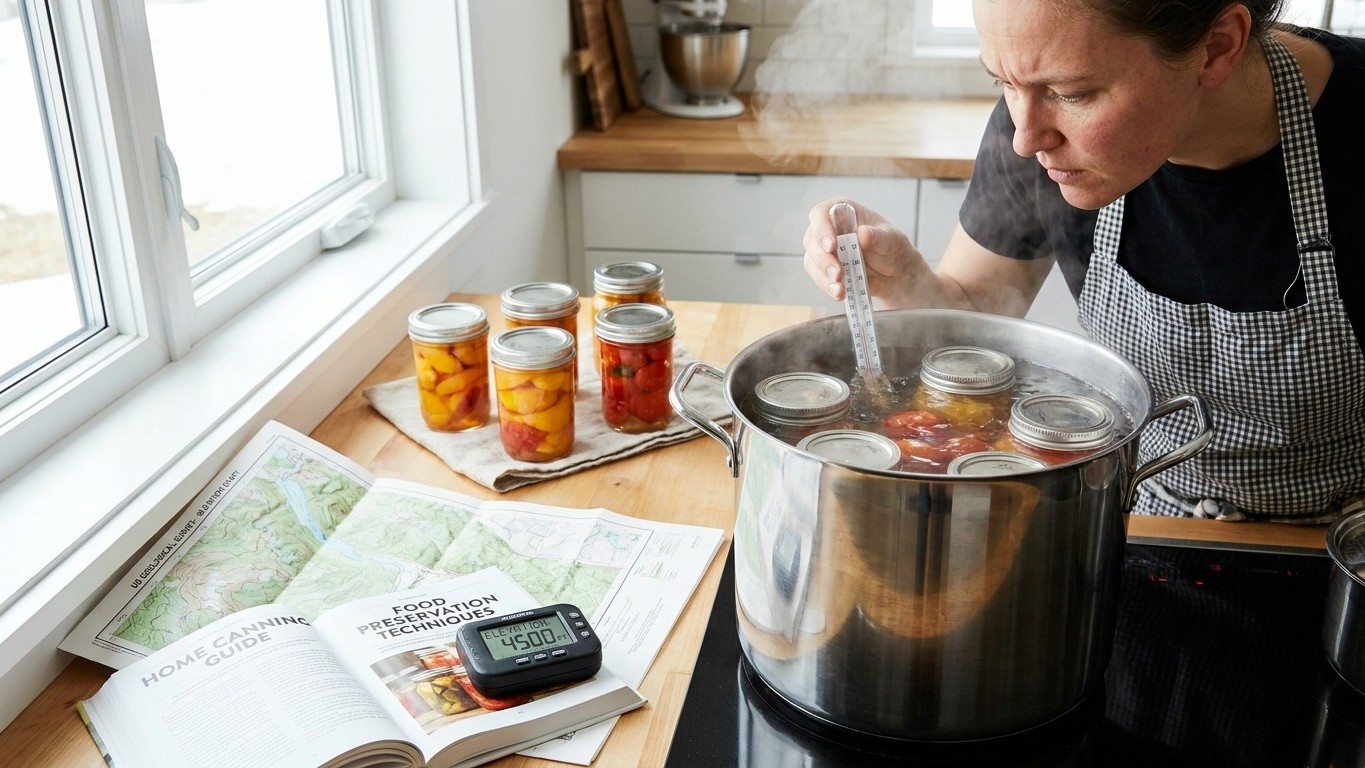

Philadelphia sits at 39 feet above sea level, well inside the 0-to-2,000-foot band where the USDA’s canning charts group water as boiling somewhere between 208°F and 212°F. At that elevation, standard processing times and pressures apply with no altitude adjustment. But Pennsylvania stretches from river valleys near sea level to ridges in the Alleghenies well above 2,000 feet, and the number that matters isn’t Philadelphia’s. It’s yours. Find your own elevation before you adjust anything.
The short answer

Start with the reference point: Philadelphia, the elevation figure most often cited for Pennsylvania in canning discussions, sits at 39 feet. That’s a geographic fact, not a canning rule, and it comes from geographic elevation data, not from any food-safety authority. What it tells a home canner is simple: at 39 feet, you’re deep inside the lowest elevation band the USDA’s Complete Guide to Home Canning recognizes, the 0-to-2,000-foot bracket, where the guide’s own figures put boiling water somewhere between 208°F and 212°F depending on the day’s barometric pressure and the exact spot on the map.
That’s the entire question, reduced to one useful fact. If your kitchen sits in that same band, the tested recipe you’re following applies as written, with no altitude adjustment. If it doesn’t, everything downstream, the time in a boiling-water canner or the pressure in a dial or weighted-gauge canner, has to move.
Here’s the part that trips people up: Pennsylvania is not a single elevation. A canner in Philadelphia, a canner in Pittsburgh, and a canner up in the Poconos or along a ridge in Potter County are not canning at the same barometric conditions, even though they’re all in the same state, sometimes even in the same county. The 39-foot figure describes a city, not a state. Nobody should read “Pennsylvania” and assume their kitchen matches that number.
| Reference point | Elevation | Elevation band | Boiling water range |
|---|---|---|---|
| Philadelphia | 39 ft | 0 to 2,000 ft | 208°F to 212°F |
That table holds exactly one certainty: what Philadelphia’s numbers say. It says nothing about a cabin at 2,400 feet outside State College, or a homestead higher up in the Laurel Highlands. Those kitchens belong to a different bracket in the USDA chart, and a different bracket means a different adjustment. The mechanism behind that shift, and why a weaker boil actually matters for jar safety, is worth understanding before you touch a single recipe.
Why a lower boil is a weaker process
Water has a ceiling. At sea level, that ceiling sits at 212°F, and no matter how hard the pot boils, how many bubbles roll across the surface, the water in it will never climb past that number. Boiling is a phase change, not a heating curve. Once water reaches its boiling point, added energy goes into turning liquid into steam, not into raising the temperature further. That’s why “boiling harder” is a myth that costs people jars: a rolling boil and a gentle boil sit at the exact same temperature, they just look different.
Elevation lowers that ceiling. Air pressure drops as you climb, and water needs less energy to turn to vapor under lower pressure, so it boils at a lower temperature. At sea level, water boils at 212°F. At 10,000 feet, it boils at 194°F. That’s an 18-degree gap, and it’s not a rounding error, it’s the difference between a process that reliably destroys Clostridium botulinum spores in a properly tested recipe and one that falls short.
A cooler boil kills less. That’s the whole mechanism, stated plainly. Every minute a jar spends in a boiling-water canner, or every pound of pressure a dial gauge holds in a pressure canner, was calculated against an assumed boiling temperature. Drop that temperature and the same number of minutes, or the same pressure, delivers less lethality than the recipe’s testing assumed. The bacteria and their spores don’t know the recipe says otherwise.
Two levers exist to make up that gap, and only two. In a boiling-water canner, the fix is more time at the stove, extending the process so the lower temperature has longer to do its work. In a pressure canner, the fix is more pressure, because raising the pressure inside a sealed canner raises the boiling point of the water inside it, pushing it back toward what a sea-level process assumes. Neither fix is something to estimate by feel. Both come from a tested chart matched to a specific elevation band, for a specific food, in a specific size jar. Guessing which lever to pull, or by how much, is exactly the mistake a compensations chart exists to prevent.
Finding your own elevation
Philadelphia’s 39 feet is a reference point, nothing more. Before adjusting any recipe, a canner needs the number for the actual kitchen the jars are cooling in, and that number can come from an official source in a few short steps.
- Open the National Center for Home Food Preservation’s “Find Your Elevation” page, built specifically for canners who don’t know their own altitude.
- Enter an address, town name, or ZIP code into the lookup tool provided there.
- Read the elevation figure the tool returns, in feet above sea level.
- Compare that figure against the altitude bands listed in the tested recipe being used, since each canning guide organizes its adjustments by band, not by exact foot count.
- Apply the adjustment listed for that band, for that specific food, and for the canning method in use, boiling-water or pressure.
Skipping straight to a chart without confirming the actual elevation is how mismatches happen. A kitchen at 1,800 feet and a kitchen at 2,100 feet can sit in two different bands despite being just a few hundred feet apart, and the difference between those bands is the difference between a recipe that needs no change and one that does. The lookup step takes under a minute. Guessing it wrong takes considerably longer to undo, if it’s even noticed before the jar is opened at the table.
What goes wrong
- An under-processed jar that looks perfect. A jar can seal, sit on the shelf looking exactly like every safe jar beside it, and still carry an underprocessed batch inside if the elevation adjustment was skipped. Lid concavity and a good seal only confirm that air was pushed out during processing, not that the contents reached a lethal temperature for long enough. The fix is procedural, not visual: apply the adjustment for the actual elevation every time, and never judge safety by how the jar looks on the shelf.
- A recipe pulled from a sea-level source. Plenty of canning instructions circulating online, in older family notebooks, or on general recipe sites were written with no altitude adjustment built in, often because the writer canned near sea level and never thought to mention it. The fix is to treat every recipe as needing a band check before use, matching it against a tested chart from the NCHFP or the USDA guide rather than assuming the printed number already accounts for elevation.
- A pressure gauge read as if elevation didn’t exist. Dial gauges and weighted gauges both need their target pressure set for the canner’s actual elevation band, and a canner that runs a flat 10 or 11 pounds regardless of altitude, because that’s the number remembered from somewhere, is running the wrong process for a kitchen above the lowest band. The fix is checking the pressure adjustment for the elevation band before the canner ever goes on the stove, not adjusting by ear once steam starts venting.
- Reusing an old chart after moving. A canner who moves from a low-elevation kitchen to a higher one, even within Pennsylvania, and keeps using processing times memorized from the old address, carries the previous kitchen’s assumptions into a new one where they no longer apply. The fix is running the elevation lookup again after any move, however short the distance seems on a map.
Where the exact adjustment comes from
This page gives no processing time and no canner pressure, and it won’t. The exact adjustment for an elevation band belongs to the specific tested recipe for the specific food being canned, published by the National Center for Home Food Preservation, and nowhere else should a canner look for that number. A boiling-water time for green beans and a pressure figure for tomato sauce are not interchangeable, even at the identical elevation.
The reason for that caution isn’t bureaucratic. Botulinum toxin has no taste and no smell. A jar can look, smell, and taste completely normal and still be unsafe, which is exactly why the adjustment can’t be estimated, remembered from a different food, or skipped because the jar “seems fine.” Match the elevation found in the previous section to the tested recipe published by the National Center for Home Food Preservation, for that exact food, and follow the figure printed there.
Common questions
Does Philadelphia’s elevation apply to the rest of Pennsylvania?
No. Philadelphia’s 39 feet describes Philadelphia, and only Philadelphia. Pennsylvania spans elevations from near sea level to well above 2,000 feet in its mountainous regions, and each kitchen needs its own figure, found through the NCHFP’s elevation lookup tool.
If I’m below 1,000 feet, do I still need to check anything?
Checking takes under a minute and removes the guesswork. Even within the lowest band, confirming the figure through the NCHFP tool means the tested recipe’s default numbers can be trusted rather than assumed.
Can boiling water harder make up for a lower boiling point?
No. Boiling water sits at a fixed temperature for its elevation, and a rolling boil is not hotter than a gentle boil at the same altitude. The only way to compensate for a lower boiling point is more time in a boiling-water canner or more pressure in a pressure canner, both taken from a tested chart.
Where do I find the exact time or pressure for my food?
Directly from the National Center for Home Food Preservation’s tested recipe for that food, matched to the elevation band found through their “Find Your Elevation” page. No general chart or memory substitutes for that specific match.