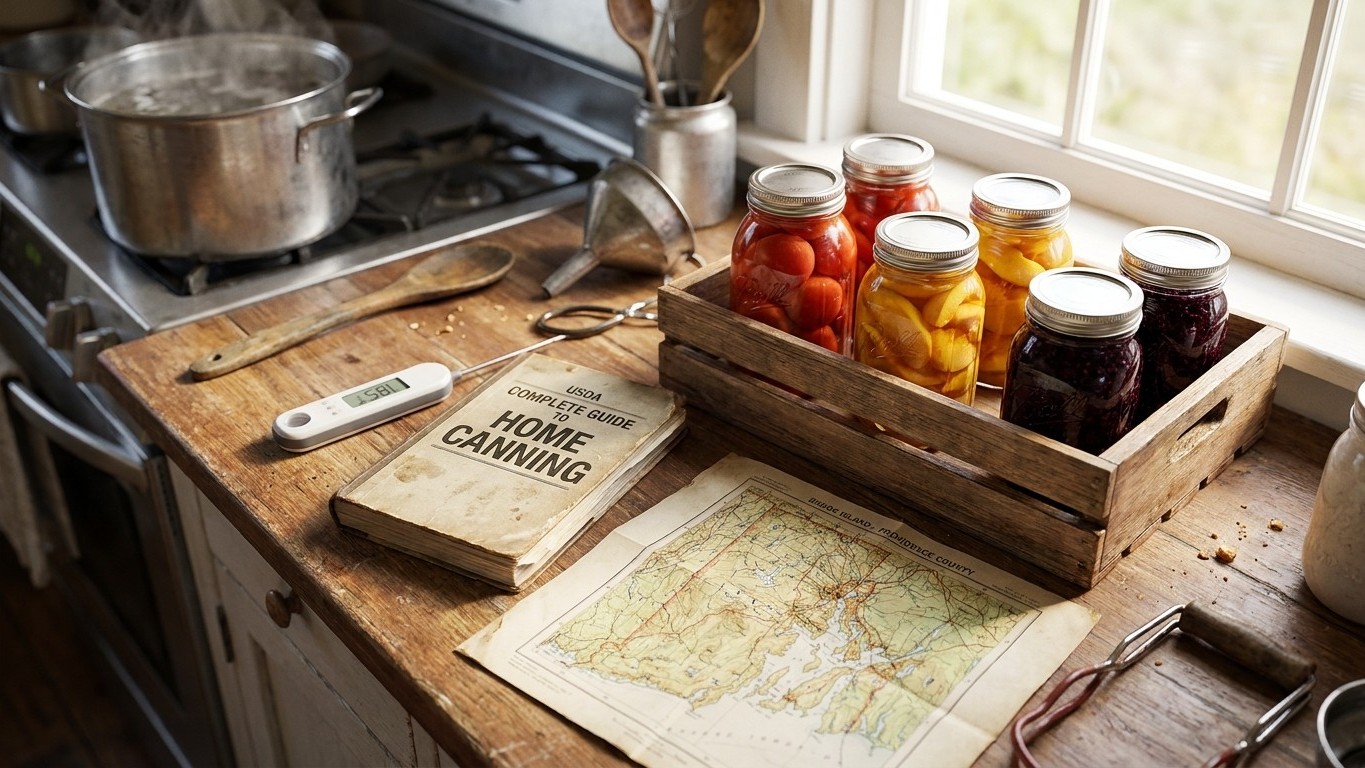

Providence sits at just 7 feet above sea level, squarely inside the 0-2,000 foot elevation band where the U.S. Complete Guide to Home Canning places boiling water between 208°F and 212°F. For a home canner working near the coast, that’s close enough to sea-level standard that the tested processing times in a trusted recipe apply without adjustment. But Providence is a reference point, not a description of Rhode Island itself.
The short answer

Start with the number that matters: Providence, the reference city for this state, sits at 7 feet of elevation. According to the USDA Complete Guide to Home Canning, as published by the National Center for Home Food Preservation, water at that kind of elevation boils somewhere between 208°F and 212°F, the band that covers 0 to 2,000 feet. For anyone canning at or near that elevation, the answer is simple: no altitude adjustment is needed. Standard, tested processing times written for sea-level conditions will do the job.
That’s the easy case, and it covers a lot of ground in a small, densely populated coastal state. But “Rhode Island’s elevation” isn’t really a single number, any more than “New England’s weather” is a single forecast. A state is a patch of land with hills, valleys, coastline, and river bottoms, and each of those sits at a different height above sea level. Providence, as the reference city here, tells you what conditions look like at 7 feet. It does not tell you what conditions look like on a hillside twenty or thirty miles inland, where the ground climbs well above the coastal plain.
Why the band matters more than the exact foot count
The 208°F to 212°F range isn’t a rounding error, it reflects a real spread within the 0 to 2,000 foot band itself. Boiling point drops as elevation rises, gradually and predictably, which is why canning guidance is organized by elevation bands rather than by single-degree thresholds. A kitchen at 50 feet and a kitchen at 1,800 feet are both technically in the same broad band, but they’re not identical, and serious canning references break the guidance down more finely than a single wide range once you get into the specific processing charts for pressure canners and boiling-water canners.
The practical takeaway at this stage is narrower than it sounds. If your kitchen sits at an elevation close to Providence’s 7 feet, and much of Rhode Island’s coastal and low-lying terrain does, you’re working in conditions where water reaches a genuine, strong boil at essentially the temperature the recipe writer assumed. Move inland to higher ground, and that assumption starts to erode, degree by degree, until the tested process is no longer strong enough to do its job.
Why a lower boil is a weaker process
Here’s the mechanism, and it’s worth sitting with because it trips up a lot of careful, well-meaning canners. Water boils when it reaches its boiling point for the local air pressure, and at higher elevations, air pressure is lower, so water boils at a lower temperature. At sea level that’s 212°F. Climb toward 10,000 feet and water is fully boiling, rolling, bubbling, at only 194°F. Same pot, same flame, same vigorous boil to the eye. Different temperature entirely.
That gap matters because canning is fundamentally a heat-and-time equation aimed at destroying microorganisms, including the spores that cause botulism. A boiling-water canner relies on sustained exposure to boiling temperature to make jars of high-acid foods safe. A pressure canner relies on higher, controlled temperatures under pressure to make low-acid foods safe. In both cases, the tested process assumes a specific temperature is actually being reached inside that jar for a specific length of time. Drop the boiling temperature and you’ve quietly changed the entire equation, even though nothing about the recipe or the equipment looks any different.
This is where a common instinct leads people astray. Faced with a weaker boil, the natural response is to crank the heat and get the water boiling harder, on the theory that a more vigorous, more violent boil must be doing more work. It isn’t. Boiling water does not get hotter no matter how hard it boils; once water is boiling, its temperature is fixed by elevation, not by how much flame is under the pot. A gentle boil and an aggressive, rolling boil sit at exactly the same temperature at the same elevation. Turning up the burner wastes fuel and rattles the jars. It does nothing to raise the temperature inside them.
What actually compensates for a lower boiling point is different for the two kinds of canning. In a boiling-water canner, processing at a lower temperature is offset by processing for longer, giving the heat more time to do the work that a hotter boil would have done faster. In a pressure canner, the compensation runs the other way: instead of extending the time, the canner is run at a higher pressure, which raises the internal temperature back up to where the tested process needs it to be, regardless of what the ambient boiling point of water happens to be outside the sealed canner. Both adjustments exist for the same reason. They restore the destructive power that altitude quietly took away.
Finding your own elevation
Providence’s 7 feet is a starting reference, not a stand-in for your kitchen. Before touching a canning chart, find your own number using a straightforward sequence.
- Start with your street address or the nearest town center, since elevation lookups work from a specific location rather than a general region.
- Use the National Center for Home Food Preservation’s “Find Your Elevation” page, built specifically so home canners can locate their own elevation rather than guessing from a state average.
- Enter your location into the tool and read off the elevation in feet above sea level.
- Compare that number against the elevation bands published in your specific tested recipe, since canning guidance is organized by band (such as 0 to 1,000 feet, 1,001 to 3,000 feet, and higher) rather than by a single cutoff.
- Note which band you fall into and keep that figure on hand every time you can, since it applies to boiling-water processing times and to pressure canner settings alike.
- Recheck if you move, can at a relative’s house in a different part of the state, or work from a cabin or camp at a noticeably different elevation than home.
That last step matters more than it seems. Rhode Island is small, but a canning session at a coastal cottage and a canning session at an inland farmhouse can sit in genuinely different elevation bands, even within the same afternoon’s driving distance.
What goes wrong
- An under-processed jar that looks completely normal. A jar canned at the sea-level time despite sitting at a higher elevation can seal properly, look clear, and show no sign of spoilage, while still not having reached a temperature capable of destroying botulinum spores. The fix is to always match the processing time or pressure to your actual elevation band before you can, not after you notice a problem, because there’s usually nothing to notice.
- A recipe pulled from a source written for sea-level conditions. Plenty of recipes online and in older family collections were written without any elevation guidance at all, or assume a coastal kitchen. The remedy is to check any recipe against a current tested source that explicitly publishes elevation adjustments, and to treat a recipe with no altitude guidance as incomplete rather than universal.
- A pressure gauge read as if elevation didn’t exist. Running a pressure canner at the pressure that would be correct at sea level, without adjusting upward for a higher elevation, quietly undercooks the load even though the gauge needle looks exactly where it’s supposed to be. The remedy is to set canner pressure according to your elevation band every single time, checking the gauge against the adjusted target rather than a memorized sea-level number.
- Treating one Rhode Island canning session as proof for every future one. A batch canned successfully at a low-lying coastal kitchen doesn’t validate the same process at a higher inland location. The remedy is to re-verify elevation and re-check the corresponding band whenever the canning location changes, rather than assuming past success travels with you.
Where the exact adjustment comes from
Nothing on this page tells you how many minutes to process a jar or how many pounds of pressure to run a canner at, and that’s deliberate. The correct adjustment depends on the specific food, the jar size, and the recipe being used, and it has to come from a tested source matched to that exact combination. The National Center for Home Food Preservation publishes the elevation-adjusted processing times and pressures for the full range of home-canned foods, organized by elevation band, and that’s the resource to use once you know your own elevation from the steps above.
The reason this caution matters more than it might seem is simple and unforgiving: botulinum toxin has no taste and no smell. A jar that’s under-processed because of an unadjusted altitude gives no warning sign before it’s eaten. Getting the number from a tested source isn’t a formality, it’s the entire point of the exercise.
Common questions
Does Rhode Island have one official canning altitude?
No. Providence, at 7 feet, serves as this article’s reference city, but elevation varies across the state. Your own kitchen’s elevation, found through the NCHFP tool, is what determines your canning adjustment, not a single statewide figure.
If I live near Providence, do I need to adjust my canning times at all?
At an elevation close to Providence’s 7 feet, within the 0 to 2,000 foot band, standard tested processing times written for sea-level conditions generally apply without modification. Confirming your specific elevation is still worthwhile if you’re unsure how close you sit to that reference point.
Why does boiling water harder not fix a low-elevation boiling point?
Because boiling water is already at its maximum temperature for that elevation and air pressure. A harder, more vigorous boil looks more intense but sits at the exact same temperature as a gentle boil at the same elevation. Compensation comes from extending time in a boiling-water canner or raising pressure in a pressure canner, not from a bigger flame.
What happens if I use a recipe that doesn’t mention elevation at all?
Treat it as incomplete rather than safe to use as written. Cross-check the food and jar size against a current tested source, such as the National Center for Home Food Preservation, that explicitly publishes elevation-adjusted times and pressures, and use that adjusted figure instead of the unadjusted recipe.