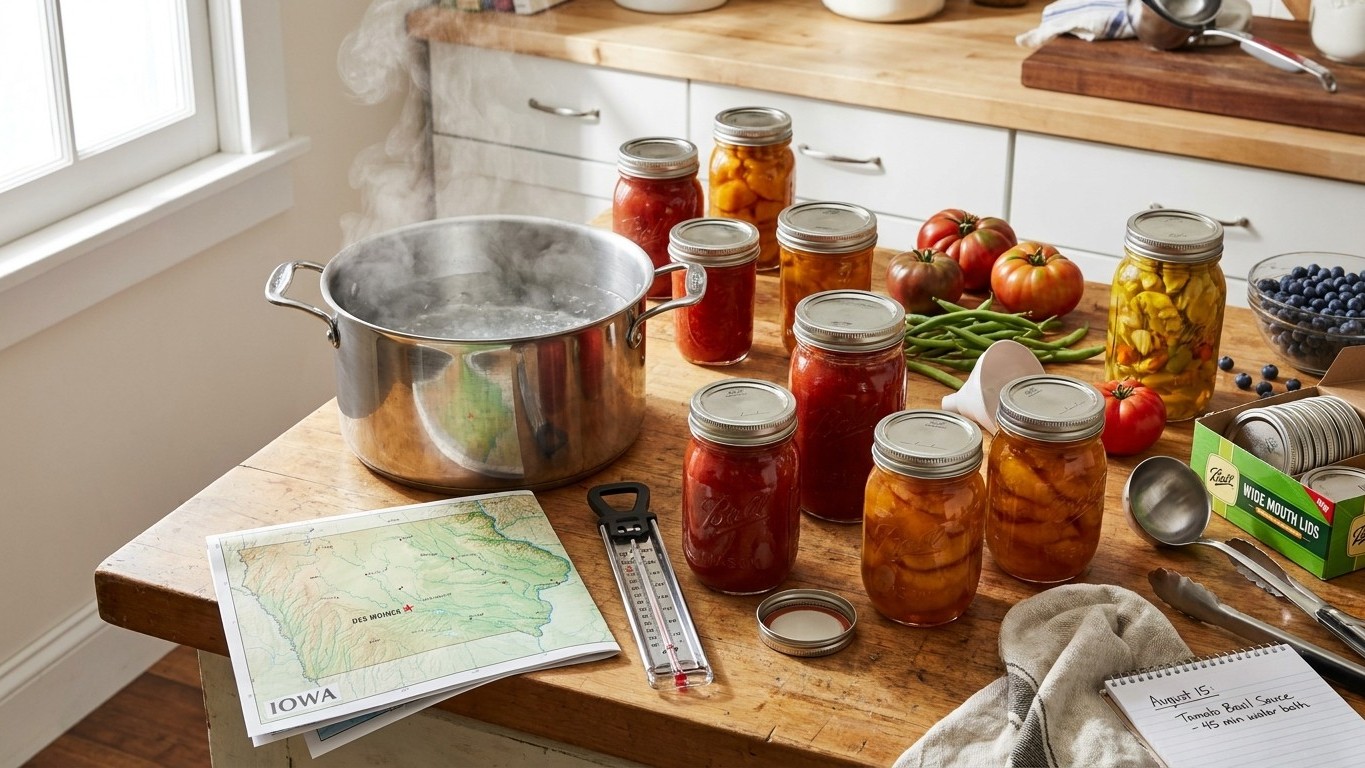

Des Moines sits at 873 feet above sea level, where water boils somewhere between 208°F and 212°F depending on the day’s barometric pressure. That elevation falls in the 0-2,000 foot band, which means the standard sea-level canning guidance stays close to accurate for anyone canning near that mark. But Des Moines is a reference point, not a guarantee, your own kitchen might sit somewhere else on Iowa’s gently rolling terrain, and that difference is what actually decides your process.
The short answer

Des Moines, the reference city used for this state, measures 873 feet in elevation according to geographic data drawn from GeoNames. At that height, water reaches a rolling boil somewhere between 208°F and 212°F, the range the USDA’s Complete Guide to Home Canning uses to bracket boiling temperatures across the low-altitude band, as published by the National Center for Home Food Preservation. Those two numbers aren’t a coincidence of rounding. They mark the low and high ends of what “boiling” actually means once you’re a few hundred feet off the coast, and Des Moines lands squarely inside that window.
For a home canner working at or near 873 feet, this is not an elevation that rewrites the rulebook. A 4-degree drop from the textbook 212°F is small enough that it sits inside the buffer already built into most tested processing times for the 0-2,000 foot band. Compare that to somewhere sitting at 6,000 feet, where the boiling point drops closer to 201°F, a gap wide enough that every single jar processed with an unadjusted sea-level recipe risks under-processing, no matter how carefully the rest of the recipe was followed.
Why the reference city matters and the state doesn’t
Iowa is not a single elevation. It’s a landscape that climbs and dips across river valleys, glacial till plains, and loess hills, and no single number can describe all of it honestly. Des Moines gets used as the reference point here because it’s a population center with reliable elevation data, not because it represents every kitchen in the state. Someone canning tomatoes in a river-bottom town might sit closer to 600 feet. Someone else up on a ridge in the northeast corner of the state could be canning at 1,300 feet or more. Both of those elevations still fall inside the 0-2,000 foot band that covers Des Moines, but the point stands: the number that matters is the one under your own feet, not the one attached to the nearest big city on a map.
Why a lower boil is a weaker process
Boiling-water canning and pressure canning both rely on heat to destroy microorganisms and inactivate enzymes inside a sealed jar. The heat that does that work comes from the temperature of the boil, not from the fact that the water is bubbling. And that’s the detail that trips people up: water at a rolling boil in Denver and water at a rolling boil in Des Moines are both “boiling,” but they are not the same temperature. As elevation rises, atmospheric pressure drops, and water needs less energy to turn to vapor. It boils at a lower temperature. At sea level that’s 212°F. At 10,000 feet, it’s 194°F, a full 18-degree difference, even though both pots look identical on the stove.
A cooler boil delivers less heat to the food inside the jar over the same span of time. That’s the entire mechanism, and it’s worth sitting with because so much kitchen instinct points the other way. Cranking the burner higher doesn’t fix it. Once water is boiling, it cannot get hotter, all the extra energy goes into making more steam, not into raising the temperature of the water itself. A furious boil and a gentle boil sitting at the same elevation are the same temperature. So the fix can’t come from turning up the heat. It has to come from somewhere else.
What actually compensates is time, or in the case of pressure canning, pressure. In a boiling-water canner, a higher elevation calls for a longer processing time, giving the cooler water more minutes to do the job that hotter water would have done faster. In a pressure canner, the fix runs the other direction: instead of stretching the clock, you raise the pounds of pressure, which pushes the internal temperature of the canner back up past what elevation alone would allow. Either way, the adjustment exists because the physics of boiling changed, not because anyone did anything wrong with the recipe itself. It’s a correction for altitude, applied to a process that otherwise stays the same.
Finding your own elevation
Des Moines gives you a reference point, not your kitchen’s actual number. Before you touch a canning chart, you need the elevation where your jars will actually process, and it doesn’t have to be exact to the foot, but it has to be close enough to land you in the right band.
- Start with the address where you’ll be canning, not a town center or a mailing address in a different zip code, a farmhouse a few miles outside a small town can sit at a meaningfully different elevation than the town itself.
- Use the National Center for Home Food Preservation’s “Find Your Elevation” page, built specifically so home canners can look up elevation by location rather than guessing from a state average or a nearby city.
- Note the number in feet, then round to the nearest elevation band listed on your canning chart or in your recipe source, most tested resources group elevations rather than requiring an exact figure.
- Recheck if you move, can at a relative’s house, or process food somewhere other than home, a lake cabin or a hunting property can sit at a very different elevation than your regular kitchen.
- Keep that number somewhere you’ll actually see it again, taped inside a cabinet door or written on the inside cover of your canning notes, since it applies to every batch you process, not just one.
What goes wrong
- An under-processed jar that looks perfect. Nothing about a sealed lid, a clear liquid, or a properly popped button tells you whether the contents reached a safe temperature. A jar processed at a sea-level time but a higher-elevation boil can seal beautifully and still carry organisms that a fully adjusted process would have destroyed. Always process using the time or pressure matched to your actual elevation band, not the appearance of the finished jar.
- A recipe pulled from a sea-level source. Older family recipes, general food blogs, and even some printed cookbooks assume a sea-level boil without saying so. If a recipe doesn’t mention altitude adjustments at all, treat that as a red flag rather than reassurance, and cross-check it against a tested source that publishes elevation-based charts by food type.
- A pressure gauge read as if elevation didn’t exist. Dial gauges and weighted gauges both need elevation-specific pressure settings, and the required pressure at 2,500 feet is not the same as at sea level or at 6,000 feet. Reading “10 pounds” off a chart without checking which elevation column that number came from is one of the more common mistakes in home pressure canning.
- Assuming a boiling-water canner adjustment covers a pressure canner, or the reverse. The two methods compensate for altitude in different ways, one through time and one through pressure, and the adjustment for one method doesn’t transfer to the other even for the same food at the same elevation.
Where the exact adjustment comes from
This page won’t hand you a processing time or a pressure setting, and that’s deliberate. The correct adjustment depends on the specific food, the jar size, and the tested recipe behind it, not on elevation alone. A pint of green beans and a quart of tomato sauce don’t share a processing time even at the same elevation, and guessing at the gap between them is exactly how safety margins disappear.
For the actual figures, go to the National Center for Home Food Preservation, the authority tested recipes and altitude charts trace back to. Botulinum toxin, the danger behind under-processed low-acid and some acid foods, has no taste and no smell, a jar can be contaminated and still taste completely normal, which is precisely why the tested time or pressure matters more than instinct or appearance.
Common questions
Does Iowa count as a high-altitude state for canning purposes?
No. Des Moines, used here as the reference city, sits at 873 feet, well within the 0-2,000 foot band where standard low-altitude guidance generally applies. Higher pockets exist across the state, so your own elevation is still the number that matters.
Can I just boil food longer to be safe, regardless of my elevation?
Adding extra time without knowing your elevation band can either under-process food or, in some cases, degrade texture and quality without adding real safety margin. The tested charts exist because the correct adjustment is specific, not a matter of “more is always safer.”
Does altitude affect boiling-water canning and pressure canning the same way?
The underlying cause is the same, a lower boiling point at higher elevation, but the fix differs: boiling-water canning adjusts the time, while pressure canning adjusts the pressure. Check the chart that matches your actual method.
What if my elevation falls right between two bands on a chart?
Tested charts are built with a buffer, but when a location sits near a boundary, using the adjustment for the higher band is the safer choice. The National Center for Home Food Preservation’s elevation lookup tool can help confirm which side of that boundary you actually fall on.