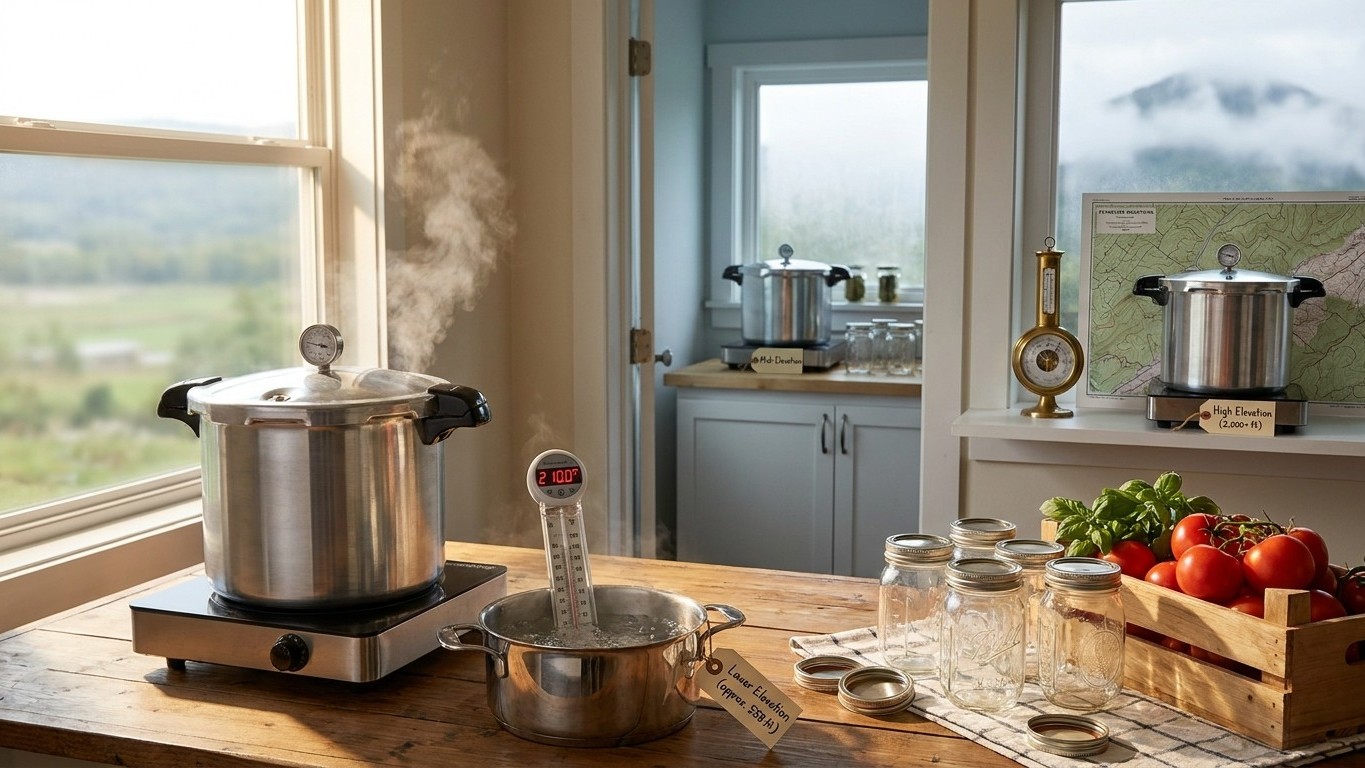

Nashville sits at 558 feet, where water boils somewhere between 208°F and 212°F depending on the day’s weather. That’s close enough to sea level that most tested canning recipes work as written for anyone near that elevation. But Tennessee runs from river bottoms below 500 feet to mountain communities well above 2,000 feet, and your own elevation, not Nashville’s, decides whether your canner needs an adjustment.
The short answer

Nashville, the reference city for this page, sits at 558 feet above sea level. At that height, published boiling temperatures for water fall between 208°F and 212°F. That’s a narrow band, and it lands inside the range where standard tested processing times generally apply without modification. If you can and live within a few hundred feet of Nashville’s elevation, in most cases you’re following recipes as printed.
That number describes Nashville. It does not describe Tennessee. A state is not a single elevation any more than it’s a single climate. Memphis sits low along the Mississippi River. Knoxville sits higher in the eastern valley. Communities in the Great Smoky Mountains climb well past 2,000 feet, and some ridge roads run higher still. Two home canners forty miles apart can be working at meaningfully different elevations, and the canner doesn’t care what county you’re in. It cares what your kitchen’s height above sea level actually is.
Here’s why this matters so much for a food safety topic and so little for almost everything else in cooking. Water boils at a temperature set by atmospheric pressure, and atmospheric pressure drops as elevation rises. At sea level, water boils at 212°F. At 10,000 feet, it boils at 194°F, a full 18 degrees cooler. That’s not a rounding error. It’s the difference between a canning process that reliably destroys Clostridium botulinum spores and one that leaves a margin too thin to trust.
So the honest answer to “does my elevation change anything” splits into two cases. If you’re canning near Nashville’s 558 feet, the boiling temperature stays close enough to the standard 212°F that the tested times in most home canning references apply directly. If you’re canning from a mountain community in East Tennessee, or anywhere your local elevation climbs meaningfully higher, the boil in your kitchen is measurably cooler than the boil the recipe was tested against. That gap is exactly what altitude adjustments exist to close, and it only gets wider the higher you go. Nobody drifts into unsafe canning by exaggeration. They drift into it by assuming their kitchen matches a reference point on a chart that was never describing their kitchen in the first place.
Why a lower boil is a weaker process
The mechanism here is almost embarrassingly simple, which is probably why it gets overlooked. Boiling water processes food by holding it at a set temperature for a set time. At sea level that temperature is 212°F. Climb higher and the same pot of vigorously boiling water sits at a lower temperature, because boiling point tracks air pressure, not effort. At 10,000 feet, a full rolling boil only reaches 194°F. The water is still boiling. It’s just boiling cooler.
This is where a lot of good instincts go wrong. A canner who suspects their process might be running weak often responds by cranking the heat higher, watching for a harder, more violent boil, and assuming that fiercer bubbling means a hotter pot. It doesn’t. Once water reaches its boiling point for the given elevation, adding more heat just makes it boil away faster. It does not raise the temperature past that ceiling. A raging boil at 6,000 feet and a gentle boil at 6,000 feet are both sitting at the same temperature, whatever that happens to be for that elevation. More flame under the pot buys you nothing except a shorter processing window before you run low on water.
A cooler boil kills less. That’s the entire logic chain, and it’s worth holding onto because everything downstream follows from it. Bacterial spores, particularly the ones that produce botulinum toxin, are destroyed through a combination of temperature and time. Drop the temperature and you need more time at that lower temperature to achieve the same destructive effect, the same way a lukewarm oven needs longer to finish a roast than a hot one. In a boiling-water canner, used for high-acid foods like most fruits, pickles, and jams, that means longer processing minutes as elevation climbs. In a pressure canner, used for low-acid foods like vegetables, meats, and most soups, the compensation works differently: instead of stretching the time, tested guidance raises the pressure inside the canner, which raises the temperature the food actually reaches, restoring the margin that a simple boil can’t provide once you’re high enough that boiling alone falls short.
Neither fix is something to estimate by feel. Both come from tested processes matched to specific elevation bands, which is exactly the territory the next two sections cover.
Finding your own elevation
Nashville’s 558 feet is a data point, not a personal answer. Before touching a recipe’s processing time, find the number that actually applies to your kitchen.
- Start with the county extension office. Tennessee’s local UT Extension offices routinely field canning questions and often have elevation figures on hand for their service area.
- Check a topographic reference for your specific address rather than your town’s general reputation. Elevation can shift by hundreds of feet within a few miles, especially in hilly or mountainous parts of the state.
- Use the National Center for Home Food Preservation’s “Find Your Elevation” page, which exists precisely for this purpose and lets you locate a reliable figure without guessing.
- Round up rather than down if you land between two figures or aren’t fully certain. Treating your kitchen as slightly higher than it might be costs you a little extra processing time. Treating it as lower than it actually is costs you food safety margin.
- Write the number down somewhere you’ll see it at canning time, on the inside of a cupboard door or taped to the canner itself, so you’re not recalculating from memory every season.
Once you have that number, match it to the elevation bands published in your tested recipe source rather than trying to interpolate a number of your own. Canning guidance is built in bands for a reason: small differences within a band don’t change the outcome, but crossing into the next band does.
What goes wrong
- An under-processed jar that looks perfectly normal. A jar can seal properly, show no bulging, and still carry a processing time too short for its actual elevation. There’s no visual cue for this. The remedy is entirely procedural: match your processing time or pressure to your elevation band before you can, not after, because there’s no way to inspect your way to safety later.
- A recipe pulled from a sea-level source. Plenty of recipes online and in older community cookbooks were tested at or near sea level and never mention elevation at all. Using one without adjustment at a Tennessee elevation above the lowest band quietly weakens the process. The remedy is to treat any recipe silent on elevation as a sea-level recipe and adjust it yourself using a current tested source, not to assume silence means it applies everywhere.
- A pressure gauge read as if elevation didn’t exist. Pressure canner gauges need to be set for the elevation band you’re in, and a canner run at a pressure meant for a lower elevation delivers a lower effective temperature than intended. The remedy is checking your gauge’s accuracy periodically and setting pressure according to your actual elevation band every single time, not just the first time you learned the number.
- Assuming one adjustment covers every food. The correction for green beans and the correction for tomatoes aren’t the same, because acidity and density change how heat penetrates the jar. The remedy is looking up the elevation adjustment for the specific food and process method each time, rather than reusing a number learned for a different recipe.
Where the exact adjustment comes from
This page won’t hand you a processing time or a canner pressure, and that’s intentional. The right adjustment depends on the specific food, the jar size, and the tested recipe behind it, and those figures belong to the National Center for Home Food Preservation, not to a general explainer about elevation. Look up your food on the National Center for Home Food Preservation’s website and follow the elevation adjustment listed for your specific process and your elevation band.
The reason for that caution isn’t bureaucratic. Clostridium botulinum, the organism a proper process is designed to destroy, produces a toxin with no taste and no smell. A jar can look, smell, and taste completely fine and still be unsafe. There’s no sensory check that substitutes for matching your elevation to a tested time and pressure, which is exactly why the number has to come from the tested source itself, not from memory or approximation.
Common questions
Does Tennessee have one official altitude for canning?
No. Tennessee spans elevations from below 500 feet to well above 2,000 feet. Nashville’s 558 feet, used as a reference point on this page, describes one city, not the state, and your own local elevation is what should guide any adjustment.
If I live near Nashville, do I need to adjust my canning times at all?
At an elevation close to Nashville’s 558 feet, boiling water still reaches close to 212°F, which is the range most standard tested recipes are built around. Confirm your own elevation using the steps above rather than assuming, but many canners at this elevation follow standard processing times as published.
Why does a harder boil not fix a cooler boiling point?
Because boiling point is set by atmospheric pressure, not by how much heat you apply. Once water reaches its boiling point for your elevation, additional heat just makes it boil away faster. It doesn’t push the temperature any higher.
What happens if I use a sea-level recipe at a higher Tennessee elevation without adjusting?
The process runs cooler than the recipe was tested for, which weakens its ability to destroy harmful spores. The jar can seal and look completely normal while still being unsafe, since botulinum toxin has no taste or smell to warn you.