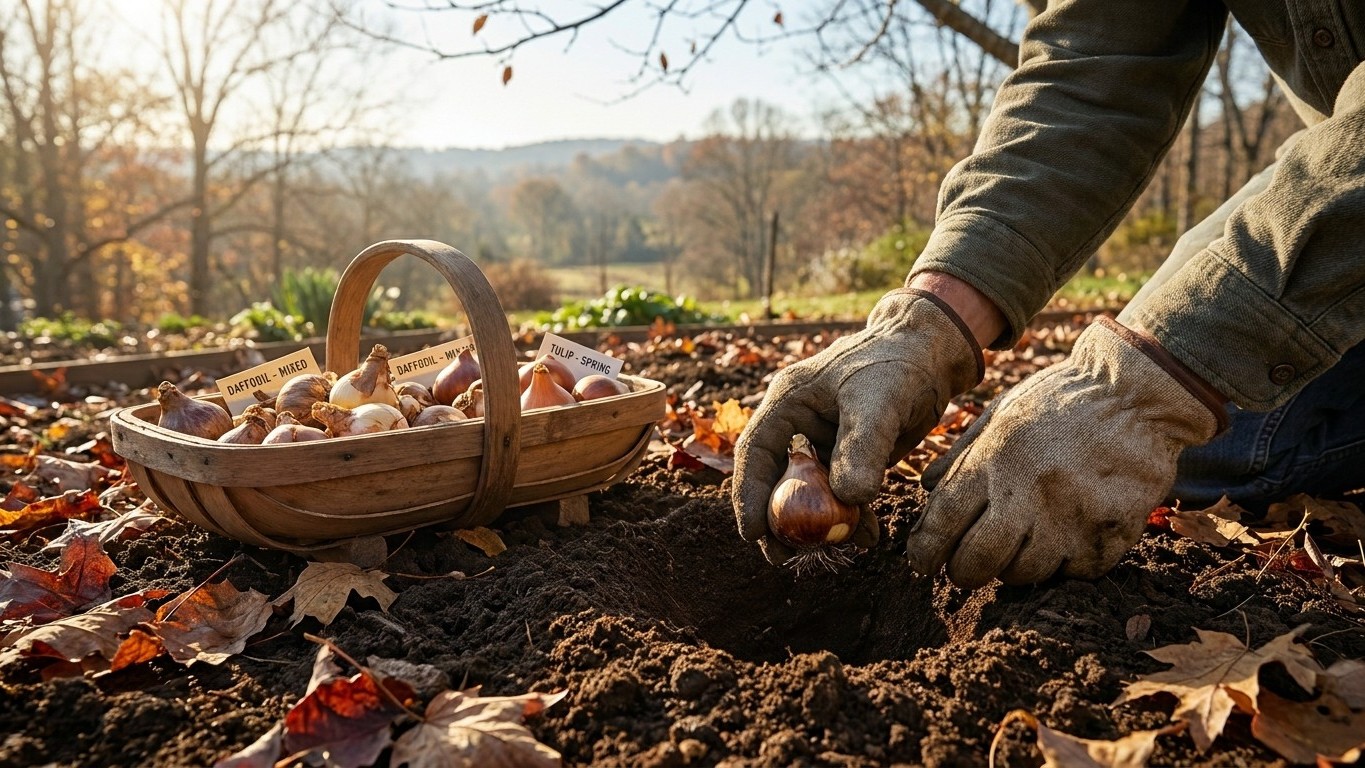

Spring bulbs go into Virginia soil on a schedule tied to the first fall frost, but timing is only half of what decides whether they bloom. The other half is winter cold itself, measured in weeks below 45°F, not just a date on the calendar. Coastal Virginia and the mountains answer that question very differently, and this guide on Growing Spring Bulbs in Containers in Virginia walks through both: when to plant, whether your winter delivers enough chill, and which bulbs actually reward the effort.
When to plant bulbs in Virginia

The target date is roughly six weeks before the ground freezes hard, and in Virginia that point tracks the average first fall frost, which falls between November 10 and November 24 depending on where in the state you garden (NOAA NCEI 1991-2020 Climate Normals, reference station USW00013769, NAS Oceana near Virginia Beach). Counting six weeks back from that window puts the ideal planting stretch at roughly late September through mid-October, with plantings continuing into November as long as the soil can still be worked.
Both edges of that window carry a real cost. Plant too early, while the soil is still warm from summer, and a bulb like a daffodil or tulip can push top growth before winter arrives. That growth gets caught by the first hard freeze and dies back, weakening the bulb before it has even rooted properly. Plant too late, after the ground has already gone cold and started to lock up, and the bulb never builds the root system it needs before winter shuts things down. The result the following spring is a stunted plant, a bloom that never opens fully, or no shoot at all.
The frost date is an average, not a guarantee
It’s worth being blunt about what that November 10 to November 24 range actually means: it’s an average drawn from three decades of data, which means roughly half of all years fall on one side of it and half on the other. Some Novembers bring frost on the 8th. Others hold off until Thanksgiving. A gardener who plants exactly on the midpoint of that range and assumes they’ve hit the target is gambling on an average, not a promise.
The coastal reference station used here, near Virginia Beach, sits at the mild end of Virginia’s climate. The Blue Ridge and southwest Virginia run their own calendar entirely, with frost arriving weeks earlier in fall and lingering weeks later in spring. A planting date that works on the coast can be badly wrong two hundred miles inland, which is exactly why the next section separates what a bulb needs from what a specific place actually delivers.
Whether your winter is cold enough
This is the question that actually decides whether a bulb flowers, and most gardening advice skips right past it. A spring bulb needs a long stretch of genuine cold, typically twelve to fourteen weeks with the soil below about 45°F, and gardeners in milder pockets of the state who can’t count on that much natural chill outdoors can still get blooms by Forcing Spring Bulbs Indoors in Virginia, to trigger the internal process that produces a flower stalk. Skip that chill and the bulb doesn’t die. It just puts out leaves, or a flower bud too short and weak to ever open above the soil line. That figure, the weeks and the 45°F threshold, is the yardstick to measure any bulb against, no matter where you garden.
Virginia’s coldest month, measured at the Virginia Beach reference station, runs a mean daily minimum of 31.6°F (NOAA NCEI Climate Normals 1991-2020). That’s well below the 45°F line, which confirms the soil does drop into the right range for a sustained stretch each winter, from December into February. The margin, though, is not identical for every bulb, because some species need a longer chill window than others, and the coastal end of the state runs the mildest winters Virginia has to offer.
How each bulb measures up
| Bulb | Cold required | What coastal Virginia delivers | Verdict |
|---|---|---|---|
| Crocus | 8-10 weeks below 45°F | Comfortably covered by the December-February stretch | Reliable, no pre-chilling needed |
| Grape hyacinth (Muscari) | 8-10 weeks below 45°F | Comfortably covered | Reliable |
| Daffodil (Narcissus) | 12-14 weeks below 45°F | Met most years, margin not wide | Reliable, perennializes well |
| Allium (most species) | 10-15 weeks below 45°F, varies by species | Met for shorter-requirement species | Fine for most; check the exact species |
| Tulip | 12-14 weeks below 45°F | Borderline; a mild December can shave weeks off | Marginal on the coast; pre-chill or treat as short-lived |
| Hyacinth | 13-15 weeks below 45°F | Falls short in many years right on the coast | Weak without pre-chilling |
For anything marked marginal, pre-chilling is the fix, and it needs to be done properly. That means twelve weeks in a refrigerator at a steady cold temperature, stored away from apples, pears, or any ripening fruit, because the ethylene gas fruit gives off kills the flower bud sealed inside the bulb before it ever touches soil. Skip that precaution and a pre-chilled bulb can come out no better off than one left on a warm windowsill. And there’s no way to soften this: a gardener who plants full-size tulips or hyacinths on the immediate coast without pre-chilling, and expects them back for a second or third spring, has spent that money on what amounts to an expensive annual.
Which bulbs suit Virginia
Virginia’s USDA hardiness range runs from 5a to 8b (USDA Plant Hardiness Zone Map, 2023 edition, based on 1991-2020 normals), and the coastal reference city sits at the mild end of that span. A bulb whose hardiness rating covers zone 8, combined with a chill requirement the table above marks as reliable, is the safest bet anywhere in the state. Bulbs rated for zones 3 through 7 only, especially ones with a long chill requirement, run into trouble the closer a garden sits to the coast.
Bulbs that perform reliably
- Daffodil (Narcissus), hardy zones 3-8
- Crocus, hardy zones 3-8
- Grape hyacinth (Muscari), hardy zones 4-8
- Allium, most garden species hardy zones 4-8
- Species tulips (Tulipa clusiana, T. bakeri), hardy zones 4-8, better suited to warm winters than full-size hybrid tulips
A hardiness rating is a guide, not a hard line. A bulb rated to the edge of its range, planted against a south-facing brick wall that holds extra heat, or in a low spot where cold air pools, can behave very differently from the same bulb planted a hundred feet away. Full-size hybrid tulips and hyacinths, both rated to zone 8 on paper, are the two most likely to disappoint on the coast: strong bloom the first spring after planting, then leaves only the second year, and by the third year, nothing at all. Snowdrops (Galanthus), rated to zone 7, can struggle in the same way in the mildest coastal pockets, coming up thin and finished early. Crown imperial (Fritillaria), while it tolerates the cold fine, rots outright in heavy clay that stays wet through winter, regardless of hardiness zone.
What digs them up here
Squirrels and voles don’t raid every bulb bed equally, and the pattern isn’t random. It comes down to chemistry. Daffodils and true alliums contain compounds, lycorine in daffodils and sulfur compounds in the onion family, that make them bitter or mildly toxic, so wildlife generally leaves them alone. Tulips, crocus, and hyacinths carry no such defense and are treated as a food source the moment they’re planted.
Left alone
- Daffodil (Narcissus)
- Allium
- Snowdrop (Galanthus)
Dug up and eaten
- Tulip
- Crocus
- Hyacinth
The one measure with a real track record is physical, not chemical: lay galvanized wire mesh flat over the planting bed, pin it down, and leave it in place until the ground freezes solid, at which point squirrels lose interest in digging anyway. Repellent sprays and granules, by contrast, wash off with the first rain or heavy dew and need constant reapplication to do anything at all, which makes them a poor match for a bulb bed planted once in fall and left alone until spring.
Where to check for your own county
Every figure in this guide, the frost window, the 31.6°F coldest-month minimum, the coastal end of Virginia’s 5a-8b range, comes from a single reference station near Virginia Beach. That’s useful as a baseline, but Virginia stretches from tidewater to the Blue Ridge to the far southwest corner of the state, crossing several degrees of latitude and multiple hardiness zones along the way. A planting window built around the coast can run three weeks off the mark by the time you reach the mountains, in either direction.
Virginia Cooperative Extension, the state’s land-grant extension service, keeps localized frost data and planting guidance by county, and a call to the local office is the fastest way to confirm the numbers above actually apply to your specific garden. Find your county office through the main extension site at ext.vt.edu before finalizing a planting date, especially if you garden west of the Piedmont.