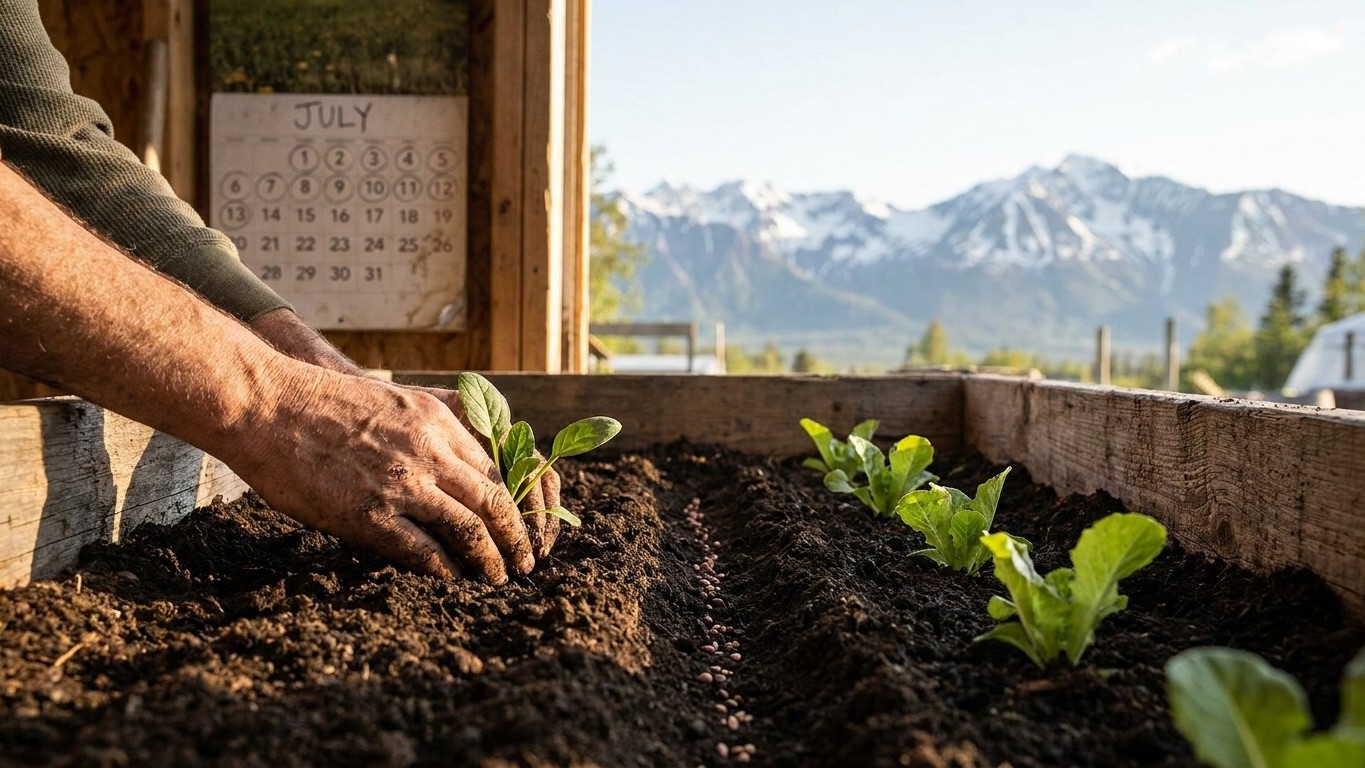

July in Alaska falls squarely inside the frost-free window that runs from the first half of May to late September, so the direct answer is simple: this is the state’s most active planting month, not a marginal one. The catch is time, not temperature. With first fall frost arriving September 22 to October 1, anything sown in July has to finish fast, and the answer changes depending on whether you’re planting on July 1 or July 31.
What goes in the ground in July

Soil temperature stopped being the limiting factor weeks ago in most of south-central Alaska. Last spring frost lands May 3 to May 12 at the Anchorage reference station, so by July the ground has had a full month or more to warm. The real constraint now is the calendar running out the other end: first fall frost hits September 22 to October 1, which leaves roughly 50 to 90 days depending on which week of July you’re standing in. Every seed packet’s “days to maturity” number has to be checked against that shrinking total before it goes in the ground.
That math still leaves plenty of room. Radishes (25 to 30 days), baby lettuce and spinach (30 to 45 days), turnips, bush beans planted in the first half of the month, and a second round of peas all fit comfortably even sown as late as mid-July. Carrots and beets can still go in during the first week or two if you’re after smaller roots rather than full-size storage ones. Brassica transplants (broccoli, cabbage, kale) set out early in the month have a reasonable shot at a fall harvest, especially with a floating row cover to buy a few extra weeks at the tail end.
What doesn’t belong in open ground in July, anywhere in the state, is anything that needs 90-plus frost-free days from seed: winter squash, pumpkins, dry beans, and full-season corn. Alaska’s territory spans USDA hardiness zones 1a to 8a, an enormous range built on one measurement (extreme minimum winter temperature), so a gardener in a milder pocket may stretch these limits further than someone at higher elevation or farther north. Tomatoes, peppers, and other heat lovers still belong under plastic or glass rather than in the open bed, no matter how warm the July air feels, because Alaska’s long daylight doesn’t raise soil temperature the way it does farther south.
What to start under cover
Counting backward from the first fall frost window is the only reliable way to decide what’s still worth starting indoors or under a cold frame in July. Take a fall crop of head lettuce needing about 55 days to maturity plus a week or two to establish after transplanting: that’s roughly 65 to 70 days total. Measured back from September 22, the earliest edge of the frost window, that lands the sowing date in mid-July at the very latest, and pushing past that risks a crop that’s still sizing up when the cold arrives.
Fast brassica greens (mizuna, tatsoi, baby kale) and a second wave of cilantro or dill are safer bets for cover-started sowings later in the month, since they tolerate a light touch of cold and don’t need the full 65-day runway. A cold frame or unheated high tunnel adds real insurance here, both by holding soil warmth into September and by shielding young transplants from the first light frosts before the true hard freeze.
The two ways this goes wrong are familiar to any gardener working a short season. Start too early in the month and warm-season starts sit too long before it’s safe to move them out, turning rootbound and leggy on a windowsill. Start too late and the plant simply runs out of daylight-warmth combination before frost, even though Alaska’s long summer days push growth faster per calendar day than the same latitude would suggest. There’s no published fixed date here beyond the frost range itself, so the safest approach is to work backward from a crop’s stated days-to-maturity rather than from habit.
What is ready to pick
July is when the spring sowings start paying off. Radishes and baby spinach planted in May are usually finished or finishing, and it’s worth pulling radishes as soon as they size up since Alaska’s long daylight pushes many of them to bolt and turn woody fast if left in the ground. Lettuce sown in late May or early June should be cutting-size, and a “cut and come again” approach on loose-leaf types stretches the harvest instead of pulling whole plants.
Peas from an early sowing typically start coming in during July, and rhubarb, one of the state’s most reliable perennials, is usually in full harvest by now, tolerant of the cool nights that would slow down more tender crops. Kale and chard planted early can be picked leaf by leaf without stopping the plant’s growth. In a greenhouse or high tunnel, early cucumbers and the first tomatoes may be starting to color up, though outdoor-grown tomatoes are rare enough in most of the state that a greenhouse or tunnel is doing most of that work.
Strawberries planted in prior seasons often bear their main flush in July as well, and it’s worth checking under the leaves daily since ripe berries left in Alaska’s near-constant summer light and moisture can go soft fast. None of this requires guesswork: color, size, and a light tug are still the best tests, exactly as they are anywhere else, just compressed into a shorter window than gardeners farther south are used to.
The jobs that matter this month
Watering rhythm deserves more attention in July than at almost any other point in the Alaska calendar, precisely because the long daylight hours (often close to 19 hours of light around the summer solstice, tapering through the month) drive high evapotranspiration even when air temperatures stay modest. A garden that looks fine at 10 p.m. in bright evening light can still be drying out fast. Deep, less frequent watering beats a light daily sprinkle, especially for anything with roots more than a few inches down.
Staking and support matter now because peas, tall brassicas, and any vining crop under a tunnel put on rapid growth during peak daylight and can sprawl or snap within days if left unsupported. Mulching around root crops and greens holds soil moisture and keeps roots cooler, which matters more than it sounds since Alaska soils can still swing in temperature between a sunny afternoon and a cool, overcast stretch.
Succession sowing is a July-specific job with a hard deadline: every week that passes narrows the list of fast crops that can still mature before the September frost window opens. A gardener who sows a new short row of radishes, lettuce, or spinach every 10 to 14 days through the month keeps harvests coming into fall instead of hitting a wall in August. Pest scouting also earns its keep now, since root maggots in brassicas and aphids on peas and greens build populations fastest during the warmest, brightest stretch of the season, and catching them early with row covers or hand-picking beats reacting after damage is visible. Alaska gardeners have one scouting task most of the country skips entirely: checking fencing and deterrents against moose, which browse garden rows through the summer and can undo a month of growth in one visit.
What not to do in July
The most common mistake is treating warm July air as proof the soil is warm too. Alaska soils, especially in shaded or poorly drained beds, lag well behind air temperature, so tucking a heat-loving crop like squash or melon into open ground because it “feels like summer” usually ends in stalled, stunted plants rather than a harvest. Keep those under cover.
Pulling row covers or cold frame lids off too early after a warm stretch is a close second mistake. A few mild days in July don’t rule out a cool night snap, and young transplants that were hardening off under cover can take real damage if exposed too soon, undoing weeks of careful starting.
Nitrogen timing trips people up as well. Heavy nitrogen feeding late in the season, especially on root crops or anything meant to bulk up rather than leaf out, pushes soft, sappy top growth right when the plant should be directing energy toward roots or fruit, and that soft growth is also more attractive to aphids. A lighter, balanced feed suits July better than a nitrogen push. Finally, don’t let long daylight fool you into skipping shade or bolt-resistant varieties for lettuce and spinach: nearly 24-hour light in parts of the state during peak summer sends many greens to seed fast, and a bit of afternoon shade cloth or a bolt-resistant cultivar buys real weeks of harvest.
Checking this against your own county
A statewide July guide is a starting point, not an instruction sheet, because Alaska’s geography moves these windows by weeks in either direction. Coastal and lake-effect areas run milder and later into fall than inland spots at the same latitude, elevation shortens the frost-free stretch fast as you climb, and the difference between south-central Alaska and the Interior or the north is measured in whole growing-season lengths, not days. Before locking in a July planting plan, check current conditions and local planting guidance through the University of Alaska Fairbanks Cooperative Extension Service, which tracks conditions specific to your region rather than the state as a whole.
Common questions
Can you plant tomatoes outside in Alaska in July?
Not reliably in open ground anywhere in the state. Alaska soils stay cooler than the air suggests even in mid-summer, and tomatoes need consistent warm soil to set fruit. A greenhouse, high tunnel, or at minimum a warmed raised bed with cover is the standard approach.
What vegetables mature fast enough for Alaska’s short season if planted in July?
Radishes, baby lettuce, spinach, turnips, and a second sowing of peas or bush beans (planted early in the month) are the safest bets, since all can mature within the 50 to 90 days left before the first fall frost window opens.
Does Alaska’s long daylight actually change What to Plant in July?
Yes, in two directions. It speeds up growth for most crops, which is part of why short-season varieties can still succeed when sown mid-summer, but it also pushes lettuce, spinach, and other greens to bolt faster than they would at lower latitudes, so bolt-resistant varieties or afternoon shade help extend the harvest.
Is it too late to start a garden in Alaska in July?
No. With first fall frost not arriving until September 22 at the earliest, there’s still a real window, particularly for fast greens, root vegetables, and a second round of peas. It is too late to start anything needing 90 or more frost-free days from seed, like winter squash or dry beans.