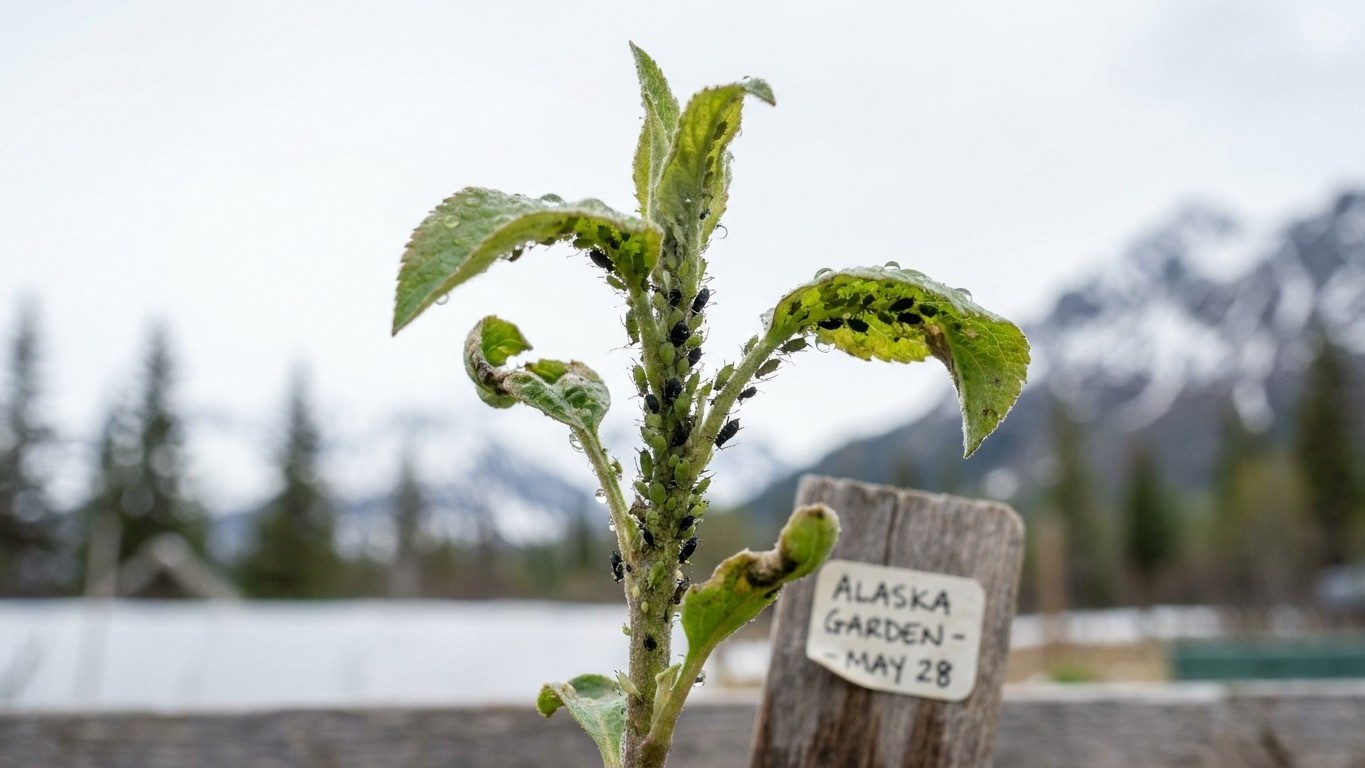

Aphids show up in Alaska gardens and greenhouses from late May through September, with the heaviest pressure hitting in June and July when nearly round-the-clock daylight speeds up their reproduction. One species, the spruce aphid, breaks that pattern entirely and does its damage during the cooler months instead. What stops them combines Alaska’s own hard freezes with a short list of predators, cultural fixes, and targeted treatments that actually work in a subarctic growing season.
When Aphids Show Up in Alaska

Timing in Alaska doesn’t follow the same calendar as the Lower 48. Growers in Anchorage, Fairbanks, and the Kenai Peninsula work with a compressed frost-free window, sometimes just 100 to 120 days, and aphids adjust their strategy to match it.
Outdoor aphids on vegetables and ornamentals typically appear as soon as tender new growth develops, usually mid-to-late May in Southcentral Alaska and a bit later in the Interior. Once they arrive, the near-endless summer daylight (18 to 20-plus hours in June) pushes their reproduction into overdrive. Aphids reproduce asexually for most of the season, and each female can produce dozens of offspring without ever mating. Longer light exposure means more feeding hours and faster generation turnover, so a population that looks manageable in early June can explode by the Fourth of July.
Greenhouse aphids don’t wait for spring at all. Alaska’s growing culture leans heavily on hoop houses and heated greenhouses precisely because the outdoor season is so short, and those structures give aphids a year-round refuge. Extension specialists and commercial growers across the state regularly list aphids among the top two or three insect problems in enclosed growing spaces, right alongside whitefly and spider mites.
The Spruce Aphid Exception
Spruce aphid (Elatobium abietinum) flips the usual script. Instead of thriving in summer heat, this species stays active during cool, mild stretches in fall, winter, and early spring, then largely disappears once summer temperatures climb. It’s a recurring problem on Sitka spruce and other ornamental spruce in Southeast Alaska and parts of Southcentral, where winter thaws and mild coastal temperatures give it just enough of a window to feed on old needles. Damage shows up as yellowing and needle drop on the lower and interior branches, often mistaken for drought stress or a nutrient deficiency.
Which Aphids You’ll Actually Find
Not every aphid problem in Alaska looks the same, and the species involved usually points to where the infestation is happening.
Green peach aphid and potato aphid are the two most common culprits on vegetable crops, especially brassicas, potatoes, and leafy greens grown in home gardens and market gardens around Palmer, Wasilla, and the Matanuska-Susitna Valley. Foxglove aphid shows up frequently on greenhouse ornamentals and houseplants that overwinter indoors, since it tolerates lower light levels better than some other species. Spruce aphid, as mentioned, sticks to conifers and follows its own cooler-season schedule.
A practical way to tell them apart without a hand lens: aphids clustered on soft new leaf growth or flower buds during summer are almost always the vegetable and ornamental feeders. Aphids on spruce needles that show up when temperatures dip toward freezing, or right after a warm January thaw, are almost certainly spruce aphid.
What Actually Stops Them in Alaska Conditions
Cold is Alaska’s biggest natural pest control tool, but it’s not a complete solution. Aphid eggs overwinter on host plants and in soil litter, tucked into bark crevices or under leaf debris, and they’re built to survive temperatures that would kill the adult insects outright. A hard freeze in September ends the active outdoor season, but it doesn’t erase next year’s population. That’s why relying on winter alone leaves gardeners surprised every spring.
Natural Predators That Do the Heavy Lifting
Ladybugs, lacewings, and parasitic wasps are present in Alaska and will move into an aphid outbreak if given the chance, though their numbers build up more slowly here than in warmer regions with longer active seasons. Gardeners who avoid broad-spectrum insecticides early in the season give these predators time to establish, which matters more in a place where the beneficial insect population can’t rebound as quickly after a chemical knockdown.
Planting flowering herbs like dill, cilantro, and yarrow near vegetable beds gives adult lacewings and hoverflies a nectar source, which keeps them in the garden longer instead of just passing through.
Cultural Controls That Fit the Short Season
Because the Alaska growing window is already tight, prevention matters more than damage control. A few habits make a real difference:
- Inspect transplants and greenhouse starts closely before bringing them outside, since aphids often hitchhike on nursery stock.
- Space plants for airflow, since dense, humid foliage is exactly what aphids favor in a greenhouse or hoop house.
- Remove and destroy heavily infested leaves rather than composting them on site.
- Clean up fallen spruce needles and debris in fall to reduce overwintering sites for spruce aphid eggs.
A strong blast of water from a garden hose knocks aphid colonies off leaves and stems without any chemical involved, and it’s often enough for light infestations on backyard vegetables. For heavier colonies, insecticidal soap or horticultural oil applied directly to the aphids works well and breaks down quickly, which matters in home gardens where food crops are harvested throughout the short season.
Greenhouse Management Deserves Its Own Approach
Because Alaska greenhouses run for so much of the year, aphids that get established indoors don’t face the same die-off that outdoor populations do. Regular scouting, ideally weekly, on the undersides of leaves catches colonies before they spread to neighboring plants. Yellow sticky traps hung near vents and doorways catch winged adults dispersing to new plants, giving an early warning before a full infestation takes hold.
Introducing beneficial insects like lacewing larvae or parasitic wasps into an enclosed greenhouse is more effective than in an open garden, since the structure keeps them contained near the pest population instead of dispersing. Several commercial suppliers ship these predators specifically for greenhouse release, and Alaska growers running season-extension operations increasingly use them as a first line of defense before reaching for any spray.
Spruce Aphid: A Different Treatment Window
Treating spruce aphid means working against the calendar most people expect for garden pests. Since this species feeds during cool weather and goes dormant once summer heat arrives, applications timed for typical June garden pests miss the target entirely. Horticultural oil applied in early spring, before new growth breaks but while aphids are still active on old needles, catches the population when it’s most vulnerable. Waiting until visible needle drop shows up in late spring usually means the active feeding window has already closed for the year, and the tree just needs time to recover.
Healthy, well-watered spruce trees tolerate light spruce aphid feeding without lasting harm. Repeated years of heavy feeding, though, can thin a tree’s canopy enough to stress it further during Alaska’s already demanding winters, so trees showing consistent yellowing on interior branches are worth a closer look each fall.
One detail that surprises a lot of Alaska gardeners: a mild, wet winter with several thaw cycles tends to produce a worse spruce aphid year than a winter that stays reliably cold. The insect actually does better when temperatures hover just above freezing for extended stretches than when Alaska gets its usual deep, sustained cold snaps.