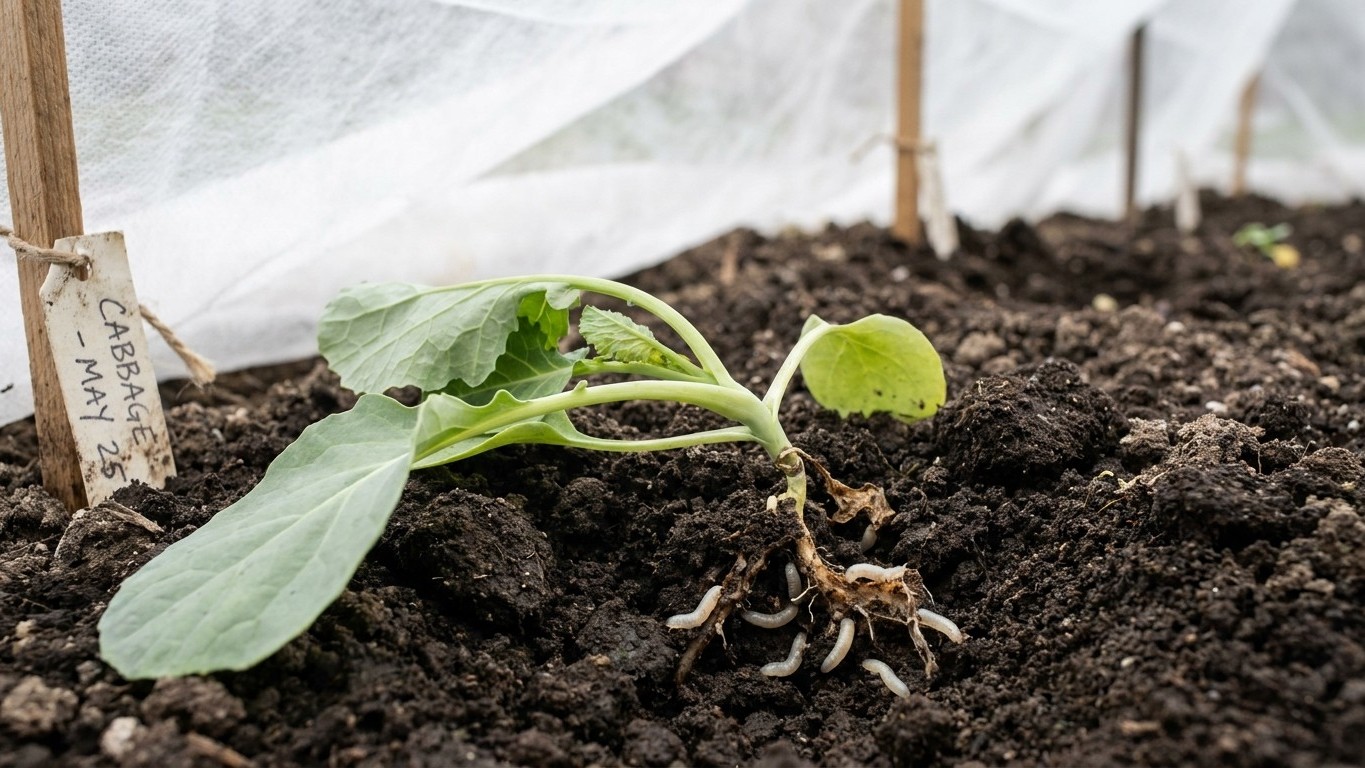

Root maggots hit Alaska gardens earlier than most people expect, usually within two to three weeks after the soil warms past 50°F in late May or early June, and they hammer brassicas and root crops hardest in the Matanuska-Susitna Valley, the Fairbanks area, and Southcentral coastal gardens where cool, moist soil gives the larvae exactly the conditions they need. Floating row covers installed at transplant time, tight rotation away from last year’s brassica bed, and timing plantings to dodge the first adult fly emergence remain the most reliable defenses growers use across the state.
When Root Maggots Show Up in Alaska

Alaska’s short growing season doesn’t spare gardeners from this pest, it actually concentrates the damage into a narrower window. The adult flies, which look like small gray houseflies, need soil temperatures in the high 40s to low 50s Fahrenheit before they’ll lay eggs at the base of seedlings. In the Matanuska-Susitna Valley, that threshold typically arrives in the last week of May. In the Interior around Fairbanks, where soil warms faster under near-24-hour daylight, the first flight can show up by the first week of June. Southeast Alaska, with its milder but wetter maritime climate, sees activity a bit earlier but spread out over a longer stretch because temperatures fluctuate less dramatically.
Unlike states with long, hot summers where root maggot species can push through three or four generations, most of Alaska only supports one full generation and a partial second one before fall cooling shuts egg-laying down. That sounds like good news, and it partly is, but it also means the single generation that does hatch tends to be dense and synchronized. A grower who misses the first-flight window by even a week can lose an entire planting of radishes or turnips almost overnight.
Soil moisture matters just as much as temperature. Alaska’s clay-heavy valley soils and the state’s frequent early-summer drizzle keep the top few inches of soil damp longer than in drier climates, and root maggot larvae need that moisture to survive after hatching. Raised beds with amended, faster-draining soil see somewhat lower pressure than flat garden rows sitting in heavier ground, which is one reason raised-bed growers in Palmer and Wasilla report fewer losses than neighbors gardening directly in native soil.
Which Crops Alaska Gardeners Lose to Root Maggots
Two different maggot species do most of the damage in Alaska gardens, and they don’t target the same plants. The cabbage maggot goes after brassicas: cabbage, broccoli, cauliflower, kale, and especially radish and turnip, whose thin skins offer almost no resistance to tunneling larvae. The onion maggot, a separate species, attacks onions, leeks, garlic, and shallots, tunneling into the bulb base rather than the root itself.
Rutabaga deserves its own mention, because Alaska is famous for it. The Alaska State Fair in Palmer regularly produces some of the largest rutabagas grown anywhere in the country, a result of the region’s long daylight hours pushing extraordinary bulb growth during the growing season. That same crop is a favorite target of cabbage maggot larvae, which tunnel through the developing root and create entry points for rot organisms. A rutabaga that looks fine above ground can be riddled with brown, corky tunnels once it’s pulled, and by the time symptoms show above soil the damage is already done.
Radish and turnip growers see the fastest, most visible losses because these crops mature quickly and the roots stay small and tender the whole time. A wilting radish seedling in mid-June, especially one that pulls out of the ground with almost no resistance and shows brown tunnels through the root, is close to a textbook case. Cabbage and broccoli transplants react differently, often just failing to grow, yellowing at the base, or toppling over in a light breeze because the root system supporting them has been chewed through underground.
Onion Maggot: A Related but Distinct Problem
Onion maggot larvae work their way into the bulb near the roots, and infested plants often show yellowing, twisted leaves before collapsing entirely. Because onion sets and transplants are already slow to establish in Alaska’s cool spring soil, an onion maggot infestation on top of that slow start can wipe out a bed before the bulbs ever size up. Growers who’ve had onion maggot trouble one year almost always see it again the next season in the same bed, since the pupae overwinter in the soil close to where the previous crop grew.
What Actually Stops Root Maggots in Alaska Gardens
Floating row covers remain the single most effective tool for home gardeners, and the timing matters more than the material. Covers need to go on immediately at seeding or transplanting, before the first adult flies are active, and stay sealed at the edges with soil or landscape staples so flies can’t crawl underneath. Once a cover is breached or removed too early, its protection is essentially gone for that generation.
Crop rotation works, but it has to be aggressive to matter in a small garden. Moving brassicas to a different bed just 10 or 15 feet away isn’t enough, since adult flies can cover that distance easily. A rotation cycle of three to four years, moving the crop to the opposite end of the garden or even a different growing area entirely, cuts down on flies emerging directly into a fresh host crop.
A few additional tactics that Alaska gardeners consistently report success with include:
- Delayed planting of radishes and turnips by a week or two past the typical first-flight window, sacrificing a little of the short season for a better survival rate.
- Diatomaceous earth or wood ash worked into the soil surface around the base of transplants, which can deter egg-laying adults, though it needs reapplication after rain.
- Beneficial nematodes applied to soil in early spring, which attack maggot larvae before they reach the root.
- Removing crop debris immediately after harvest, since leftover roots and stems left in the ground over winter give overwintering pupae a head start the following spring.
- Sticky traps (yellow index cards coated in petroleum jelly, staked at soil level) to monitor when adult flies actually become active in a specific garden, since timing varies year to year with spring weather.
Sanitation between seasons often gets overlooked, but it matters more in Alaska than in warmer climates simply because the pest only gets one real shot per year. Tilling the soil in fall, after harvest, exposes overwintering pupae to freezing temperatures and predator birds, and can meaningfully reduce the population that emerges the following spring. Gardeners who till in fall consistently report lighter damage the next year compared to those who leave beds undisturbed over winter.
Chemical controls exist, typically as soil-applied insecticides labeled for root maggot control on vegetables, but they work best as a preventive treatment applied at planting rather than a rescue once damage is visible. Once larvae are inside a root, no product reaches them there. Home gardeners considering a chemical option should check current labeling carefully, since registered products and approved uses change from year to year, and always follow the pre-harvest interval listed for edible crops.
Companion planting gets mentioned often in gardening circles, and while there’s no strong controlled evidence that specific companion plants repel root maggot flies, interplanting brassicas with taller, unrelated crops can physically disrupt the flies’ ability to locate host plants by scent and sight. It’s a modest benefit at best, worth trying alongside the tactics above but not a substitute for row covers or timing.
Gardeners dealing with heavy infestation one year shouldn’t assume the next season will automatically be worse. Population pressure swings noticeably from year to year depending on how cold and how long the previous winter ran, and a hard, early freeze in fall can knock back overwintering pupae significantly before spring. That’s cold comfort in a bad year, but it does mean a rough season with root maggots in Alaska isn’t necessarily the new normal for that garden bed.