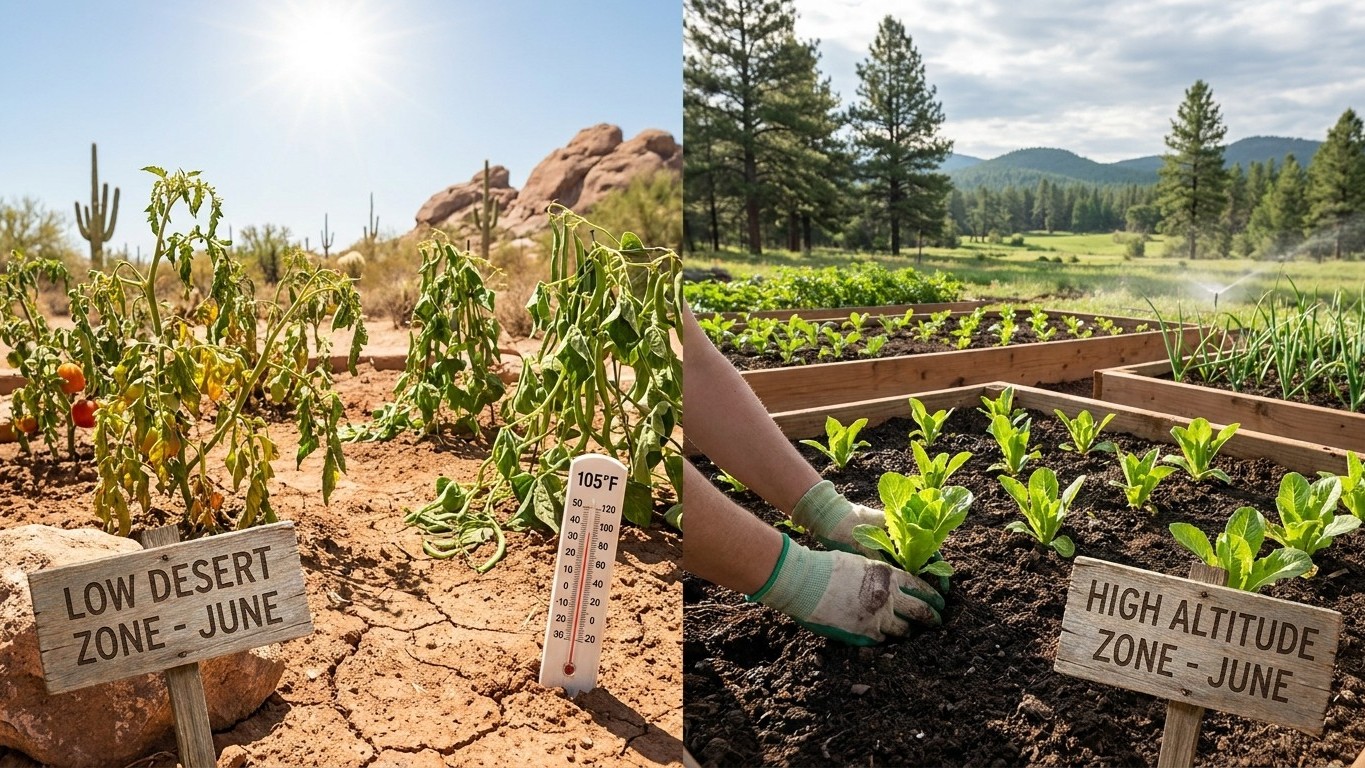

In Arizona’s low desert, June is not really a planting month at all: triple-digit heat stops tomatoes, squash and beans from setting fruit, so the vegetable garden shifts into survival mode instead of expansion. In the high country around Flagstaff and the Mogollon Rim, the opposite is true, since the frost has finally cleared and June opens the main planting season. What actually works this month depends on which Arizona you’re gardening in.
What goes in the ground in June

Arizona’s growing calendar splits into two very different states sharing one border, and June is the month that makes the split impossible to ignore.
In the low desert, frost was never the limiting factor to begin with. NOAA’s climate normals for the Phoenix station show a rare freeze at 32°F showing up in only six of the last 30 springs on record, and NOAA classifies the frost-free season there as running the full 365 days. That sounds like an invitation to plant anything, anytime. It isn’t. The number that actually shuts the desert garden down is heat, not cold, and by June soil temperatures are already well past the point where tomato and pepper blossoms abort before they ever become fruit.
At the far end of the state’s USDA Plant Hardiness Zone range, which the 2023 map sets at 4b to 10b for Arizona as a whole, the high country around Flagstaff and the White Mountains is a genuinely different climate with real, sometimes late freezes. June there is often the first full month it’s safe to put tender crops outside without a nightly cover.
| Region | June climate reality | What goes in now |
|---|---|---|
| Low desert (Phoenix, Tucson, Yuma) | Heat, not frost, is the limiting factor; fruit set stalls | Black-eyed peas, okra, Armenian cucumber, roselle, sweet potato slips, malabar spinach |
| High country (Flagstaff, White Mountains) | Frost risk has cleared for the season | Tomatoes, peppers, squash, corn, beans, cucumbers, melons |
For low-desert gardeners, June belongs to the short list of crops bred for punishment: heat-tolerant legumes, okra, and vining greens that shrug off soil too hot to touch barehanded at noon. For high-country gardeners, this is the moment to get the warm-season garden in the ground before the short mountain summer starts running out.
What to start under cover
The math for starting seeds under cover in June runs in opposite directions depending on elevation, so it’s worth doing separately for each.
In the high country, most warm-season transplants should already be hardening off or going into the ground by now, counted backward from the last-frost window rather than a fixed date. Anyone still holding seedlings indoors risks the classic failure of a rootbound, leggy plant that sulks for weeks after transplant instead of taking off. A second, smaller batch of squash or cucumber seed started under cover now can still catch up, since the mountain growing season, while short, has room for a fast-maturing succession crop behind the first.
In the low desert, the useful work under cover in June has nothing to do with the current garden and everything to do with the fall one. Local gardeners start broccoli, cabbage and other cool-season transplants indoors, under shade cloth or in an air-conditioned space, counting backward from the point in early fall when soil temperatures finally drop enough for those crops to survive outside. Start too early here and the seedlings cook before the heat breaks; start too late and the short fall window closes before the plants mature. Getting that backward count right, rather than working from a calendar date, is what separates a fall harvest from another failed planting.
What is ready to pick
Low-desert gardens are finishing their spring run in June, not starting a new one. Tomatoes planted in late winter are putting out their last fruit before heat shuts down pollination, melons and watermelons seeded earlier in spring are sizing up fast in the heat, and garlic and onions planted the previous fall are ready to pull and cure once their tops fall over and dry. Low-chill peach and apricot varieties bred for desert conditions are also coming ripe, and stone fruit left even a few days past ready softens quickly in the heat, so daily checking beats a weekly pass.
High-country gardens are further behind. Anything harvestable in June there tends to come from very early, frost-tolerant plantings: spinach, radishes and lettuce sown as soon as the ground opened up, plus rhubarb, which is usually ready for its first cutting once the stalks reach full color and size. Neither region has much of a mid-season harvest yet; the desert is closing one chapter while the mountains are still opening theirs.
The jobs that matter this month
Heat management is the low desert’s entire June job list, and skipping it costs plants within days rather than weeks. Mulch goes down heavy, several inches deep, to keep root zones from cooking. Shade cloth goes up over anything still trying to hold fruit, cutting direct sun during the hottest hours without blocking it entirely. Watering shifts from frequent and shallow to deep and less frequent, pushing roots downward where soil stays cooler, and irrigation lines get checked for the cracks and leaks that heat causes and that waste water fast when nobody’s watching. Garlic and onion harvested this month need proper curing in a shaded, airy spot before storage, not a quick toss into a bag.
June also marks the start of Arizona’s monsoon season, and that changes the priority list. Tall plants and young trees need staking now, before the first big wind event flattens them. Gutters and drainage paths are worth clearing ahead of the first heavy storm, since desert soil sheds water fast and poorly graded beds flood in minutes. Pest scouting matters too: squash bugs and aphids build up quickly in the heat, and catching an infestation in its first week is far easier than fighting it once it’s established across a whole bed.
In the high country, June’s jobs look more like a normal spring: staking tomatoes and beans before they sprawl, mulching to conserve the moisture that still matters even at elevation, and starting the succession sowing of quick crops like beans or salad greens to keep the short growing season fully used. None of this waits. A staking job skipped this month usually means a broken plant next month.
What not to do in June
The most common mistake in the low desert is treating June like any other planting month because the calendar says late spring. Warm air and long days feel like an invitation, but soil that’s already over 100°F at root depth will abort blossoms on tomatoes and peppers no matter how carefully they’re watered. The fix isn’t more water or more fertilizer; it’s accepting that those crops are done for the season and shifting effort to heat-tolerant plantings or fall-garden prep instead.
A related error is over-fertilizing struggling plants with nitrogen, hoping to push them through the heat. Nitrogen at this point encourages soft, leafy growth that wilts even faster in high temperatures and does nothing to help fruit set, which is a hormonal response to temperature, not a nutrient deficiency. Better to hold off and let stressed plants coast.
In the high country, the classic June mistake is the reverse: uncovering tender transplants too early after what looked like a settled warm stretch, only to lose them to a late, elevation-driven cold snap. Since Arizona’s mountain freeze pattern doesn’t follow the low desert’s calendar at all, a warm week at 7,000 feet doesn’t guarantee the next one will be.
Checking this against your own county
A state-wide planting month is a starting point, not an instruction, and nowhere is that truer than in Arizona, where elevation alone can separate two towns by a growing season of several months. Desert valleys, mid-elevation transition zones, and the high country around Flagstaff each run on their own clock, and the USDA’s 4b-to-10b hardiness range for the state reflects just how wide that spread is. Before committing seed or transplants to the ground, check current conditions and local planting windows through the University of Arizona Cooperative Extension, which tracks county-level guidance across the state.
Common questions
Can you plant tomatoes in Arizona in June?
In the low desert, no. Heat has already pushed past the point where tomato blossoms set fruit, and new plantings will struggle rather than thrive. In the high country, June is often the right time to transplant tomatoes outdoors as frost risk clears.
What vegetables tolerate Arizona’s summer heat?
Black-eyed peas, okra, Armenian cucumber, roselle, malabar spinach and sweet potato slips are among the crops that keep producing through low-desert summer heat, while most standard garden vegetables shut down.
Is it too late to plant a garden in Phoenix in June?
It’s too late for spring vegetables like tomatoes and squash, but it’s exactly the right time to start fall transplants indoors or under shade cloth, and to plant a short list of heat-specialist crops outdoors.
When should I start my fall garden in Arizona’s desert areas?
Many desert gardeners start fall transplants such as broccoli and cabbage indoors or under cover in June, counting backward from the point in early fall when soil temperatures drop enough for those crops to survive outside.