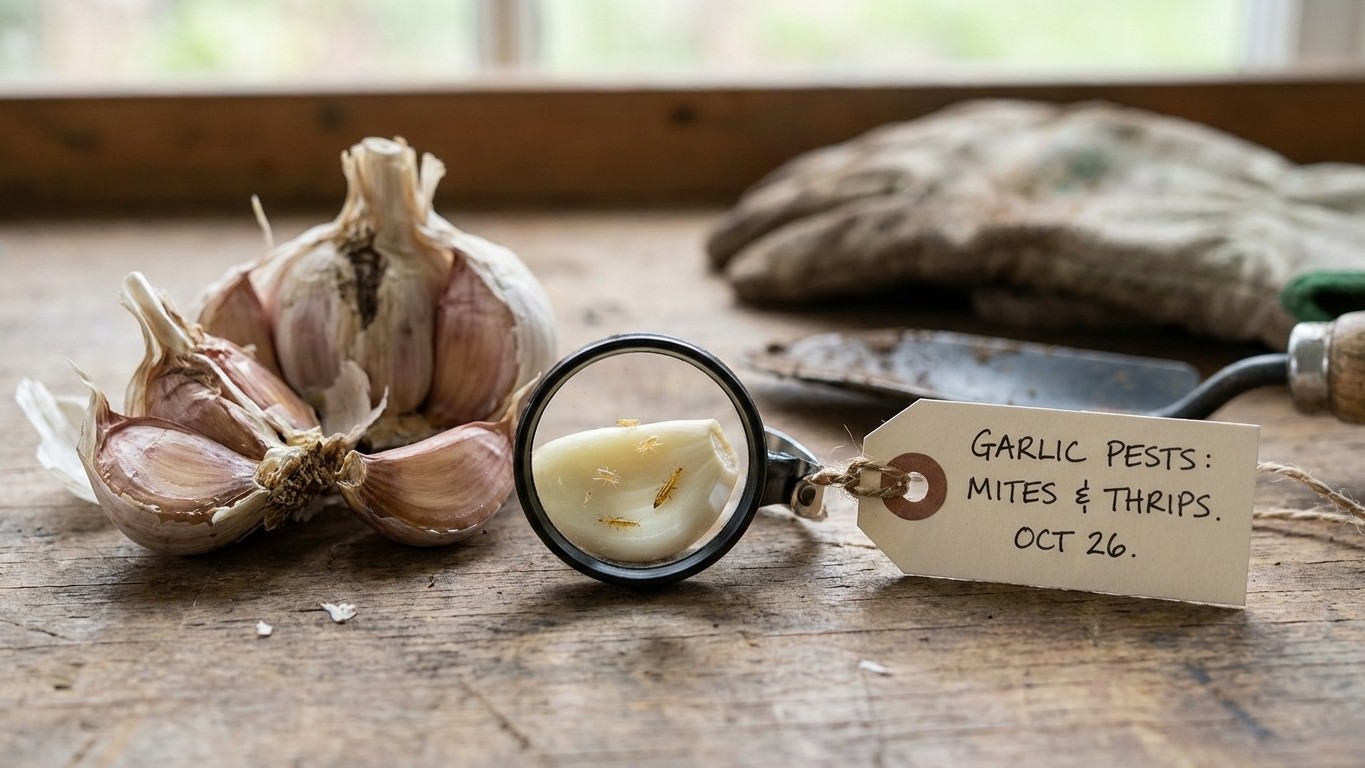

A handful of pests cause nearly all of the reported damage in garlic: onion maggot, allium leafminer, bulb mites, wireworms and onion thrips. Everything else that turns up on a general vegetable pest list is a rare visitor to an allium bed. Check the base of a few bulbs at harvest and the leaf blades in early spring for the signs described below, since that is when each pest first becomes visible to the naked eye.
Why this matters for garlic
Garlic spends the better part of a year in the ground, longer than almost anything else in the vegetable bed, which is exactly why pest damage catches out growers who otherwise have the basics of growing garlic down cold. A maggot tunneling into a clove in October does not show up as a wilted plant until the following spring, and by then the damage inside the bulb is already done.
The bigger loss is not usually a dead plant. It is a bulb that looks fine from the outside and rots in storage, or one with a soft, discolored patch around the basal plate that you only find when you go to braid or peel it. Seed garlic carries risk forward: cloves saved from an infested planting carry bulb mites or damaged tissue into next year’s bed, so one bad batch can shadow two or three seasons of a rotation. Scouting at the right stage is the only real defense, since there is no way to treat what is already inside a bulb once it is back in the ground.
When to do it
There is no single calendar date for garlic pest scouting, because the pests that matter operate on the plant’s growth stage, not the month.
Checkpoints by growth stage
- Before planting: check seed cloves for soft or discolored tissue, the tell for bulb mites and early rot.
- Early spring, once growth resumes: check leaf blades for the first sign of leafminer punctures or thrips streaking.
- Around scape formation: check the neck and shoulders of the bulb for continuing leaf damage.
- At harvest: check the basal plate, since onion maggot and wireworm damage is often invisible from above ground.
Where regions disagree
Extension programs in different regions disagree on how many generations a pest like allium leafminer produces in a season, largely because a longer or shorter cold season changes how many life cycles fit between fall and spring. That is one more reason to scout by growth stage rather than by date, and to treat any single source’s calendar as a starting point rather than a rule. Where onion thrips are concerned, a warm, dry stretch right before harvest is worth a closer look at the leaf axils even if you checked them a few weeks earlier. A missed spring check is the one that costs the most, because it is the only inspection that happens while a cultural response can still change the outcome.
How to do it
Most garlic pest problems are diagnosed by matching a visible sign to a location on the plant, not by catching the insect itself. The table below is a starting point for narrowing down what you are looking at before you pull a bulb to confirm it.
| Pest | Where to look | What you’ll see | Feeding sign |
|---|---|---|---|
| Allium leafminer | Leaf blades, especially new growth | Small gray fly or a tiny white maggot inside the leaf | A neat row of white puncture dots crossing the leaf |
| Onion maggot | Base of the bulb and roots | Legless white to cream maggot, tapered at one end | Bulb collapses from the base, often with rot following |
| Bulb mites | Basal plate and space between cloves | Tiny pearly white to tan mites in clusters | Cloves turn spongy and brown from the base up |
| Wireworms | Soil around the bulb, especially recent sod | Shiny orange-brown, hard-bodied, segmented larva | Narrow round tunnels bored straight into the clove |
| Onion thrips | Fold where the leaf meets the neck | Slender, pale yellow to brown, under 1/16 inch | Silvery streaks and stippling on the leaf surface |
Allium leafminer

The adult is a small gray fly, barely bigger than a fruit fly, that lays eggs by puncturing leaf tissue in a line, which is the first sign most growers actually notice. The larva itself is a legless, cream-white maggot under a quarter inch long that mines down inside the leaf toward the bulb. Floating row cover over the bed during the fly’s active period is the main defense, since once a larva is inside the leaf there is no spray that reaches it.
Onion maggot

The adult resembles a small gray housefly and is rarely noticed. The larva is what causes the damage: a legless, cream to white maggot around a third of an inch long that burrows in at the base of the bulb and works upward, opening the door to secondary rot. Cool, wet spring soil favors this pest, and rotating away from any allium bed for at least a year lowers the population a new planting has to contend with.
Bulb mites

These are barely visible without a hand lens: tiny, shiny, pearly white to light tan, and slow moving, usually found in clusters rather than singly. They rarely attack a healthy bulb outright and are mostly a secondary problem, moving in on tissue already damaged by another pest or by rot, which is why a bulb carrying bulb mites usually has something else wrong with it too. Discarding rather than replanting any clove with soft or spongy tissue keeps them out of next year’s seed stock.
Wireworms

This is the larval stage of the click beetle, a shiny, hard-bodied, orange-brown to yellow larva with a segmented, worm-like body, usually a half inch to an inch and a half long. Wireworms live in the soil for several years before pupating, so a bed recently converted from sod or pasture carries a higher risk than one that has been in vegetable rotation for a while. They bore narrow, round tunnels straight into a clove, and the damage is often not visible until the bulb is lifted.
Onion thrips

An onion thrips is small enough to miss, under a sixteenth of an inch, slender, and pale yellow to brown. Feeding by rasping the leaf surface and sucking the released sap leaves silvery white streaks and a stippled, bleached look across the blade rather than a hole or a tunnel. Heavy thrips feeding during bulb formation weakens a plant’s storage life even when the bulb itself was never directly touched.
What goes wrong
The scouting gap
The most common mistake is treating garlic like it needs no watching at all, since it is planted once in fall and mostly ignored until scapes appear. By the time a grower notices stunted, yellowing plants in early summer, an onion maggot or wireworm problem that started the previous fall has already run its course. There is nothing left to treat at that point, only a decision about whether to salvage the harvest early.
Mulch left too thick and too wet over winter is a less obvious contributor, since it holds moisture against the soil surface right where cloves are sitting, and both onion maggot larvae and bulb mites prefer that damp environment. Pulling mulch back partway once growth resumes, as covered in mulching garlic, does double duty against pest pressure and rot.
Misdiagnosis and reused seed
Replanting seed garlic from a bed with an unresolved pest problem is the second common failure, and it is the one that compounds. Bulb mite and rot damage travel inside the clove itself, so a grower who saves the biggest, healthiest-looking bulbs for next year’s seed can unknowingly save the most heavily infested ones too, since size alone does not tell you what is inside. The mistake does not show up until the following season, when a bed planted with clean soil and good technique still comes up with the same problem.
Leaf yellowing and tip dieback look almost identical whether the cause is a pest or a fungal disease, and treating one as the other wastes the narrow window when a response would still help. Splitting a few affected leaves open, or checking whether the damage is a straight-line row of punctures versus a blotchy, spreading lesion, usually settles which one you are dealing with. When the symptoms point toward a fungus rather than an insect, that distinction is worth working through separately, covered in garlic diseases.
How this changes across the country
Cold-winter growers
Pest pressure in garlic tracks winter length and summer humidity more than anything else, so a bed in a short, cold-winter region deals with a different mix than one in a long, hot-summer region. Growers in cold-winter regions such as the Upper Midwest and northern New England often see wireworms as the bigger concern in beds recently converted from sod or lawn, since wireworm larvae can live in soil for several years and a fresh planting into old turf runs straight into an existing population. The same growers usually have a narrower spring window to catch an allium leafminer flight before scapes form, since a shorter, colder spring compresses every growth stage into fewer weeks.
Hot, dry-summer growers
Growers in hot, dry-summer regions such as California’s Central Valley or the Columbia Basin of Washington and Oregon tend to see heavier onion thrips pressure right at bulking, since thrips populations build fastest in warm, dry weather and a dry stretch before harvest is exactly when bulbing takes place. Humid, high-rainfall regions such as the Southeast see more pressure from rot organisms working alongside bulb mites, since the mites move in fastest on tissue that is already softened by excess moisture.
A pest still on the move
Allium leafminer is a newer arrival in North America and its range is still moving, so a grower outside the areas where it has already been confirmed should check with their state extension service before assuming it is not a local risk, since a pest that was absent from a region five years ago can be established there now.
Common questions
Can I spray for garlic pests once I see damage?
Usually not effectively, since most of the damage happens inside the leaf, the bulb, or the soil where a spray cannot reach it. Cultural steps like row cover timing, rotation and clean seed stock do most of the real work, and any product choice should be checked against its label and your state’s rules before use.
Do these pests spread from garlic to my onions and leeks?
Yes, most of them are generalist allium feeders, so a bed of onions, leeks or shallots planted near infested garlic is not protected just because it is a different crop. Rotation plans should treat the whole allium family as one group rather than rotating garlic away from itself while leaving onions in the same spot.
I see a few small holes in the leaves, is that a pest?
Not necessarily. Wind damage, hail, and simple leaf tearing during scape removal all leave irregular holes or tears, while pest damage tends to follow a pattern, a straight line of punctures for leafminer or fine stippling for thrips. Isolated, random damage on a handful of leaves with no pattern is usually not worth treating.
Should I toss the whole harvest if I find pests in a few bulbs?
No, cull the affected bulbs and use the rest for eating rather than seed. The real risk is replanting a clove that looks fine on the outside but carries hidden damage, so sort seed stock by feel, not just by size or appearance.