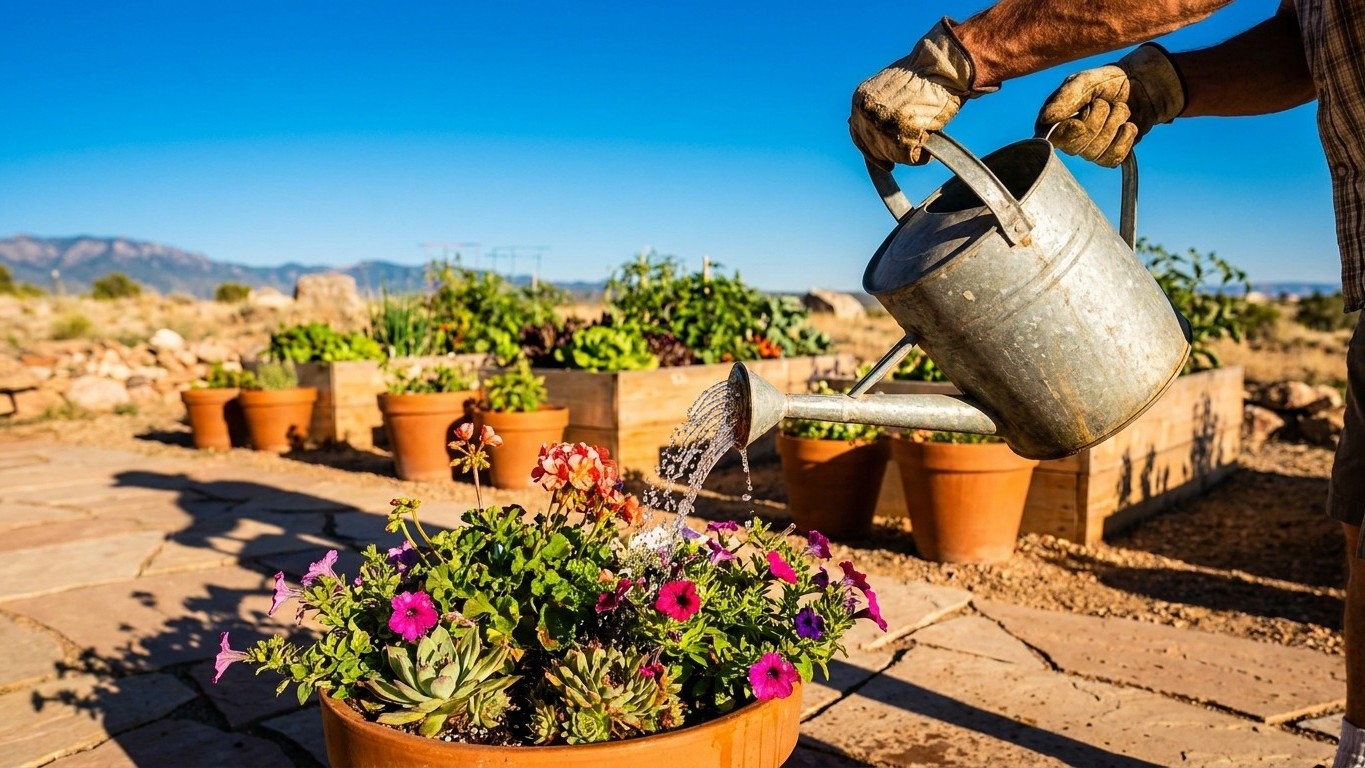

Colorado’s summer sky delivers far less water than most gardens need, and the state’s heat pushes that gap even wider. Whether you’re filling raised beds or a row of patio pots, the numbers below tell you exactly how much watering falls on you rather than the clouds.
What changes here

Two figures set the terms for every watering decision in Colorado. The driest summer month, August, averages just 1.58 inches of rain. And the state’s reference station logs 39.6 days a year at or above 90F. Put together, that means the driest stretch of summer arrives at the same time the air is pulling moisture out of soil and Containers fastest, a combination that leaves almost nothing to chance for anyone growing in pots.
Do the arithmetic and the picture gets sharper. A vegetable bed or a mixed container planting wants roughly an inch of water a week to keep growing without stress. Spread that August total of 1.58 inches evenly across the month’s four-plus weeks, and the sky is handing over about four-tenths of an inch a week. That leaves roughly six-tenths of an inch, more than half the total requirement, for the gardener to supply by hand or by hose.
June and July aren’t much better cushioned. June averages 1.94 inches and July 2.14 inches for the month, both still short of the four-inch monthly pace an inch-a-week target implies. Across the three summer months combined, Colorado sees about 5.7 inches of rain, against a season that, by the inch-a-week measure, would call for closer to 13 inches. The shortfall is the whole story: this is a supplemental-watering climate, not one where rain carries the load.
Containers make that shortfall more urgent, not less. A pot has no reserve of surrounding earth to draw from, and its sides are exposed to sun and wind on every face, not just the top. On a day that reaches 90F, a container can lose visible moisture within hours, while an in-ground bed with the same rainfall might coast for a day or two longer. The two figures above aren’t background information for pot gardening here. They’re the reason a watering can needs to become a daily habit for containers, even in a month that gets nearly two inches of rain.
How to water when it matters
The method that works in Colorado is deep and infrequent for beds, at the base rather than overhead, done in the morning rather than the evening. Each choice matches something the plant is actually doing. A deep soak pushes water down to where roots can follow it, training them to grow deeper and search less desperately during the next hot stretch. Watering at the base means the moisture goes where roots can use it instead of evaporating off leaf surfaces in the day’s heat. Morning watering gives plants a full supply before the day’s heat load builds, and lets any splashed foliage dry before nightfall, when damp leaves left overnight invite fungal problems.
Containers flip part of that rhythm. Because potting soil dries from all sides and holds far less total volume than garden ground, pots often need water more than once a day during the hottest stretch of August, even though a bed nearby might go three or four days between soakings. The test for both is the same: check moisture at root depth, not just on the surface. For beds, push a finger about two inches into the soil, or use a trowel to check just below the surface. For containers, the same two-inch check works, but drainage means it can turn dry again within hours on a 90-degree day.
- Check the soil two inches down with a finger before watering anything, in beds and in pots alike.
- Water bed plantings deeply, aiming for roughly an inch a week total between rain and hand-watering, adjusted up during stretches of 90-degree days.
- Water containers whenever the top two inches feel dry, which in peak summer heat may mean once or even twice a day.
- Apply water at the base of the plant or at the soil line of the pot, not over the foliage.
- Do the watering in the morning, so plants enter the heat of the day already supplied and any wet leaves have hours to dry.
Treat the one-inch-a-week figure as a starting point, not a fixed rule. A gardener with sandy soil, a windy balcony, or unglazed terra cotta pots will need to water more often than that number suggests; heavy clay beds or glazed, well-shaded containers may need less. Checking the soil directly settles the question every time a number on a page can’t.
What goes wrong
Watering a little every day
A light daily sprinkle wets only the top inch of soil, and roots respond by staying shallow, right where that thin layer of moisture sits. When August’s heat and 90-degree days show up, those shallow roots have no reserve to draw on, and the plant wilts fast. This is the single costliest habit in a climate this hot and this dry in midsummer.
Watering the leaves in the evening
Wetting foliage after dark leaves water sitting on leaf surfaces for hours with no sun or breeze to dry it. That damp window overnight is exactly when fungal diseases take hold, a risk that a morning, base-level watering avoids almost entirely.
Trusting a rain shower that barely wet the surface
A summer thunderstorm can look generous while depositing only a fraction of an inch that soaks no deeper than the top half-inch of soil. Given that August averages just 1.58 inches for the entire month, a single shower rarely covers what a bed or a pot actually needs. Checking with a finger two inches down settles it faster than judging by how wet the ground looks on top.
Skipping mulch, or its container equivalent
Bare soil in a bed loses moisture to the sun almost as fast as it’s applied, undoing a deep watering within a day or two on a 90-degree afternoon. Containers face the same problem without a mulch layer or without grouping pots together to shade each other’s sides, and an unmulched, sun-exposed pot can dry out dramatically faster than one with even a thin protective layer on top.
Local help
Colorado State University Extension publishes guidance tailored to the state’s growing conditions, from soil questions to plant selection, and is worth bookmarking for anything beyond general watering timing: extension.colostate.edu. Watering restrictions vary by water district and change from year to year, so check current rules with your own local water provider rather than assuming statewide guidance applies to your address.
Common questions
How often should I water containers in Colorado during summer?
Check the top two inches of soil daily during stretches of 90-degree heat; many pots need water once or even twice a day in peak August conditions, far more often than an in-ground bed nearby.
Is Colorado’s summer rain enough for a vegetable garden?
No. August averages just 1.58 inches for the month, well short of the roughly four inches an inch-a-week target implies, so hand-watering has to make up the difference most weeks.
What time of day should I water in Colorado?
Morning. It supplies the plant before the day’s heat builds and gives any incidental leaf moisture time to dry before evening, reducing disease risk overnight.
Do the same watering rules apply to pots and to garden beds?
The core method (deep, at the base, in the morning) applies to both, but frequency differs sharply: containers dry out much faster than beds because they lose moisture from all sides and hold far less soil volume.