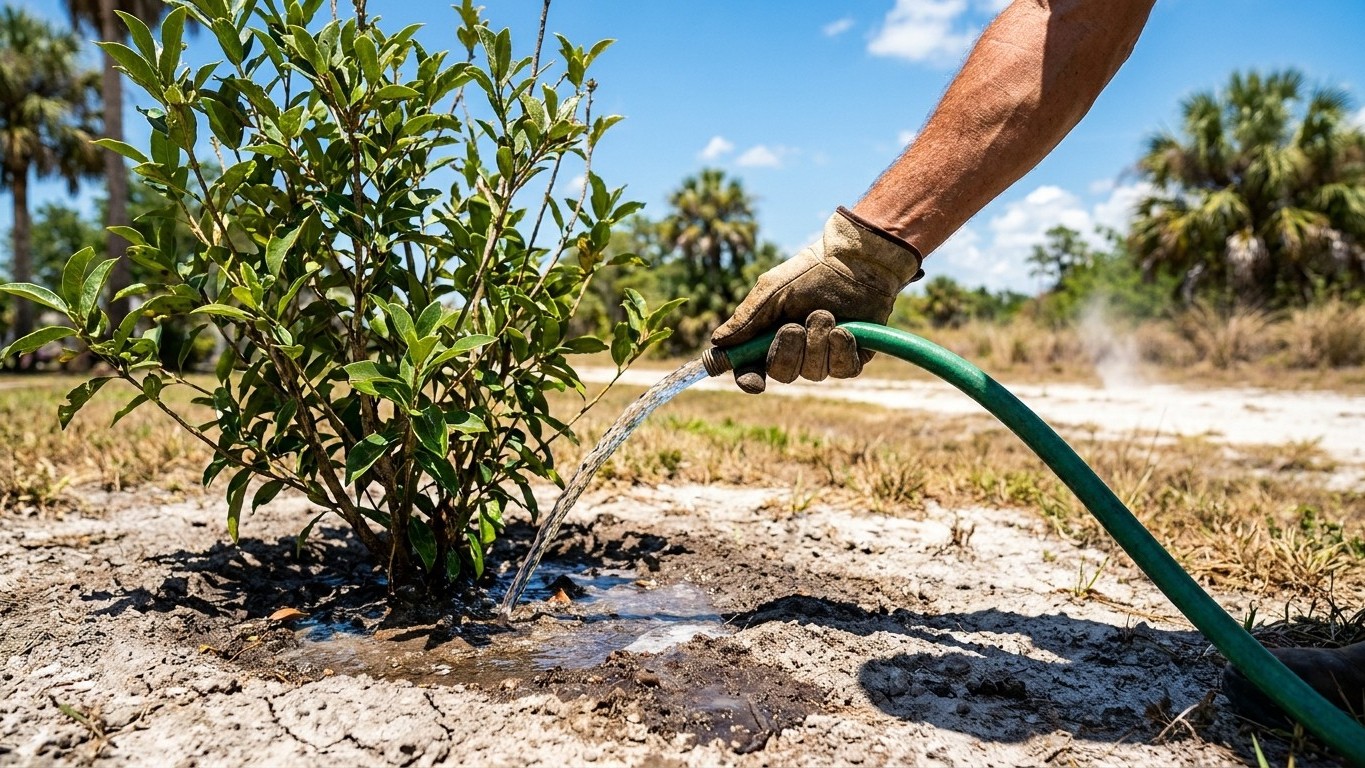

Florida’s driest summer month still delivers 6.77 inches of rain, yet 73.2 days a year climb past 90°F. That combination means the sky rarely fails a Florida garden outright, but heat and timing decide whether that rain ever reaches root depth. The short answer: water deeply, water at the base, and check the soil with your finger before you trust either the forecast or the hose.
What changes here

Two numbers set the terms for every watering decision in this state. July, the driest month of summer, still averages 6.77 inches of rain. And the reference station logs 73.2 days a year at or above 90°F. Put together, they say something specific: Florida doesn’t lack rain, it lacks reliable rain, and the heat load is high enough to erase whatever moisture arrives before a plant can use it.
Run the arithmetic and the picture gets clearer. A garden bed generally wants about an inch of water a week. Spread July’s 6.77 inches evenly across the month’s four and a half weeks, and you get roughly 1.5 inches a week from the sky alone, more than enough on paper. But Florida rain doesn’t arrive evenly. It comes as afternoon thunderstorms, often dumping most of that water in twenty or thirty minutes. A hard, fast downpour sheds a large share of itself as runoff before it ever soaks past the first inch or two of soil, and with 73.2 days a year pushing past 90°F, whatever does soak in gets pulled back toward the surface by evaporation faster than in cooler climates.
That’s the gap a gardener has to fill by hand, not the full inch, but the difference between what a thunderstorm actually delivers to root depth and what the plant needs there. On Florida’s characteristically sandy ground, that gap widens further. Sandy soil drains fast: water that lands on it moves down and through within hours, carrying nutrients with it and leaving little reserve for the days between storms. That’s the mechanical reason July’s generous rainfall total doesn’t translate into a garden that can be left alone.
How to water when it matters
The method that works here is deep, infrequent watering at the base of the plant, done in the morning. Each piece of that has a reason rooted in what’s actually happening underground and in the air above it.
Deep watering pushes moisture down several inches, which trains roots to grow downward chasing it. Shallow, frequent watering does the opposite: it keeps roots shallow and close to the surface, right where Florida’s heat bakes the soil hardest. Watering at the base, rather than overhead, keeps leaves dry, and morning watering gives any moisture that does land on foliage time to dry out in daylight, before humidity and warm overnight temperatures can turn a damp leaf into a breeding ground for fungal disease.
On Florida’s sandy ground, water moves through quickly and doesn’t hold long, so the rhythm has to be shorter and more frequent than the classic “once a week and deeply” advice you’ll hear for heavier soils. If your particular bed runs heavier, with more clay content, that same volume of water sits longer, and watering it again before it’s had a chance to dry can drown roots rather than feed them. Either way, the surface tells you almost nothing. The only real test is what’s happening two inches down.
- Push a finger, or the tip of a trowel, about two inches into the soil near the plant’s root zone before you water at all.
- If it’s dry at that depth, water slowly and deeply until moisture reaches several inches down, not just the surface crust.
- On sandy soil, expect to repeat this every two to three days during hot, dry stretches; on heavier ground, stretch that to once a week and recheck before watering again.
- Water early in the morning, before the heat of the day sets in and before evaporation claims what you just applied.
- Adjust the interval up or down based on what your finger tells you, not a fixed calendar. Twice a week is a reasonable starting point, but your own soil has the final word.
What goes wrong
“I water a little every day”
This is the costliest habit in a state logging 73.2 days a year above 90°F. A daily light sprinkle wets only the top inch of soil, so roots never need to reach any deeper. Those shallow roots then sit in the hottest, driest layer of ground, exactly where the sun does the most damage, and the plant becomes more heat-stressed than one watered less often but more deeply.
“I water in the evening, once it’s cooler”
It feels considerate, but it backfires. Water left on leaves overnight, combined with Florida’s humidity, gives fungal spores hours of damp darkness to establish themselves. Morning watering lets any wet foliage dry within a few hours; evening watering hands disease a full night’s head start.
“It rained, so I skipped watering”
A thunderstorm that looks dramatic can still leave the soil dry an inch down. Fast, heavy rain often runs off a hard or sandy surface before it soaks in. The only way to know is the same finger test used before any scheduled watering, applied after rain too.
“I didn’t bother with mulch”
Bare soil in Florida heat loses moisture fast, undoing whatever water was just applied. A two to three inch layer of mulch slows evaporation and buys the root zone time between waterings, which matters more here than in cooler regions given how many days a year push past 90°F.
The reverse mistake shows up during Florida’s wetter stretches: watering on schedule regardless of what’s already fallen from the sky, which saturates ground that never had a chance to dry and starves roots of oxygen. The finger test guards against both failures at once.
Local help
For guidance tailored to Florida soils and plants, the UF/IFAS Extension offers county-level advice and local expertise. Watering restrictions vary by water management district and change with drought conditions, so check current rules with your local water utility or district office before setting a permanent schedule.
Common questions
How often should I water a Florida garden in summer?
Twice a week is a reasonable starting point on sandy soil, adjusted based on what a finger test two inches down actually shows, since July’s rainfall of 6.77 inches rarely soaks evenly into the ground.
Does Florida’s summer rain mean I can skip watering?
Not reliably. Rain often arrives as fast, heavy thunderstorms that run off before soaking to root depth, and 73.2 days a year above 90°F pull surface moisture back out quickly.
What time of day should I water in Florida?
Morning. It gives any water on the leaves time to dry before evening humidity sets in, lowering the risk of fungal disease overnight.
Why does sandy Florida soil need more frequent watering?
Sandy ground drains quickly and holds little water in reserve, so it needs shorter, more frequent soakings compared to heavier, clay-rich soils that retain moisture longer.