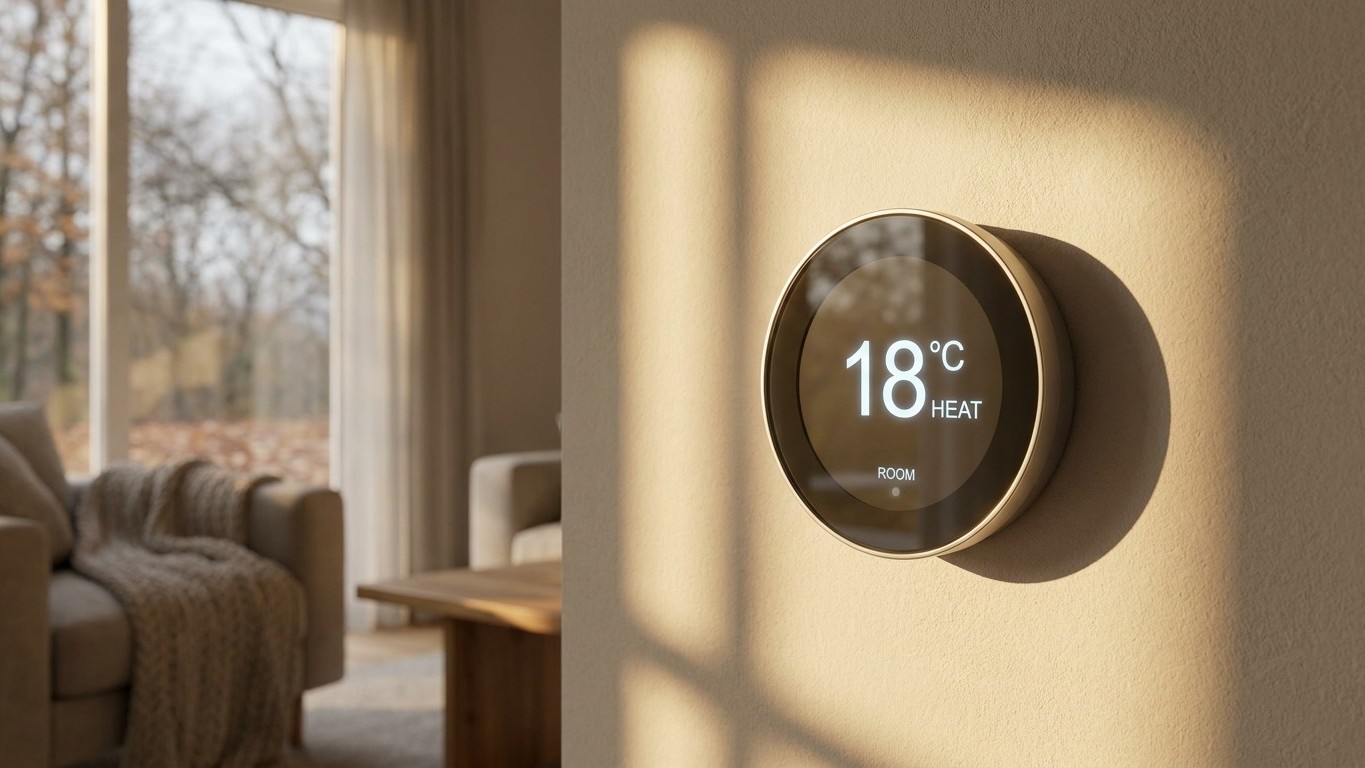

The heating season in British Columbia has no single “on” date, but the pattern behind it is clear once you look at the degree-day math. Heating demand starts building in September and doesn’t really let go until August, making this one of the longest heating seasons among Canada’s coastal provinces, though also one of the mildest month to month.
When the heating season starts in British Columbia

The number that decides this is 18°C. That’s the base temperature Environment and Climate Change Canada uses to calculate heating degree days, and any month whose normal mean daily temperature drops below it counts as part of the heating season. At the reference station, Vancouver Int’l A, September is the first month where that happens: the normal mean daily temperature falls to 14.9°C, tipping the month into heating territory. From there the season doesn’t really loosen its grip until the following August, when the mean climbs back above 18°C. That’s roughly 11 months of the year carrying some heating demand, with December as the coldest point.
The table below breaks down the degree-days for each month, and it’s worth reading closely, because the total length of the season tells you less than its shape does. A month can carry heating degree days even while its overall average sits above the 18°C line, since some individual days still fall below it. August is the clearest case: barely into heating season by the monthly average, it still logs 23 degree-days.
| Month | Heating degree-days (below 18°C) |
|---|---|
| January | 430 |
| February | 370 |
| March | 345 |
| April | 258 |
| May | 161 |
| June | 77 |
| July | 26 |
| August | 23 |
| September | 96 |
| October | 239 |
| November | 349 |
| December | 447 |
None of this points to a specific day. A monthly normal is a 30-year average, built from three decades of Vancouver-area winters, and it says nothing about which particular morning the furnace clicks on in any given year. Some Septembers stay mild well into the month; others turn cold in the first week. The safest reading of this table is not a calendar entry but a planning window: get the system checked before the demand curve steepens in October and November.
How hard the winter works here
Annual heating degree-days at this station add up to about 2,818, counted below the 18°C base over the 1981-2010 period. Degree-days are a stand-in for fuel use: a season with twice the degree-days of another, for the same house, burns roughly twice the fuel to hold the same indoor temperature. That’s the practical value of the number, even without a dollar figure attached to it.
What the annual total doesn’t show is timing, and that’s where the monthly table above earns its keep. Two places can post similar yearly totals while feeling completely different to live through: one spreads its load over a long, mild stretch, the other compresses it into a short, brutal one. British Columbia’s coastal profile leans toward the first pattern, a long season built mostly of moderate months rather than a short one dominated by deep cold. December is the peak, but it’s not an outlier the way a true cold-climate December can be; it’s simply the top of a gradual curve that starts building in September and eases just as gradually through spring.
That shape matters more than the total when sizing up how a house will perform. A furnace or heat pump built for a short, sharp cold snap works differently than one that has to run at moderate output for months on end. Neither number tells the whole story alone.
What most homes in British Columbia actually heat with
Statistics Canada’s 2023 breakdown of primary heating systems shows a province still leaning heavily on two very different technologies.
| System | Share of homes |
|---|---|
| Forced-air furnace | 36% |
| Electric baseboard heaters | 28% |
| Heat pump | 10% |
| Boiler with hot-water or steam radiators | 9% |
| Heating stove | not reported |
That “not reported” line isn’t a zero. It means the survey sample for that category was too small or too unreliable to publish an estimate, not that nobody in the province heats with a stove.
Forced-air furnaces lead the list, and that share reflects what got installed when the housing stock was built and what fuel was cheap at the time, not what’s necessarily right for a given house today. A furnace moves heat fast and pairs easily with central air conditioning, which suits British Columbia’s warmer summer months. Where it struggles is distribution: air cools as it travels through ductwork, especially in older homes where ducts run through unheated crawlspaces or attics. The one maintenance item that punishes neglect more than any other is the filter. A clogged filter restricts airflow, forces the blower motor to work harder, and can eventually shorten the life of the whole system. Electric baseboard heaters, close behind at 28%, ask for less mechanical upkeep but carry a different tradeoff: they heat a room directly with no ductwork to lose energy through, at the cost of higher electricity use per hour of runtime.
Run it once before you need it
Furnaces and heat pumps rarely fail on a mild afternoon. They fail on the first genuinely cold night, which is also the night every heating technician in the region is already booked solid. The fix is to run the system once in September, while the degree-day count is still low and there’s no urgency, so any problem surfaces on a day when getting it fixed is still easy.
- Set the thermostat a few degrees above room temperature and let the system run a full cycle, listening for banging, squealing, or a burner that struggles to light.
- Expect a faint burnt-dust smell in the first few minutes. That’s dust burning off elements or a heat exchanger that sat unused all summer, and it should fade within minutes. If it lingers or smells like something else entirely, shut the system down and call for service.
- Replace or clean the filter if it hasn’t been swapped since spring. This is the single cheapest step that prevents the most common furnace complaints.
- Clear the space around vents, radiators, or the outdoor heat pump unit. Furniture blocking a vent or debris packed against an outdoor coil forces the system to work harder for less output.
- Test the carbon monoxide alarm using its test button. Fuel-burning furnaces and boilers can produce carbon monoxide if the exchanger cracks or venting is blocked, so a working alarm is a basic, non-negotiable check before winter, not an optional extra.
- If the system short-cycles, trips a breaker, or won’t hold a steady temperature after these checks, stop troubleshooting and call a technician while appointments are still easy to book.
Even a furnace in perfect working order can underdeliver once the air leaves it. According to the U.S. Department of Energy, “in a typical house, about 20%-30% of the air that moves through the duct system is lost due to leaks, holes, and poorly connected ducts.” That’s not a measure of total heat loss for a house, just of what happens inside the ducts themselves, but it explains a lot of “the furnace runs constantly and one room still stays cold” complaints that have nothing to do with the furnace at all.
What turning it down is actually worth
The Department of Energy states it plainly: “You can save as much as 10% a year on heating and cooling by simply turning your thermostat back 7-10 F for 8 hours a day from its normal setting.” That figure covers heating and cooling combined over a full year, for that specific setback and that specific 8-hour window. It is not a per-degree rule, and stretching it into one overstates what a smaller or shorter setback actually delivers.
In a province where heating demand touches roughly 11 months of the year, that 8-hour setback window has more months to work in than it would somewhere with a short, sharp winter. A programmable thermostat set back overnight or during work hours doesn’t just apply through the coldest weeks of December; it’s quietly doing the same job through the long, mild stretch from September through May, which is most of the year here.